Di Trani Livia, Bedini Barbara, Donatelli Isabella, Campitelli Laura, Chiappini Barbara, De Marco Maria Alessandra, Delogu Mauro, Buonavoglia Canio, Vaccari Gabriele
Department of Food Safety and Veterinary Public Health, Istituto Superiore di Sanità; V.le Regina Elena 299, 00161 Rome, Italy.
BMC Infect Dis. 2006 May 25;6:87. doi: 10.1186/1471-2334-6-87.
Avian influenza viruses (AIVs) are endemic in wild birds and their introduction and conversion to highly pathogenic avian influenza virus in domestic poultry is a cause of serious economic losses as well as a risk for potential transmission to humans. The ability to rapidly recognise AIVs in biological specimens is critical for limiting further spread of the disease in poultry. The advent of molecular methods such as real time polymerase chain reaction has allowed improvement of detection methods currently used in laboratories, although not all of these methods include an Internal Positive Control (IPC) to monitor for false negative results. Therefore we developed a one-step reverse transcription real time PCR (RRT-PCR) with a Minor Groove Binder (MGB) probe for the detection of different subtypes of AIVs. This technique also includes an IPC.
RRT-PCR was developed using an improved TaqMan technology with a MGB probe to detect AI from reference viruses. Primers and probe were designed based on the matrix gene sequences from most animal and human A influenza virus subtypes. The specificity of RRT-PCR was assessed by detecting influenza A virus isolates belonging to subtypes from H1-H13 isolated in avian, human, swine and equine hosts. The analytical sensitivity of the RRT-PCR assay was determined using serial dilutions of in vitro transcribed matrix gene RNA. The use of a rodent RNA as an IPC in order not to reduce the efficiency of the assay was adopted.
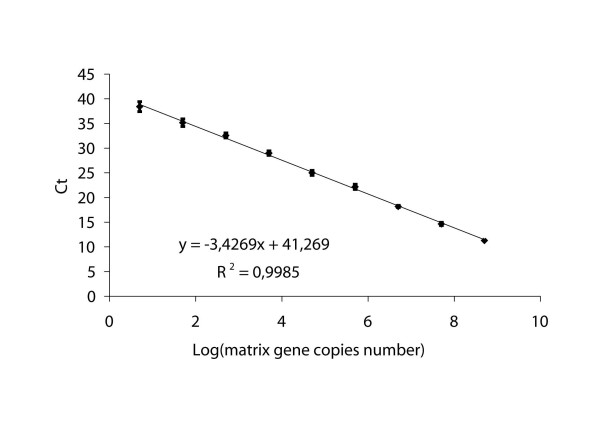
The RRT-PCR assay is capable to detect all tested influenza A viruses. The detection limit of the assay was shown to be between 5 and 50 RNA copies per reaction and the standard curve demonstrated a linear range from 5 to 5 x 10⁸ copies as well as excellent reproducibility. The analytical sensitivity of the assay is 10-100 times higher than conventional RT-PCR.
The high sensitivity, rapidity, reproducibility and specificity of the AIV RRT-PCR with the use of IPC to monitor for false negative results can make this method suitable for diagnosis and for the evaluation of viral load in field specimens.
禽流感病毒(AIVs)在野生鸟类中呈地方性流行,其在家禽中传入并转化为高致病性禽流感病毒会造成严重经济损失,同时也有传播给人类的潜在风险。在生物样本中快速识别禽流感病毒的能力对于限制该疾病在家禽中的进一步传播至关重要。诸如实时聚合酶链反应等分子方法的出现使实验室目前使用的检测方法得到了改进,不过并非所有这些方法都包含内部阳性对照(IPC)来监测假阴性结果。因此,我们开发了一种带有小沟结合物(MGB)探针的一步法逆转录实时PCR(RRT-PCR),用于检测不同亚型的禽流感病毒。该技术还包含一个内部阳性对照。
采用改进的TaqMan技术及MGB探针开发RRT-PCR,以检测参考病毒中的禽流感病毒。基于大多数动物和人类甲型流感病毒亚型的基质基因序列设计引物和探针。通过检测从禽类、人类、猪和马宿主中分离出的属于H1-H13亚型的甲型流感病毒分离株,评估RRT-PCR的特异性。使用体外转录的基质基因RNA的系列稀释液确定RRT-PCR检测方法的分析灵敏度。为了不降低检测方法的效率,采用啮齿动物RNA作为内部阳性对照。
RRT-PCR检测方法能够检测所有测试的甲型流感病毒。该检测方法的检测限显示为每个反应5至50个RNA拷贝,标准曲线显示线性范围为5至5×10⁸拷贝,并且具有出色的重复性。该检测方法的分析灵敏度比传统逆转录PCR高10至100倍。
使用内部阳性对照监测假阴性结果的禽流感病毒RRT-PCR具有高灵敏度、快速性、重复性和特异性,这使得该方法适用于诊断以及评估野外样本中的病毒载量。