del Sol Antonio, Fujihashi Hirotomo, Amoros Dolors, Nussinov Ruth
Bioinformatics Research Unit, Research and Development Division, Fujirebio Inc., Hachioji-shi, Tokyo, Japan.
Mol Syst Biol. 2006;2:2006.0019. doi: 10.1038/msb4100063. Epub 2006 May 2.
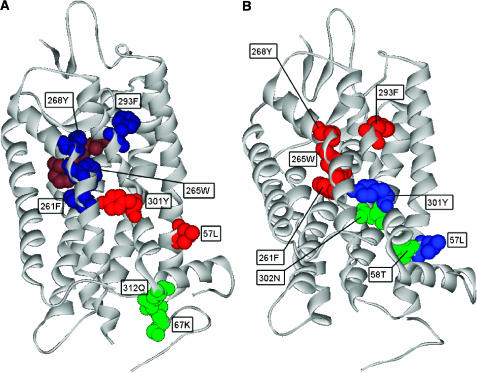
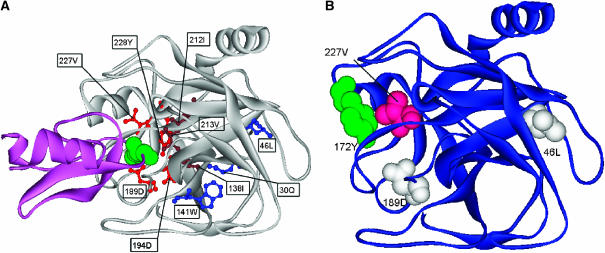
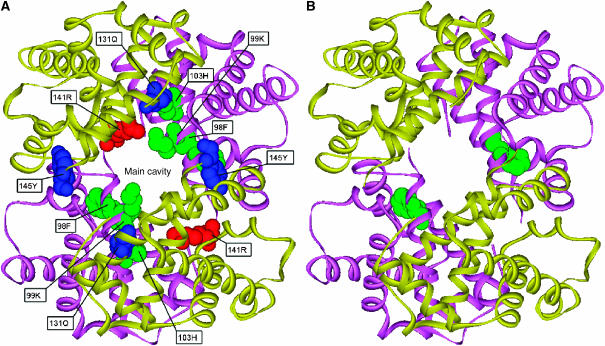
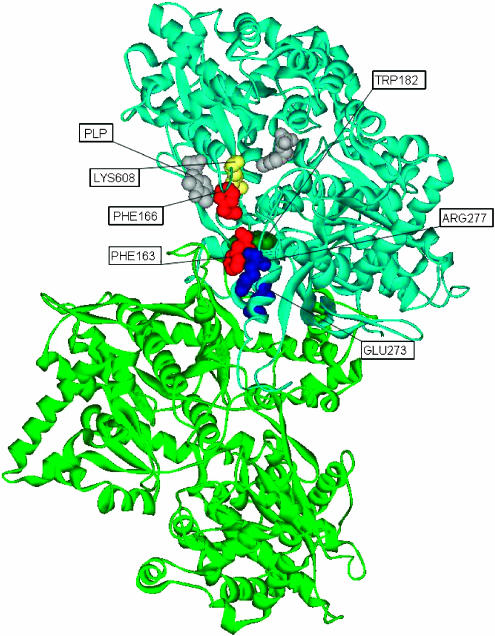
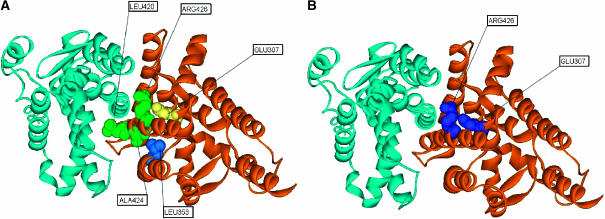
Here, we represent protein structures as residue interacting networks, which are assumed to involve a permanent flow of information between amino acids. By removal of nodes from the protein network, we identify fold centrally conserved residues, which are crucial for sustaining the shortest pathways and thus play key roles in long-range interactions. Analysis of seven protein families (myoglobins, G-protein-coupled receptors, the trypsin class of serine proteases, hemoglobins, oligosaccharide phosphorylases, nuclear receptor ligand-binding domains and retroviral proteases) confirms that experimentally many of these residues are important for allosteric communication. The agreement between the centrally conserved residues, which are key in preserving short path lengths, and residues experimentally suggested to mediate signaling further illustrates that topology plays an important role in network communication. Protein folds have evolved under constraints imposed by function. To maintain function, protein structures need to be robust to mutational events. On the other hand, robustness is accompanied by an extreme sensitivity at some crucial sites. Thus, here we propose that centrally conserved residues, whose removal increases the characteristic path length in protein networks, may relate to the system fragility.
在这里,我们将蛋白质结构表示为残基相互作用网络,假定该网络涉及氨基酸之间的信息持续流动。通过从蛋白质网络中去除节点,我们识别出折叠中心保守残基,这些残基对于维持最短路径至关重要,因此在长程相互作用中发挥关键作用。对七个蛋白质家族(肌红蛋白、G蛋白偶联受体、丝氨酸蛋白酶胰蛋白酶类、血红蛋白、寡糖磷酸化酶、核受体配体结合结构域和逆转录病毒蛋白酶)的分析证实,实验表明许多这些残基对于变构通讯很重要。在保持短路径长度方面起关键作用的中心保守残基与实验表明介导信号传导的残基之间的一致性进一步说明拓扑结构在网络通讯中起重要作用。蛋白质折叠是在功能施加的限制下进化而来的。为了维持功能,蛋白质结构需要对突变事件具有鲁棒性。另一方面,鲁棒性伴随着在某些关键位点的极端敏感性。因此,我们在此提出,去除后会增加蛋白质网络中特征路径长度的中心保守残基可能与系统脆弱性有关。