Akesson Agneta, Bjellerup Per, Lundh Thomas, Lidfeldt Jonas, Nerbrand Christina, Samsioe Göran, Skerfving Staffan, Vahter Marie
Division of Metals and Health, Institute of Environmental Medicine, Karolinska Institutet, Stockholm, Sweden.
Environ Health Perspect. 2006 Jun;114(6):830-4. doi: 10.1289/ehp.8763.
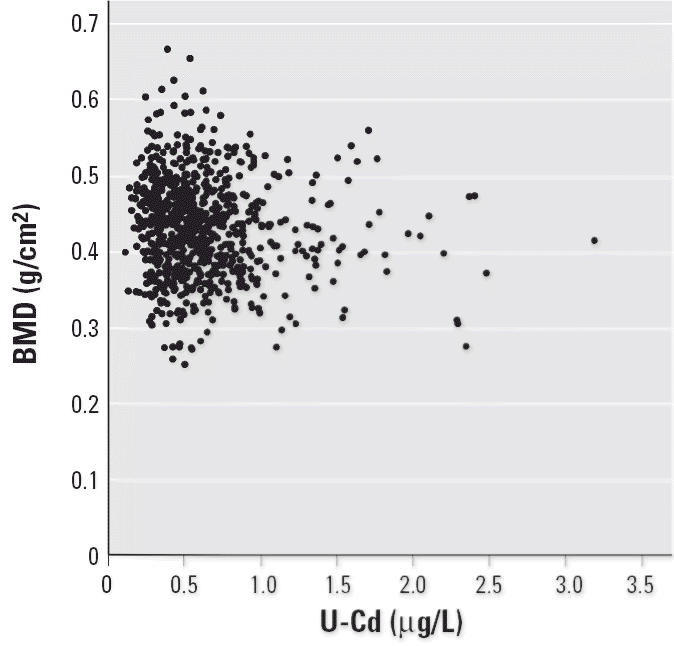
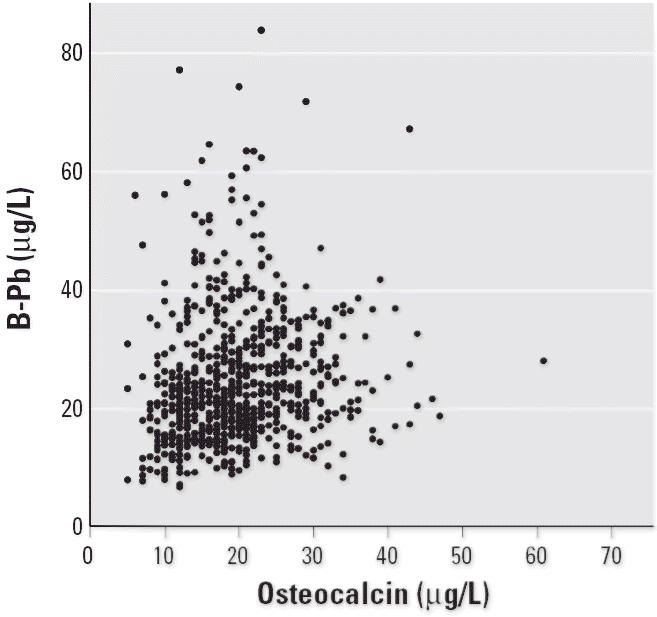
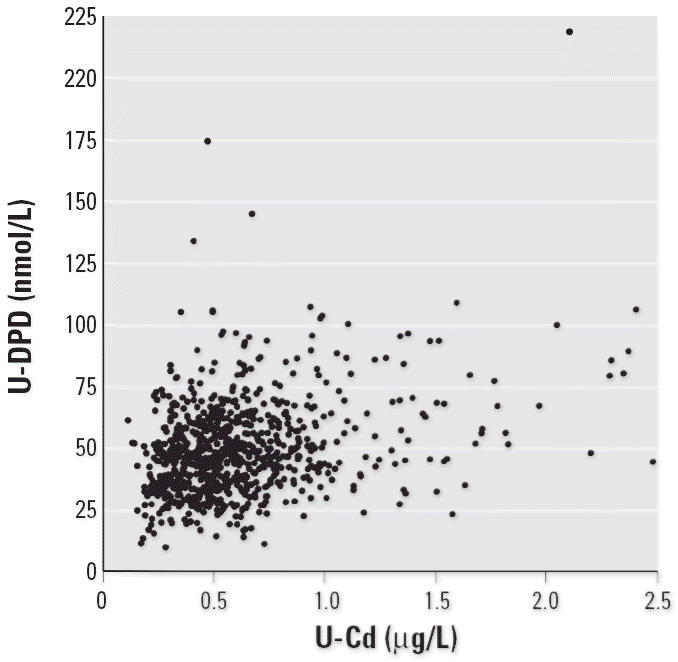
High cadmium exposure is known to cause bone damage, but the association between low-level cadmium exposure and osteoporosis remains to be clarified. Using a population-based women's health survey in southern Sweden [Women's Health in the Lund Area (WHILA) ] with no known historical cadmium contamination, we investigated cadmium-related effects on bone in 820 women (53-64 years of age) . We measured cadmium in blood and urine and lead in blood, an array of markers of bone metabolism, and forearm bone mineral density (BMD) . Associations were evaluated in multiple linear regression analysis including information on the possible confounders or effect modifiers: weight, menopausal status, use of hormone replacement therapy, age at menarche, alcohol consumption, smoking history, and physical activity. Median urinary cadmium was 0.52 microg/L adjusted to density (0.67 microg/g creatinine) . After multivariate adjustment, BMD, parathyroid hormone, and urinary deoxypyridinoline (U-DPD) were adversely associated with concentrations of urinary cadmium (p < 0.05) in all subjects. These associations persisted in the group of never-smokers, which had the lowest cadmium exposure (mainly dietary) . For U-DPD, there was a significant interaction between cadmium and menopause (p = 0.022) . Our results suggest negative effects of low-level cadmium exposure on bone, possibly exerted via increased bone resorption, which seemed to be intensified after menopause. Based on the prevalence of osteoporosis and the low level of exposure, the observed effects, although slight, should be considered as early signals of potentially more adverse health effects. Key words: biochemical bone markers, bone mineral density, cadmium, lead, osteoporosis, women.
已知高镉暴露会导致骨骼损伤,但低水平镉暴露与骨质疏松症之间的关联仍有待阐明。我们利用瑞典南部一项基于人群的女性健康调查[隆德地区女性健康(WHILA)],该地区无已知的历史镉污染情况,对820名年龄在53至64岁的女性进行了镉对骨骼影响的调查。我们测量了血液和尿液中的镉、血液中的铅、一系列骨代谢标志物以及前臂骨矿物质密度(BMD)。在多元线性回归分析中评估了相关性,分析中纳入了可能的混杂因素或效应修饰因素的信息:体重、绝经状态、激素替代疗法的使用、初潮年龄、饮酒量、吸烟史和身体活动情况。尿镉中位数经密度调整后为0.52微克/升(0.67微克/克肌酐)。多变量调整后,在所有受试者中,BMD、甲状旁腺激素和尿脱氧吡啶啉(U-DPD)与尿镉浓度呈负相关(p<0.05)。这些关联在镉暴露最低(主要为饮食暴露)的从不吸烟者组中持续存在。对于U-DPD,镉与绝经之间存在显著交互作用(p = 0.022)。我们的结果表明,低水平镉暴露对骨骼有负面影响,可能是通过增加骨吸收发挥作用,且这种影响在绝经后似乎会加剧。基于骨质疏松症的患病率和低暴露水平,尽管观察到的影响轻微,但应将其视为潜在更严重健康影响的早期信号。关键词:骨生化标志物、骨矿物质密度、镉、铅、骨质疏松症、女性