Ramroth Heribert, Specht-Leible Norbert, König Hans-Helmut, Brenner Hermann
German Centre for Research on Ageing, Heidelberg, Germany.
BMC Health Serv Res. 2006 Jun 8;6:70. doi: 10.1186/1472-6963-6-70.
To describe hospitalisations of nursing home (NH) residents in Germany during their last months of life.
Retrospective cohort study on 792 NH residents in the Rhine-Neckar region in South-West Germany, newly institutionalized in the year 2000, who died until the study end (December 2001). Baseline variables were derived from a standardized medical examination routinely conducted by the medical service of the health care insurance plans in Germany. Information on hospitalisations and deaths was extracted form records of the pertinent health insurance plans.
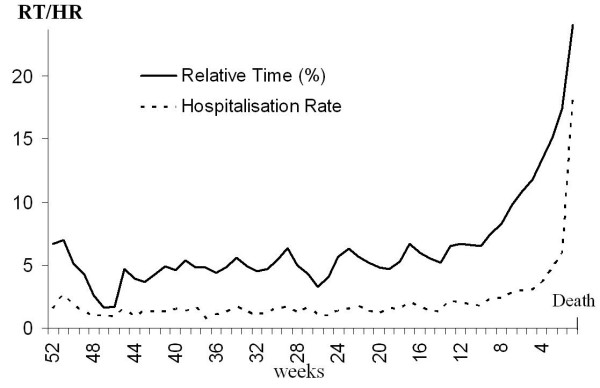
NH residents who died after NH stay of more than 1 year spent 5.8% of their last year of life in hospitals. Relative time spent in hospitals increased from 5.2% twelve months before death (N = 139 persons) to 24.1% in their last week of life (N = 769 persons). No major differences could be observed concerning age, gender or duration of stay in NH. Overall, 229 persons (28.9%) died in hospital. Among these, the last hospital stay lasted less than 3 days for 76 persons (31.9%). Another 25 persons (3.2%) died within three days after hospital discharge.
Our study indicates that proximity of death is the most important driver of health care utilization among NH residents. The relation of age or gender to health care expenditures seem to be weak once time to death is controlled for. Duration of NH stay does not markedly change rates of hospitalisation during the last months of life.
描述德国养老院居民生命最后几个月的住院情况。
对德国西南部莱茵-内卡地区2000年新入住养老院、至研究结束(2001年12月)时已死亡的792名养老院居民进行回顾性队列研究。基线变量来自德国医疗保险计划医疗服务部门常规进行的标准化医学检查。住院和死亡信息从相关医疗保险计划的记录中提取。
在养老院居住超过1年之后死亡的居民,其生命的最后一年中有5.8%的时间在医院度过。在医院度过的相对时间从死亡前十二个月的5.2%(N = 139人)增加到生命最后一周的24.1%(N = 769人)。在年龄、性别或在养老院的居住时长方面未观察到重大差异。总体而言,229人(28.9%)在医院死亡。其中,76人(31.9%)的最后一次住院持续时间不到3天。另有25人(3.2%)在出院后三天内死亡。
我们的研究表明,接近死亡是养老院居民医疗保健利用的最重要驱动因素。一旦控制了死亡时间,年龄或性别与医疗保健支出的关系似乎就很微弱。在养老院的居住时长在生命的最后几个月中并不会显著改变住院率。