Marais Dianne J, Sampson Candice, Jeftha Anthea, Dhaya Dherendra, Passmore Jo-Ann S, Denny Lynette, Rybicki Edward P, Van Der Walt Eric, Stephen Lawrence Xg, Williamson Anna-Lise
Institute of Infectious Disease and Molecular Medicine, Faculty of Health Sciences, University of Cape Town, Observatory, 7925, Cape Town, South Africa.
BMC Infect Dis. 2006 Jun 8;6:95. doi: 10.1186/1471-2334-6-95.
We have previously shown the high prevalence of oral anti-human papillomavirus type 16 (HPV-16) antibodies in women with HPV-associated cervical neoplasia. It was postulated that the HPV antibodies were initiated after HPV antigenic stimulation at the cervix via the common mucosal immune system. The present study aimed to further evaluate the effectiveness of oral fluid testing for detecting the mucosal humoral response to HPV infection and to advance our limited understanding of the immune response to HPV.
The prevalence of oral HPV infection and oral antibodies to HPV types 16, 18 and 11 was determined in a normal, healthy population of children, adolescents and adults, both male and female, attending a dental clinic. HPV types in buccal cells were determined by DNA sequencing. Oral fluid was collected from the gingival crevice of the mouth by the OraSure method. HPV-16, HPV-18 and HPV-11 antibodies in oral fluid were detected by virus-like particle-based enzyme-linked immunosorbent assay. As a reference group 44 women with cervical neoplasia were included in the study.
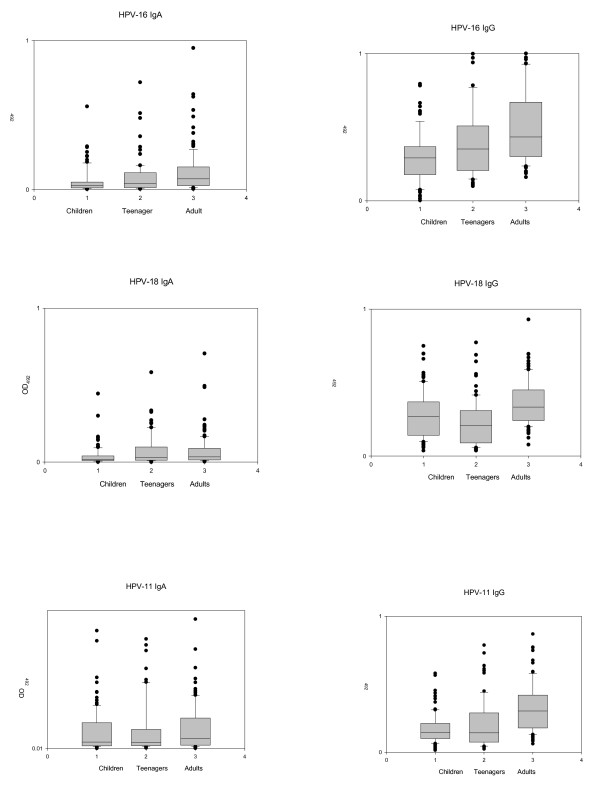
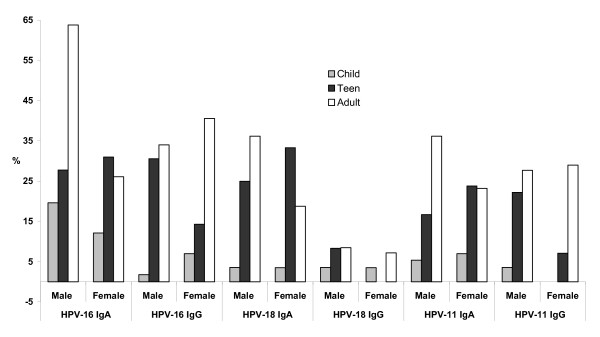
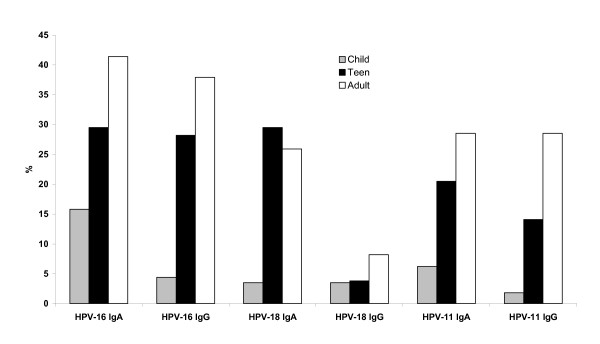
Oral HPV infection was highest in children (9/114, 7.9%), followed by adolescents (4/78, 5.1%), and lowest in normal adults (4/116, 3.5%). The predominant HPV type found was HPV-13 (7/22, 31.8%) followed by HPV-32 (5/22, 22.7%). The prevalence of oral antibodies to HPV-16, HPV-18 and HPV-11 was low in children and increased substantially in adolescents and normal adults. Oral HPV-16 IgA was significantly more prevalent in women with cervical neoplasia (30/44, 68.2%) than the women from the dental clinic (18/69, 26.1% P = 0.0001). Significantly more adult men than women displayed oral HPV-16 IgA (30/47 compared with 18/69, OR 5.0, 95% CI 2.09-12.1, P < 0.001) and HPV-18 IgA (17/47 compared with 13/69, OR 2.4, 95% CI 0.97-6.2, P = 0.04).
The increased prevalence of oral HPV antibodies in adolescent individuals compared with children was attributed to the onset of sexual activity. The increased prevalence of oral anti-HPV IgA in men compared with women was noteworthy considering reportedly fewer men than women make serum antibodies, and warrants further investigation.
我们之前已表明,在患有与人乳头瘤病毒16型(HPV - 16)相关的宫颈肿瘤的女性中,口腔抗HPV - 16抗体的患病率很高。据推测,HPV抗体是在宫颈处的HPV抗原通过共同黏膜免疫系统刺激后产生的。本研究旨在进一步评估口腔液体检测在检测对HPV感染的黏膜体液反应方面的有效性,并增进我们对HPV免疫反应的有限理解。
在一家牙科诊所就诊的正常、健康的儿童、青少年和成年人(包括男性和女性)群体中,测定口腔HPV感染的患病率以及针对HPV - 16、18和11型的口腔抗体。通过DNA测序确定颊细胞中的HPV类型。采用OraSure方法从口腔牙龈沟收集口腔液体。通过基于病毒样颗粒的酶联免疫吸附测定法检测口腔液体中的HPV - 16、HPV - 18和HPV - 11抗体。作为参照组,44名患有宫颈肿瘤的女性被纳入研究。
儿童的口腔HPV感染率最高(9/114,7.9%),其次是青少年(4/78,5.1%),正常成年人中最低(4/116,3.5%)。发现的主要HPV类型是HPV - 13(7/22,31.8%),其次是HPV - 32(5/22,22.7%)。儿童中针对HPV - 16、HPV - 18和HPV - 11的口腔抗体患病率较低,在青少年和正常成年人中大幅上升。患有宫颈肿瘤的女性中口腔HPV - 16 IgA的患病率(30/44,68.2%)显著高于牙科诊所的女性(18/69,26.1%,P = 0.0001)。成年男性中显示口腔HPV - 16 IgA的人数显著多于女性(30/47对比18/69,OR 5.0,95% CI 2.09 - 12.1,P < 0.001)以及HPV - 18 IgA(17/47对比13/69,OR 2.4,95% CI 0.97 - 6.2,P = 0.04)。
与儿童相比,青少年个体口腔HPV抗体患病率的增加归因于性活动的开始。考虑到据报道产生血清抗体的男性比女性少,男性中口腔抗HPV IgA患病率高于女性这一情况值得关注,需要进一步研究。