Lupato Valentina, Holzinger Dana, Höfler Daniela, Menegaldo Anna, Giorgi Rossi Paolo, Del Mistro Annarosa, Da Mosto Maria Cristina, Pawlita Michael, Boscolo-Rizzo Paolo
Department of Neurosciences, Regional Center for Head and Neck Cancer, University of Padua, Treviso, Italy.
Unit of Otolaryngology, Azienda Ospedaliera "S. Maria degli Angeli", Pordenone, Italy.
PLoS One. 2017 Jan 19;12(1):e0170091. doi: 10.1371/journal.pone.0170091. eCollection 2017.
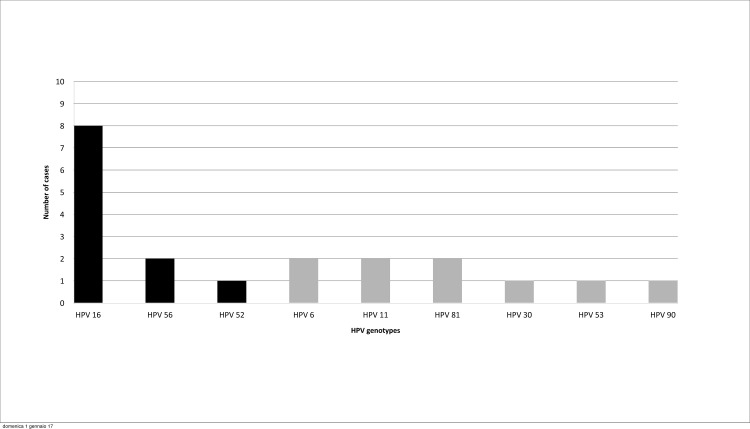
Although the prevalence of human papillomavirus (HPV)-related oropharyngeal squamous cell carcinoma (OPSCC) is increasing in developed countries and becoming a relevant health issue, the natural history of oral HPV infection is still unclear. Estimating the infection's prevalence in specific populations and identifying risk factors can widen our understanding of its natural history and help to delineate appropriate prevention strategies. This study sought to (i) determine oral HPV prevalence and genotype distribution in a large series of young Italian adults, (ii) validate an oral rinse sampling/storage protocol, and (iii) pinpoint factors associated with oral HPV infection. Five hundred students, nurses, and technicians (19-35 years-old) studying and working at/for the University of Padua were recruited. Each participant was provided with an oral rinse sampling kit and instructions for use. They were also asked to complete an anonymous questionnaire concerning their demographic characteristics and behaviors. The questionnaires and oral rinse containers were labeled with the same identification code number. The oral rinse samples were tested using a bead-based multiplex BSGP5+/6+-MPG genotyping assay which amplifies the L1 region of 51 mucosal HPV types. The prevalence of oral HPV infection was 4.0% (95% confidence interval (CI), 2.5%-6.1%); those of 14 high-risk HPV types and of HPV-type 16 (HPV16) infection were 2.2% (95% CI, 1.1%-3.9%) and 1.6% (95% CI, 0.6%-3.1%), respectively. HPV16 was the most frequent genotype (40.0% of oral HPV infections). No association was found between oral infection and the co-variables studied (gender, tobacco, alcohol and illegal drug use, number of sex and oral sex partners, HPV vaccination status, history of HPV and sexually transmitted infections, abnormal pap smears, recurrent tonsillitis and tonsillectomy). The oral rinse sampling protocol outlined here proved to be simple, efficient and well tolerated, and the prevalence rate can be considered reliable and thus useful to guide future research. Determinants of oral HPV infection are still unclear and further studies are certainly warranted.
尽管在发达国家,人乳头瘤病毒(HPV)相关的口咽鳞状细胞癌(OPSCC)的患病率正在上升,并成为一个重要的健康问题,但口腔HPV感染的自然史仍不清楚。估计特定人群中的感染率并确定风险因素,可以拓宽我们对其自然史的理解,并有助于制定适当的预防策略。本研究旨在:(i)确定一大批意大利年轻成年人的口腔HPV感染率和基因型分布;(ii)验证一种口腔冲洗液采样/储存方案;(iii)找出与口腔HPV感染相关的因素。招募了500名在帕多瓦大学学习或工作的学生、护士和技术人员(年龄在19至35岁之间)。为每位参与者提供了一个口腔冲洗液采样试剂盒和使用说明。他们还被要求填写一份关于其人口统计学特征和行为的匿名问卷。问卷和口腔冲洗液容器都标有相同的识别码。使用基于珠子的多重BSGP5+/6+-MPG基因分型检测方法对口腔冲洗液样本进行检测,该方法可扩增51种黏膜HPV类型的L1区域。口腔HPV感染率为4.0%(95%置信区间(CI),2.5%-6.1%);14种高危HPV类型和HPV-16型(HPV16)感染率分别为2.2%(CI,1.1%-3.9%)和1.6%(CI,0.6%-3.1%)。HPV16是最常见的基因型(占口腔HPV感染的40.0%)。未发现口腔感染与所研究的协变量(性别、烟草、酒精和非法药物使用、性伴侣和口交伴侣数量、HPV疫苗接种状况、HPV和性传播感染病史、巴氏涂片异常、复发性扁桃体炎和扁桃体切除术)之间存在关联。这里概述的口腔冲洗液采样方案被证明是简单、有效且耐受性良好的,该感染率可被认为是可靠的,因此有助于指导未来的研究。口腔HPV感染的决定因素仍不清楚,肯定需要进一步研究。