Müller K H, Collinson S K, Trust T J, Kay W W
Department of Biochemistry and Microbiology, University of Victoria, British Columbia, Canada.
J Bacteriol. 1991 Aug;173(15):4765-72. doi: 10.1128/jb.173.15.4765-4772.1991.
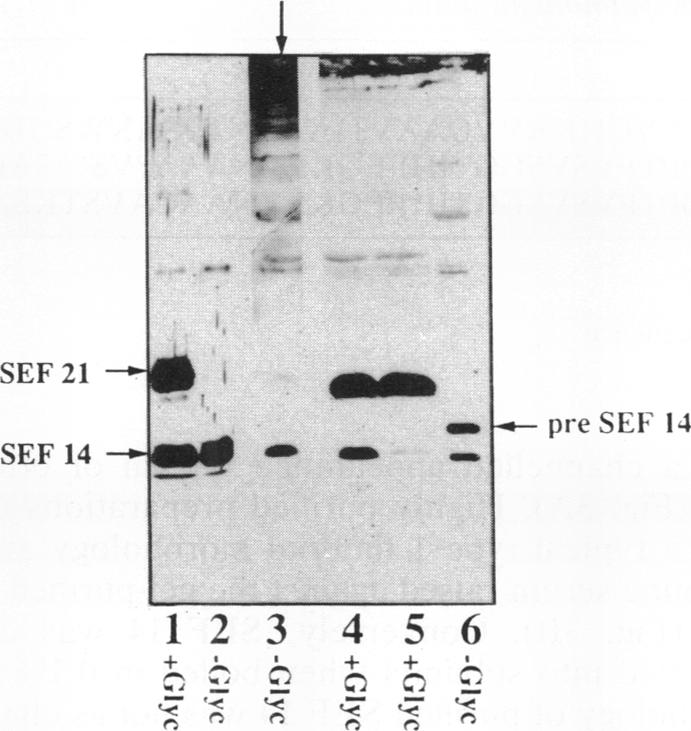
Salmonella enteritidis was previously shown to produce fimbriae composed of 14,000-molecular-weight (Mr) fimbrin monomers (J. Feutrier, W. W. Kay, and T. J. Trust, J. Bacteriol. 168:221-227, 1986). Another distinct fimbrial structure, comprising 21,000-Mr fimbrin monomers, has now been identified. These fimbriae are simply designated as SEF 14 and SEF 21, respectively (for S. enteritidis fimbriae and the Mr [in thousands] of the fimbrin monomer). A simple method for the purification of both structures was developed by using the different biochemical properties of these fimbriae. SEF 21 remained intact after being boiled in sodium dodecyl sulfate but readily dissociated into subunits of 21,000 Mr at pH 2.2. The overall amino acid composition and the N-terminal amino acid sequence of the SEF 21 fimbrin were distinct from those of SEF 14 but were virtually identical to the predicted sequence for type 1 fimbrin of Salmonella typhimurium. Immunoelectron microscopy of S. enteritidis clearly revealed fimbrial structures that reacted with immune serum specific to the 21,000-Mr fimbrin. Immune sera raised against this subunit were cross-reactive with type 1 fimbrins found in whole-cell lysates of S. typhimurium, Salmonella illinois, and Salmonella cubana. However, there was no cross-reaction with Escherichia coli type 1 fimbriae or with other fimbrins produced by S. enteritidis. Under certain growth conditions, S. enteritidis produced both SEF 14 and SEF 21. However, when S. enteritidis was grown at 30 degrees C or lower, only the 21,000-Mr SEF 21 fimbrin could be detected. There was a direct correlation between mannose-sensitive hemagglutination and the presence of SEF 21.
肠炎沙门氏菌先前已被证明能产生由分子量为14,000(Mr)的菌毛蛋白单体组成的菌毛(J. Feutrier、W. W. Kay和T. J. Trust,《细菌学杂志》168:221 - 227,1986年)。现在已鉴定出另一种不同的菌毛结构,其由分子量为21,000的菌毛蛋白单体组成。这些菌毛分别被简单地命名为SEF 14和SEF 21(用于肠炎沙门氏菌菌毛以及菌毛蛋白单体的分子量[以千计])。利用这些菌毛不同的生化特性,开发出了一种纯化这两种结构的简单方法。SEF 21在十二烷基硫酸钠中煮沸后仍保持完整,但在pH 2.2时很容易解离成分子量为21,000的亚基。SEF 21菌毛蛋白的总体氨基酸组成和N端氨基酸序列与SEF 14不同,但与鼠伤寒沙门氏菌1型菌毛蛋白的预测序列几乎相同。肠炎沙门氏菌的免疫电子显微镜检查清楚地显示出与针对分子量为21,000的菌毛蛋白的免疫血清发生反应的菌毛结构。针对该亚基产生的免疫血清与在鼠伤寒沙门氏菌、伊利诺伊沙门氏菌和古巴沙门氏菌全细胞裂解物中发现的1型菌毛蛋白有交叉反应。然而,与大肠杆菌1型菌毛或肠炎沙门氏菌产生的其他菌毛蛋白没有交叉反应。在某些生长条件下,肠炎沙门氏菌会产生SEF 14和SEF 21。然而,当肠炎沙门氏菌在30摄氏度或更低温度下生长时,只能检测到分子量为21,000的SEF 21菌毛蛋白。甘露糖敏感血凝反应与SEF 21的存在之间存在直接相关性。