Ogunniyi A D, Manning P A, Kotlarski I
Department of Microbiology and Immunology, University of Adelaide, Australia.
Infect Immun. 1994 Dec;62(12):5376-83. doi: 10.1128/iai.62.12.5376-5383.1994.
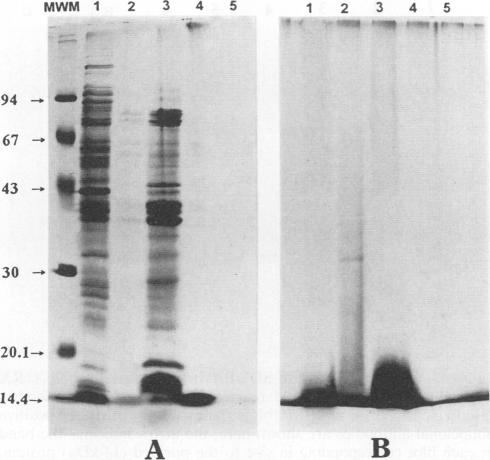
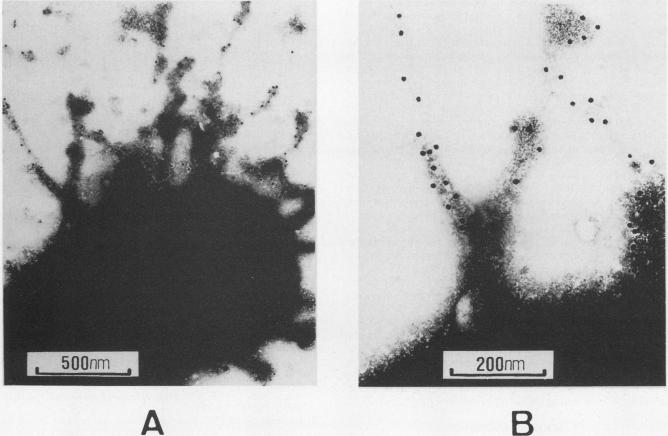
Our previous work, using proteins fractionated by sodium dodecyl sulfate-polyacrylamide gel electrophoresis to define antigens of Salmonella enteritidis 11RX able to stimulate T cells from S. enteritidis 11RX-primed (BALB/c x C57BL/6)F1 mice, had indicated the presence of a major antigenic determinant of 14 to 18 kDa (H.-M. Vordermeier and I. Kotlarski, Immunol. Cell. Biol. 68:299-305, 1990). The 14-kDa size is similar to that of the monomeric units of one of the fimbrial structures, SEF14, produced by a human enteropathogen, S. enteritidis 27655 (J. Feutrier, W. W. Kay, and T. J. Trust, J. Bacteriol. 168:221-227, 1986). Here we present data which indicate that S. enteritidis 11RX also produces this protein and that it is able to elicit delayed-type hypersensitivity reactions in S. enteritidis 11RX-primed animals and to stimulate in vitro proliferation of, and cytokine release from, T cells obtained from these animals, implying that this fimbrial protein is likely to be an important immunogen of S. enteritidis. The protein was purified to homogeneity and is free from contamination with lipopolysaccharide. Standard immunoblot analysis with unabsorbed S. enteritidis 11RX antiserum and antiserum absorbed with Salmonella typhimurium C5 and various strains of Escherichia coli, as well as a panel of anti-14-kDa-protein monoclonal antibodies, suggests that this fimbrial protein is not the common antigen expressed by a number of organisms belonging to the family Enterobacteriaceae. Immunogold electron microscopy with one of these monoclonal antibodies confirms that the 14-kDa protein and SEF14 are identical.
我们之前的工作是,使用经十二烷基硫酸钠-聚丙烯酰胺凝胶电泳分离的蛋白质来确定肠炎沙门氏菌11RX的抗原,这些抗原能够刺激来自经肠炎沙门氏菌11RX致敏的(BALB/c×C57BL/6)F1小鼠的T细胞,结果表明存在一种14至18 kDa的主要抗原决定簇(H.-M. 沃德迈尔和I. 科特拉斯基,《免疫与细胞生物学》68:299 - 305,1990年)。14 kDa的大小与一种由人类肠道病原体肠炎沙门氏菌27655产生的菌毛结构SEF14的单体单元大小相似(J. 弗特里尔、W. W. 凯和T. J. 特鲁斯特,《细菌学杂志》168:221 - 227,1986年)。在此我们展示的数据表明,肠炎沙门氏菌11RX也产生这种蛋白质,并且它能够在经肠炎沙门氏菌11RX致敏的动物中引发迟发型超敏反应,还能刺激从这些动物获得的T细胞在体外增殖并释放细胞因子,这意味着这种菌毛蛋白很可能是肠炎沙门氏菌的一种重要免疫原。该蛋白质被纯化至同质,且未受脂多糖污染。用未吸收的肠炎沙门氏菌11RX抗血清、经鼠伤寒沙门氏菌C5和各种大肠杆菌菌株吸收的抗血清以及一组抗14 kDa蛋白单克隆抗体进行的标准免疫印迹分析表明,这种菌毛蛋白不是肠杆菌科许多生物体所表达的共同抗原。用其中一种单克隆抗体进行的免疫金电子显微镜检查证实,14 kDa蛋白与SEF14相同。