Chun Carlene K, Scheetz Todd E, Bonaldo Maria de Fatima, Brown Bartley, Clemens Anik, Crookes-Goodson Wendy J, Crouch Keith, DeMartini Tad, Eyestone Mari, Goodson Michael S, Janssens Bernadette, Kimbell Jennifer L, Koropatnick Tanya A, Kucaba Tamara, Smith Christina, Stewart Jennifer J, Tong Deyan, Troll Joshua V, Webster Sarahrose, Winhall-Rice Jane, Yap Cory, Casavant Thomas L, McFall-Ngai Margaret J, Soares M Bento
Department of Medical Microbiology and Immunology, University of Wisconsin-Madison, Madison, WI 53706, USA.
BMC Genomics. 2006 Jun 16;7:154. doi: 10.1186/1471-2164-7-154.
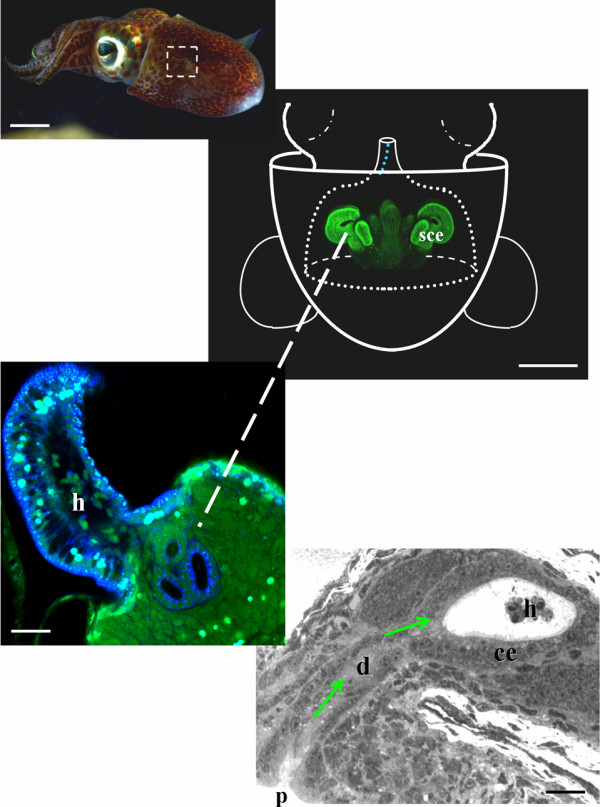
Biologists are becoming increasingly aware that the interaction of animals, including humans, with their coevolved bacterial partners is essential for health. This growing awareness has been a driving force for the development of models for the study of beneficial animal-bacterial interactions. In the squid-vibrio model, symbiotic Vibrio fischeri induce dramatic developmental changes in the light organ of host Euprymna scolopes over the first hours to days of their partnership. We report here the creation of a juvenile light-organ specific EST database.
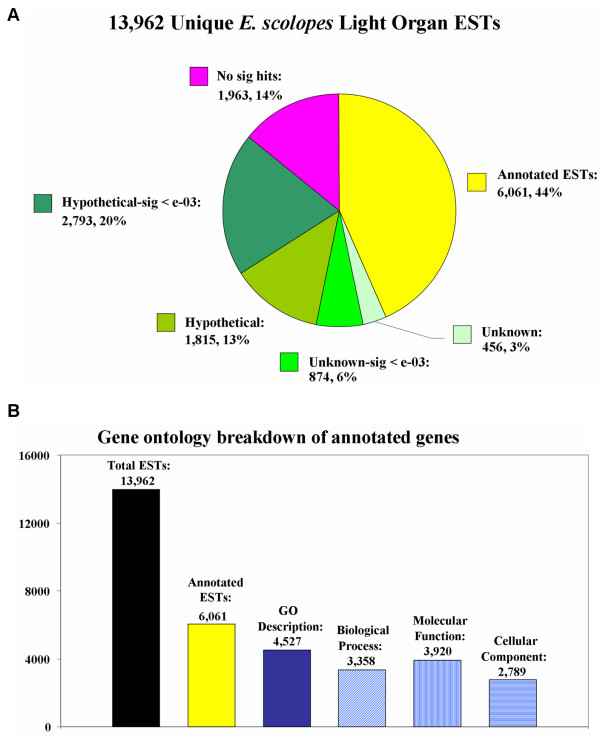
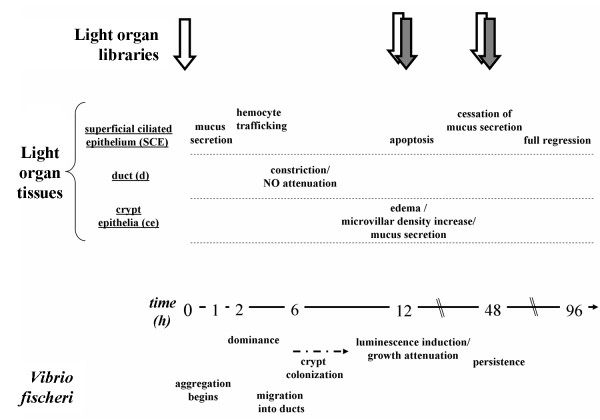
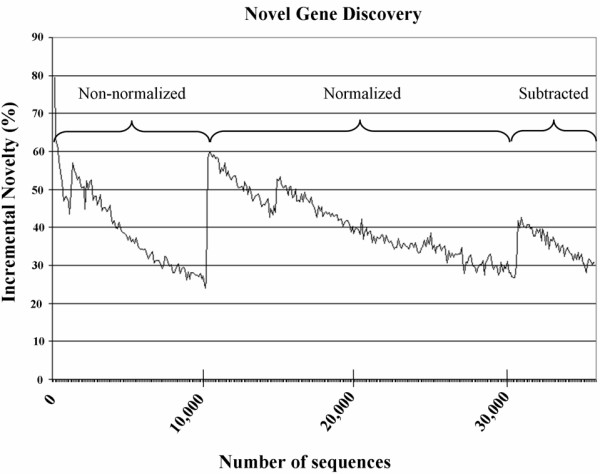
We generated eleven cDNA libraries from the light organ of E. scolopes at developmentally significant time points with and without colonization by V. fischeri. Single pass 3' sequencing efforts generated 42,564 expressed sequence tags (ESTs) of which 35,421 passed our quality criteria and were then clustered via the UIcluster program into 13,962 nonredundant sequences. The cDNA clones representing these nonredundant sequences were sequenced from the 5' end of the vector and 58% of these resulting sequences overlapped significantly with the associated 3' sequence to generate 8,067 contigs with an average sequence length of 1,065 bp. All sequences were annotated with BLASTX (E-value < -03) and Gene Ontology (GO).
Both the number of ESTs generated from each library and GO categorizations are reflective of the activity state of the light organ during these early stages of symbiosis. Future analyses of the sequences identified in these libraries promise to provide valuable information not only about pathways involved in colonization and early development of the squid light organ, but also about pathways conserved in response to bacterial colonization across the animal kingdom.
生物学家越来越意识到,包括人类在内的动物与其共同进化的细菌伙伴之间的相互作用对健康至关重要。这种日益增强的认识推动了有益动物-细菌相互作用研究模型的发展。在鱿鱼-弧菌模型中,共生费氏弧菌在其与宿主加州双斑鱿鱼的共生关系最初的数小时至数天内,会诱导宿主光器官发生显著的发育变化。我们在此报告一个幼年光器官特异性EST数据库的创建。
我们在有和没有费氏弧菌定殖的发育关键时间点,从加州双斑鱿鱼的光器官中生成了11个cDNA文库。单通道3'测序共产生了42,564个表达序列标签(EST),其中35,421个通过了我们的质量标准,然后通过UIcluster程序聚类为13,962个非冗余序列。代表这些非冗余序列的cDNA克隆从载体的5'端进行测序,其中58%的所得序列与相关的3'序列有显著重叠,从而生成了8,067个重叠群,平均序列长度为1,065 bp。所有序列都用BLASTX(E值 < -03)和基因本体论(GO)进行注释。
从每个文库生成的EST数量和GO分类都反映了共生早期阶段光器官的活动状态。对这些文库中鉴定出的序列进行的未来分析有望提供有价值信息,不仅关乎鱿鱼光器官定殖和早期发育所涉及的途径,还关乎整个动物界对细菌定殖做出反应时保守的途径。