Le Blancq S M, Korman S H, Van der Ploeg L H
Department of Genetics and Development, College of Physicians and Surgeons, Columbia University, New York, NY 10032.
Nucleic Acids Res. 1991 Aug 25;19(16):4405-12. doi: 10.1093/nar/19.16.4405.
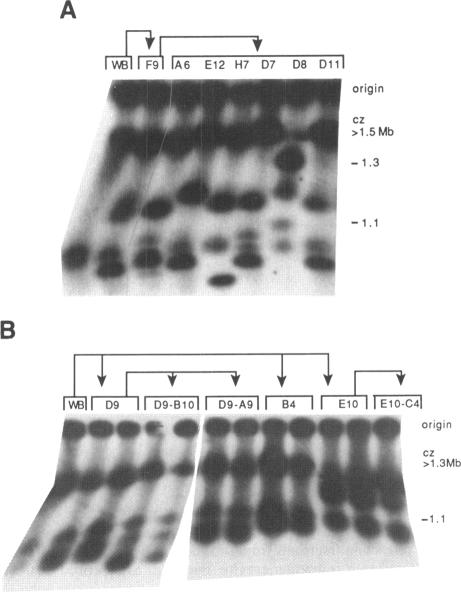
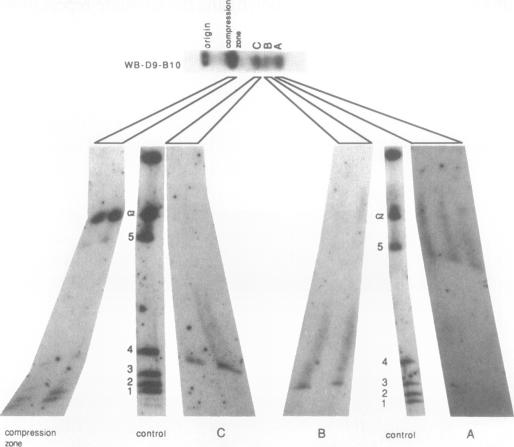
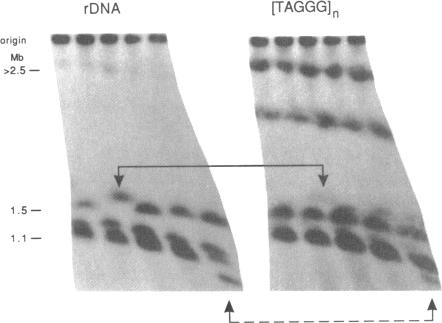
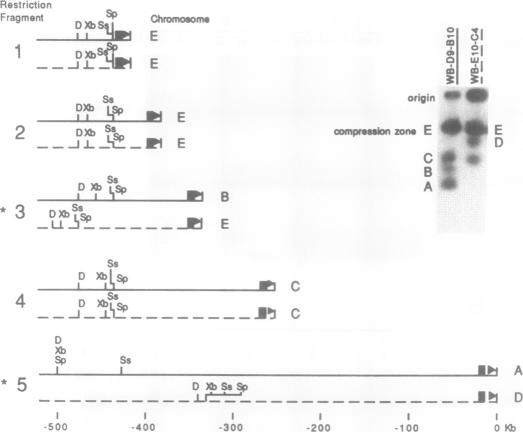
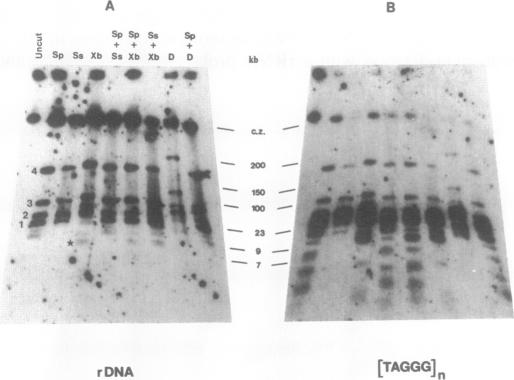
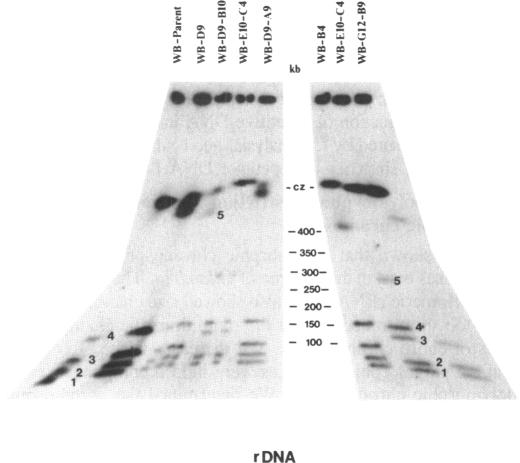
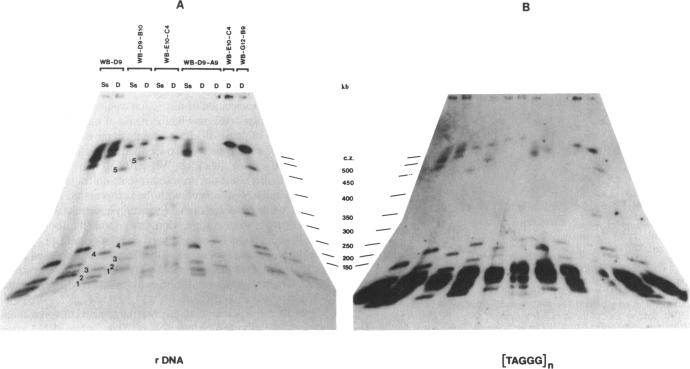
The ribosomal RNA (rRNA) genes in Giardia lamblia are present as short tandem arrays of a 5.6 Kb repeat unit on at least six telomeres. Four of these telomeres have the same overall organisation comprising a domain ranging in size from 25 to 300 Kb, delineated chromosome internally by a conserved island of restriction enzyme sites. Cloned lines of G. lamblia derived from the WB strain contain polymorphic subsets of chromosomes encoding rRNA genes. However, changes in the size of the rRNA telomere domains of these polymorphic chromosomes alone cannot account for the total size changes in the chromosomes. The rearrangement events are very frequent: 60% of subcloned lines had discrete rearranged karyotypes that differed from each other, suggesting either an estimated rearrangement rate that may be as high as 3% per division or a cloning-induced rearrangement event. The extreme plasticity of the genome has obvious implications for the maintenance of a functional genome and the control of gene expression in Giardia.
蓝氏贾第鞭毛虫的核糖体RNA(rRNA)基因以5.6 Kb重复单元的短串联阵列形式存在于至少六个端粒上。其中四个端粒具有相同的整体结构,包括一个大小在25至300 Kb之间的结构域,在染色体内部由一个保守的限制酶切位点岛划定。源自WB株的蓝氏贾第鞭毛虫克隆系包含编码rRNA基因的染色体多态性子集。然而,仅这些多态性染色体的rRNA端粒结构域大小的变化并不能解释染色体的总体大小变化。重排事件非常频繁:60%的亚克隆系具有彼此不同的离散重排核型,这表明估计的重排率可能高达每分裂3%,或者是克隆诱导的重排事件。基因组的极端可塑性对蓝氏贾第鞭毛虫功能基因组的维持和基因表达的控制具有明显影响。