DeMone Catherine, Hwang Mei-Hua, Feng Zeny, McClure J Trenton, Greenwood Spencer J, Fung Rebecca, Kim Minji, Weese J Scott, Shapiro Karen
Department of Integrative Biology, University of Guelph, Guelph, Canada.
Department of Mathematics and Statistics, University of Guelph, Guelph, Canada.
Food Waterborne Parasitol. 2020 Nov 18;21:e00096. doi: 10.1016/j.fawpar.2020.e00096. eCollection 2020 Dec.
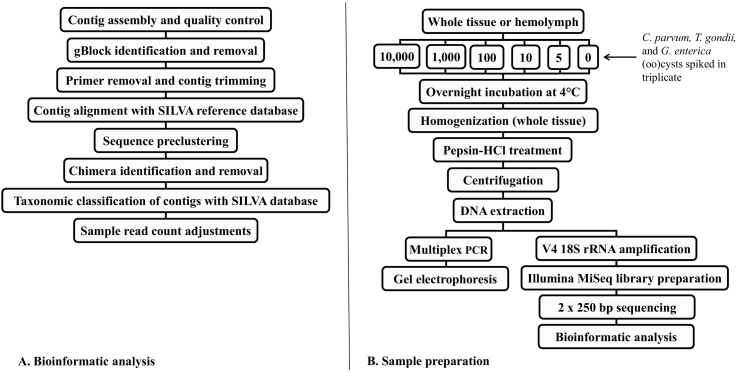
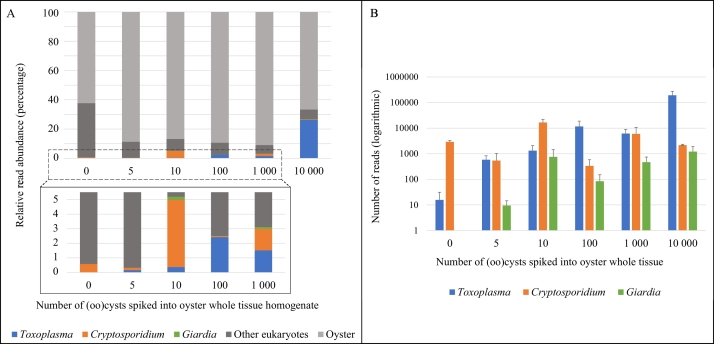
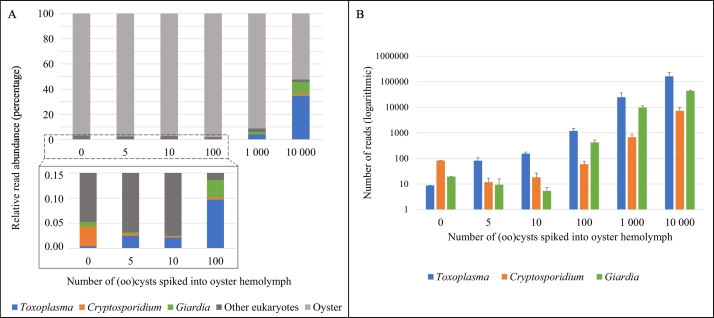
Food and waterborne protozoan pathogens can cause serious disease in people. Three common species , and can contaminate diverse shellfish species, including commercial oysters. Current methods of protozoan detection in shellfish are not standardized, and few are able to simultaneously identify multiple species. Here, we present a novel metabarcoding assay targeting the 18S rRNA gene followed by next generation sequencing (NGS) for simultaneous detection of spp., spp. and spiked into oyster samples. We further developed a bioinformatic pipeline to process and analyze 18S rRNA data for protozoa classification. The ability of the NGS assay to detect protozoa was later compared with conventional PCR. Results demonstrated that background amplification of oyster and other eukaryotic DNA competed with that of protozoa for obtained sequence reads. Sequences of target protozoans were obtained across all spiking levels; however, low numbers of target sequences in negative controls imply that a threshold for true positives must be defined for assay interpretation. While this study focused on three target parasites, the ability of this approach to detect numerous known and potentially unknown protozoan pathogens make it a promising screening tool for monitoring protozoan contamination in food and water.
通过食物和水传播的原生动物病原体可导致人类患上严重疾病。三种常见物种,即[物种名称1]、[物种名称2]和[物种名称3],可污染包括商业牡蛎在内的多种贝类。目前用于检测贝类中原生动物的方法尚未标准化,而且很少有方法能够同时鉴定多种物种。在此,我们提出了一种针对18S rRNA基因的新型宏条形码分析方法,随后进行下一代测序(NGS),用于同时检测添加到牡蛎样本中的[物种名称1]属、[物种名称2]属和[物种名称3]。我们进一步开发了一个生物信息学流程,用于处理和分析18S rRNA数据以进行原生动物分类。随后将NGS分析检测原生动物的能力与传统PCR进行了比较。结果表明,牡蛎和其他真核生物DNA的背景扩增与原生动物的背景扩增竞争获得的序列读数。在所有添加水平下均获得了目标原生动物的序列;然而,阴性对照中目标序列数量较少,这意味着必须为分析解释定义一个真阳性阈值。虽然本研究聚焦于三种目标寄生虫,但这种方法检测众多已知和潜在未知原生动物病原体的能力使其成为监测食物和水中原生动物污染的一种有前景的筛选工具。