Corbett Elizabeth L, Dauya Ethel, Matambo Ronnie, Cheung Yin Bun, Makamure Beauty, Bassett Mary T, Chandiwana Steven, Munyati Shungu, Mason Peter R, Butterworth Anthony E, Godfrey-Faussett Peter, Hayes Richard J
Department of Infectious and Tropical Diseases, London School of Hygiene and Tropical Medicine, London, United Kingdom.
PLoS Med. 2006 Jul;3(7):e238. doi: 10.1371/journal.pmed.0030238.
HIV counselling and testing is a key component of both HIV care and HIV prevention, but uptake is currently low. We investigated the impact of rapid HIV testing at the workplace on uptake of voluntary counselling and testing (VCT).
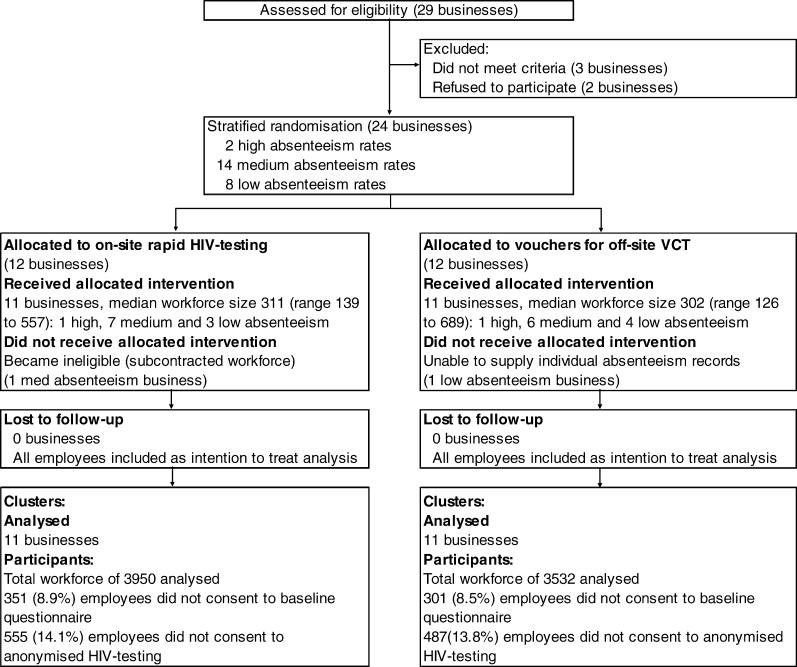
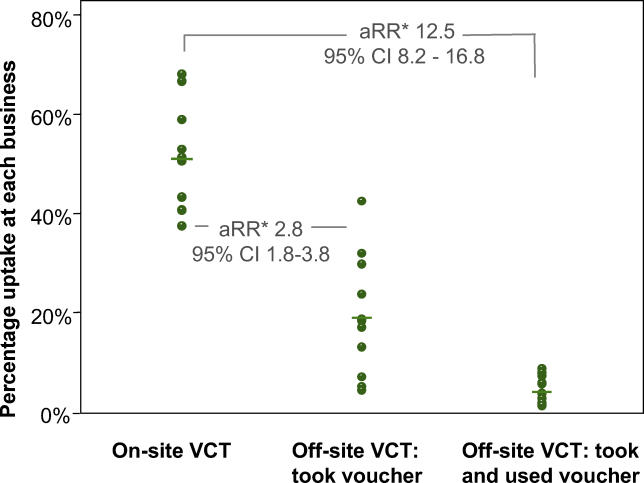
The study was a cluster-randomised trial of two VCT strategies, with business occupational health clinics as the unit of randomisation. VCT was directly offered to all employees, followed by 2 y of open access to VCT and basic HIV care. Businesses were randomised to either on-site rapid HIV testing at their occupational clinic (11 businesses) or to vouchers for off-site VCT at a chain of free-standing centres also using rapid tests (11 businesses). Baseline anonymised HIV serology was requested from all employees. HIV prevalence was 19.8% and 18.4%, respectively, at businesses randomised to on-site and off-site VCT. In total, 1,957 of 3,950 employees at clinics randomised to on-site testing had VCT (mean uptake by site 51.1%) compared to 586 of 3,532 employees taking vouchers at clinics randomised to off-site testing (mean uptake by site 19.2%). The risk ratio for on-site VCT compared to voucher uptake was 2.8 (95% confidence interval 1.8 to 3.8) after adjustment for potential confounders. Only 125 employees (mean uptake by site 4.3%) reported using their voucher, so that the true adjusted risk ratio for on-site compared to off-site VCT may have been as high as 12.5 (95% confidence interval 8.2 to 16.8).
High-impact VCT strategies are urgently needed to maximise HIV prevention and access to care in Africa. VCT at the workplace offers the potential for high uptake when offered on-site and linked to basic HIV care. Convenience and accessibility appear to have critical roles in the acceptability of community-based VCT.
艾滋病毒咨询与检测是艾滋病毒治疗和预防的关键组成部分,但目前接受率较低。我们调查了工作场所快速艾滋病毒检测对自愿咨询与检测(VCT)接受率的影响。
该研究是一项针对两种VCT策略的整群随机试验,以商业职业健康诊所作为随机分组单位。直接向所有员工提供VCT,随后两年可开放获取VCT和基本艾滋病毒治疗。企业被随机分为在其职业诊所进行现场快速艾滋病毒检测(11家企业)或在一系列也使用快速检测的独立中心获取场外VCT代金券(11家企业)。要求所有员工提供基线匿名艾滋病毒血清学检测。随机分组到现场和场外VCT的企业中,艾滋病毒流行率分别为19.8%和18.4%。在随机分组到现场检测的诊所中,3950名员工中有1957人接受了VCT(各诊所平均接受率为51.1%),而在随机分组到场外检测的诊所中,3532名使用代金券的员工中有586人接受了VCT(各诊所平均接受率为19.2%)。在对潜在混杂因素进行调整后,现场VCT与使用代金券接受检测的风险比为2.8(95%置信区间1.8至3.8)。只有125名员工(各诊所平均接受率为4.3%)报告使用了代金券,因此现场与场外VCT相比,经调整后的真实风险比可能高达12.5(95%置信区间8.2至16.8)。
迫切需要高影响力的VCT策略,以在非洲最大限度地预防艾滋病毒并提供治疗。在工作场所进行VCT,若在现场提供并与基本艾滋病毒治疗相结合,有实现高接受率的潜力。便利性和可及性似乎在基于社区的VCT可接受性方面发挥着关键作用。