Gosset Marjolaine, Berenbaum Francis, Levy Arlette, Pigenet Audrey, Thirion Sylvie, Saffar Jean-Louis, Jacques Claire
UMR 7079 CNRS, Physiology and Physiopathology Laboratory, University Paris 6, quai St-Bernard, Paris, 75252 Cedex 5, France.
Arthritis Res Ther. 2006;8(4):R135. doi: 10.1186/ar2024.
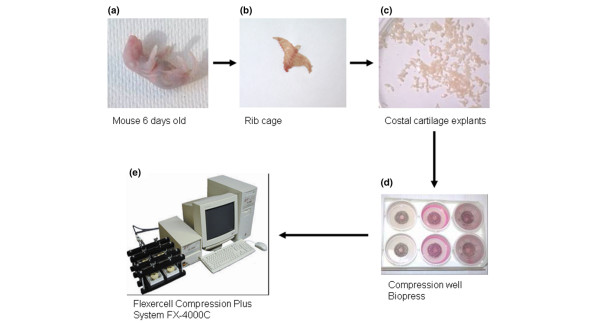
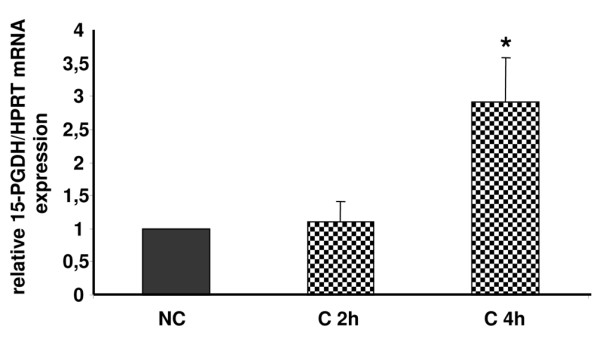
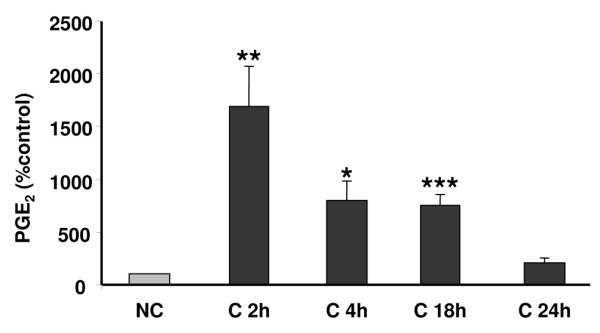
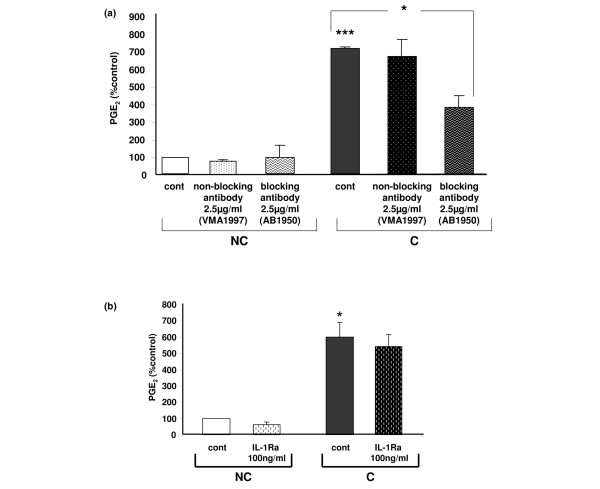
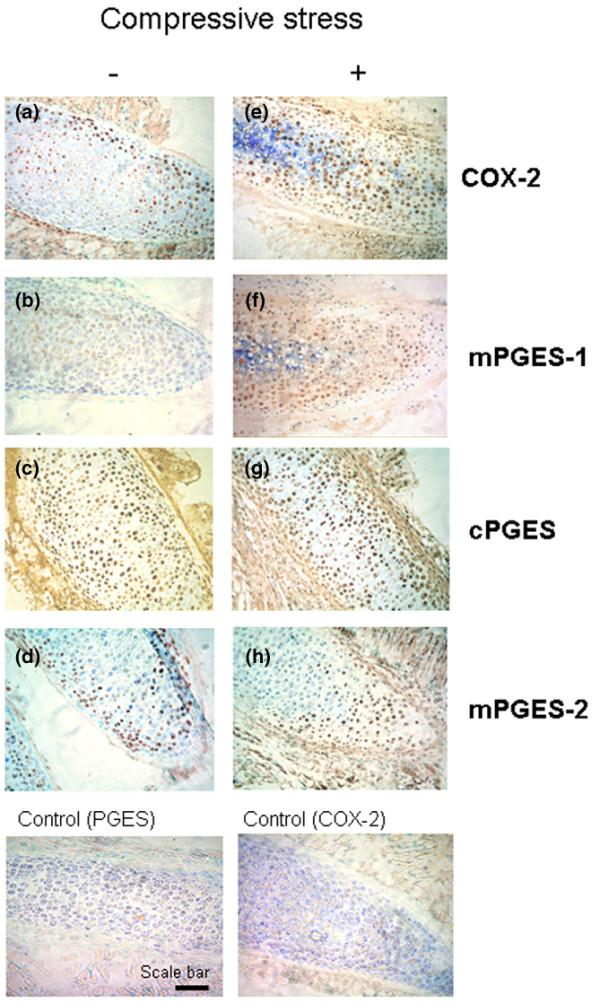
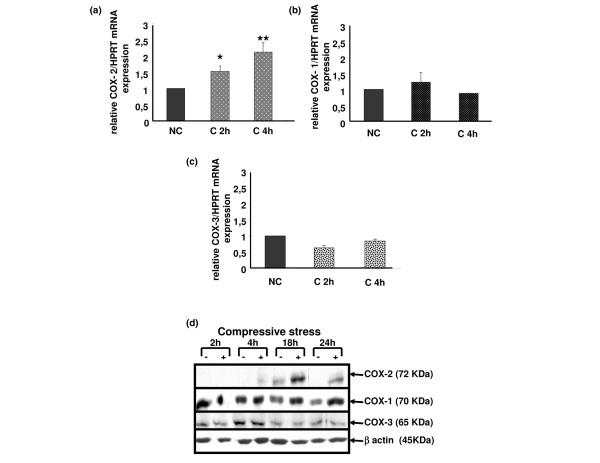
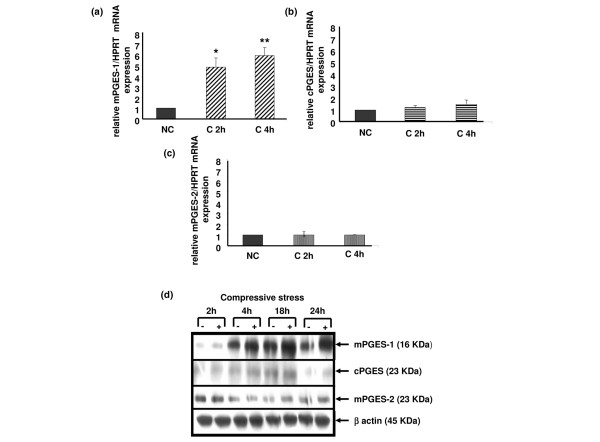
Knee osteoarthritis (OA) results, at least in part, from overloading and inflammation leading to cartilage degradation. Prostaglandin E2 (PGE2) is one of the main catabolic factors involved in OA. Its synthesis is the result of cyclooxygenase (COX) and prostaglandin E synthase (PGES) activities whereas NAD+-dependent 15 hydroxy prostaglandin dehydrogenase (15-PGDH) is the key enzyme implicated in the catabolism of PGE2. For both COX and PGES, three isoforms have been described: in cartilage, COX-1 and cytosolic PGES are constitutively expressed whereas COX-2 and microsomal PGES type 1 (mPGES-1) are inducible in an inflammatory context. COX-3 (a variant of COX-1) and mPGES-2 have been recently cloned but little is known about their expression and regulation in cartilage, as is also the case for 15-PGDH. We investigated the regulation of the genes encoding COX and PGES isoforms during mechanical stress applied to cartilage explants. Mouse cartilage explants were subjected to compression (0.5 Hz, 1 MPa) for 2 to 24 hours. After determination of the amount of PGE2 released in the media (enzyme immunoassay), mRNA and proteins were extracted directly from the cartilage explants and analyzed by real-time RT-PCR and western blotting respectively. Mechanical compression of cartilage explants significantly increased PGE2 production in a time-dependent manner. This was not due to the synthesis of IL-1, since pretreatment with interleukin 1 receptor antagonist (IL1-Ra) did not alter the PGE2 synthesis. Interestingly, COX-2 and mPGES-1 mRNA expression significantly increased after 2 hours, in parallel with protein expression, whereas COX-3 and mPGES-2 mRNA expression was not modified. Moreover, we observed a delayed overexpression of 15-PGDH just before the decline of PGE2 synthesis after 18 hours, suggesting that PGE2 synthesis could be altered by the induction of 15-PGDH expression. We conclude that, along with COX-2, dynamic compression induces mPGES-1 mRNA and protein expression in cartilage explants. Thus, the mechanosensitive mPGES-1 enzyme represents a potential therapeutic target in osteoarthritis.
膝关节骨关节炎(OA)至少部分是由过度负荷和炎症导致软骨降解引起的。前列腺素E2(PGE2)是参与OA的主要分解代谢因子之一。其合成是环氧化酶(COX)和前列腺素E合酶(PGES)活性的结果,而NAD+依赖性15-羟基前列腺素脱氢酶(15-PGDH)是参与PGE2分解代谢的关键酶。对于COX和PGES,已描述了三种同工型:在软骨中,COX-1和胞质PGES组成性表达,而COX-2和微粒体PGES-1(mPGES-1)在炎症环境中可诱导表达。COX-3(COX-1的变体)和mPGES-2最近已被克隆,但对它们在软骨中的表达和调控了解甚少,15-PGDH的情况也是如此。我们研究了在对软骨外植体施加机械应力期间COX和PGES同工型编码基因的调控。将小鼠软骨外植体置于压缩状态(0.5 Hz,1 MPa)2至24小时。在测定培养基中释放的PGE2量(酶免疫测定)后,直接从软骨外植体中提取mRNA和蛋白质,分别通过实时RT-PCR和蛋白质印迹法进行分析。软骨外植体的机械压缩以时间依赖性方式显著增加PGE2的产生。这不是由于IL-1的合成,因为用白细胞介素1受体拮抗剂(IL1-Ra)预处理不会改变PGE2的合成。有趣的是,COX-2和mPGES-1 mRNA表达在2小时后显著增加,与蛋白质表达平行,而COX-3和mPGES-2 mRNA表达未改变。此外,我们观察到在18小时后PGE2合成下降之前15-PGDH出现延迟过表达,表明15-PGDH表达的诱导可能会改变PGE2的合成。我们得出结论,与COX-2一起,动态压缩可诱导软骨外植体中mPGES-1 mRNA和蛋白质表达。因此,机械敏感的mPGES-(此处原文可能有误,推测为mPGES-1)酶是骨关节炎潜在的治疗靶点。