Leonard Brian E, Myint Ayemu
Department of Pharmacology, National University of Ireland, Galway.
Dialogues Clin Neurosci. 2006;8(2):163-74. doi: 10.31887/DCNS.2006.8.2/bleonard.
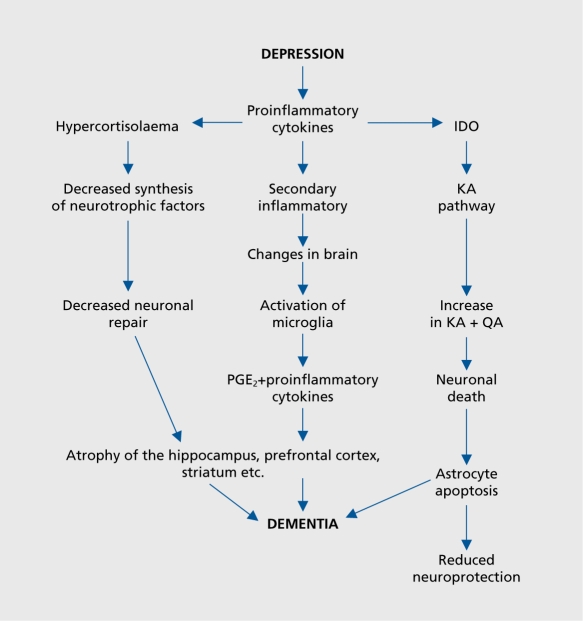
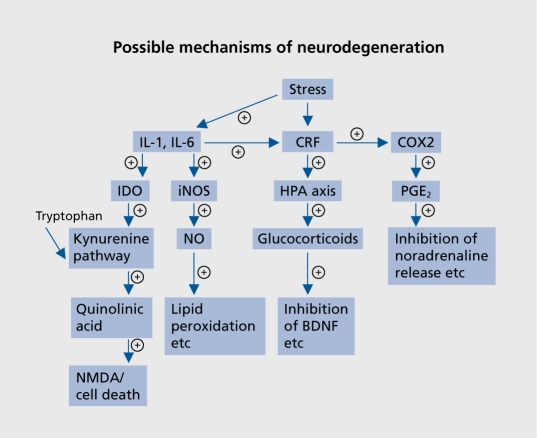
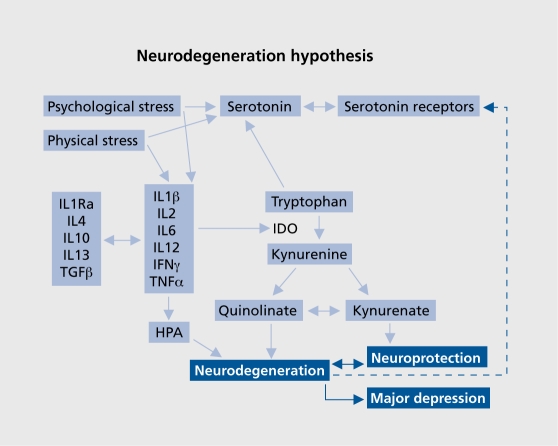
Epidemiological studies show that there is a correlation between chronic depression and the likelihood of dementia in later life. There is evidence that inflammatory changes in the brain are pathological features of both depression and dementia. This suggests that an increase in inflammation-induced apoptosis, together with a reduction in the synthesis of neurotrophic factors caused by a rise in brain glucocorticoids, may play a role in the pathology of these disorders. A reduction in the neuroprotective components of the kynurenine pathway such as kynurenic acid, and an increase in the neurodegenerative components, 3-hydroxykynurenine and quinolinic acid, contribute to the pathological changes. Such changes are postulated to cause neuronal damage, and thereby predispose chronically depressed patients to dementia.
流行病学研究表明,慢性抑郁症与晚年患痴呆症的可能性之间存在关联。有证据表明,大脑中的炎症变化是抑郁症和痴呆症的病理特征。这表明,炎症诱导的细胞凋亡增加,以及脑糖皮质激素升高导致神经营养因子合成减少,可能在这些疾病的病理过程中起作用。犬尿氨酸途径的神经保护成分如犬尿喹啉酸减少,而神经退行性成分3-羟基犬尿氨酸和喹啉酸增加,促成了病理变化。据推测,这些变化会导致神经元损伤,从而使慢性抑郁症患者易患痴呆症。