Mattina Gabriella F, Van Lieshout Ryan J, Steiner Meir
Neuroscience Graduate Program, McMaster University, 1280 Main Street West, ON L8S 4L8, Canada.
Neuroscience Graduate Program, McMaster University, ON, Canada.
Ther Adv Cardiovasc Dis. 2019 Jan-Dec;13:1753944719851950. doi: 10.1177/1753944719851950.
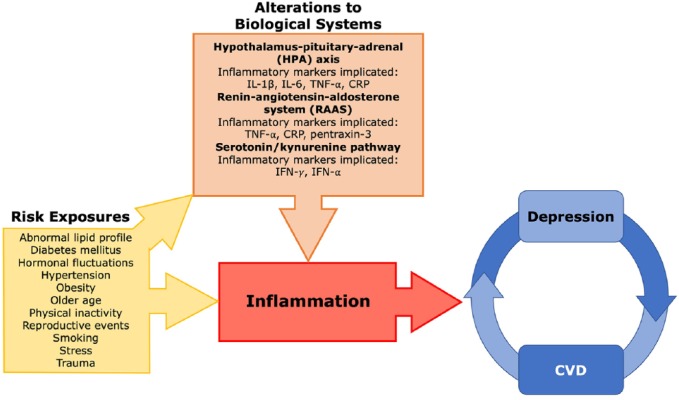
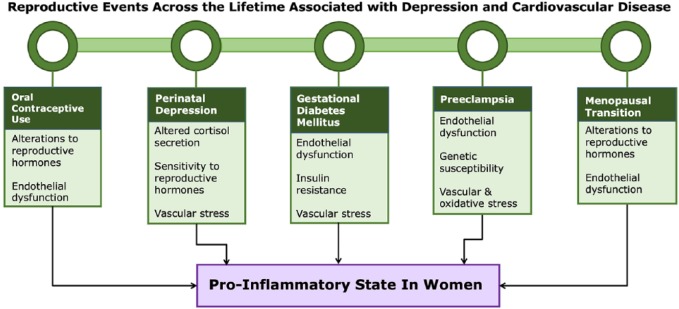
Women are at increased risk for developing depression and cardiovascular disease (CVD) across the lifespan and their comorbidity is associated with adverse outcomes that contribute significantly to rates of morbidity and mortality in women worldwide. Immune-system activity has been implicated in the etiology of both depression and CVD, but it is unclear how inflammation contributes to sex differences in this comorbidity. This narrative review provides an updated synthesis of research examining the association of inflammation with depression and CVD, and their comorbidity in women. Recent research provides evidence of pro-inflammatory states and sex differences associated with alterations in the hypothalamic-pituitary-adrenal axis, the renin-angiotensin-aldosterone system and the serotonin/kynurenine pathway, that likely contribute to the development of depression and CVD. Changes to inflammatory cytokines in relation to reproductive periods of hormonal fluctuation (i.e. the menstrual cycle, perinatal period and menopause) are highlighted and provide a greater understanding of the unique vulnerability women experience in developing both depressed mood and adverse cardiovascular events. Inflammatory biomarkers hold substantial promise when combined with a patient's reproductive and mental health history to aid in the prediction, identification and treatment of the women most at risk for CVD and depression. However, more research is needed to improve our understanding of the mechanisms underlying inflammation in relation to their comorbidity, and how these findings can be translated to improve women's health.
在整个生命周期中,女性患抑郁症和心血管疾病(CVD)的风险增加,而且这两种疾病的合并存在与不良后果相关,这些不良后果对全球女性的发病率和死亡率有重大影响。免疫系统活动与抑郁症和心血管疾病的病因都有关联,但尚不清楚炎症如何导致这种合并症中的性别差异。这篇叙述性综述提供了有关炎症与抑郁症和心血管疾病及其在女性中的合并症之间关联的研究的最新综合情况。最近的研究提供了与下丘脑 - 垂体 - 肾上腺轴、肾素 - 血管紧张素 - 醛固酮系统和血清素/犬尿氨酸途径改变相关的促炎状态和性别差异的证据,这些可能导致抑郁症和心血管疾病的发生。文中强调了与激素波动的生殖期(即月经周期、围产期和更年期)相关的炎症细胞因子变化,这有助于更好地理解女性在出现情绪低落和不良心血管事件方面所经历的独特易感性。当炎症生物标志物与患者的生殖和心理健康史相结合时,对于帮助预测、识别和治疗患心血管疾病和抑郁症风险最高的女性具有很大的前景。然而,需要更多的研究来增进我们对炎症与其合并症相关机制的理解,以及如何将这些研究结果转化为改善女性健康的措施。