Hass-Jacobus Barbara L, Futrell-Griggs Montona, Abernathy Brian, Westerman Rick, Goicoechea Jose-Luis, Stein Joshua, Klein Patricia, Hurwitz Bonnie, Zhou Bin, Rakhshan Fariborz, Sanyal Abhijit, Gill Navdeep, Lin Jer-Young, Walling Jason G, Luo Mei Zhong, Ammiraju Jetty Siva S, Kudrna Dave, Kim Hye Ran, Ware Doreen, Wing Rod A, San Miguel Phillip, Jackson Scott A
Department of Agronomy, Purdue University, West Lafayette, Indiana 47907, USA.
BMC Genomics. 2006 Aug 8;7:199. doi: 10.1186/1471-2164-7-199.
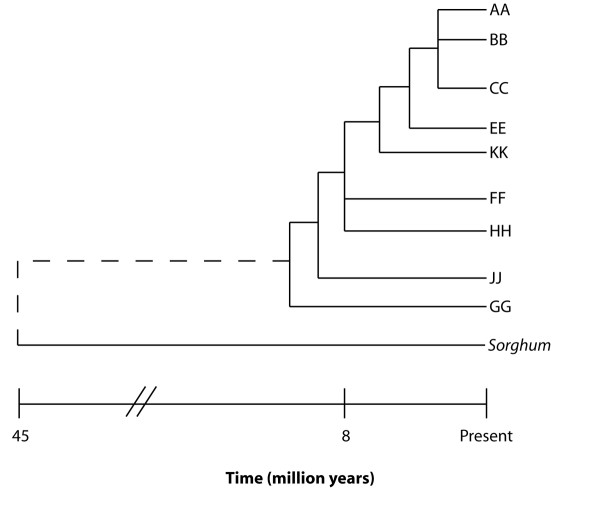
With the completion of the genome sequence for rice (Oryza sativa L.), the focus of rice genomics research has shifted to the comparison of the rice genome with genomes of other species for gene cloning, breeding, and evolutionary studies. The genus Oryza includes 23 species that shared a common ancestor 8-10 million years ago making this an ideal model for investigations into the processes underlying domestication, as many of the Oryza species are still undergoing domestication. This study integrates high-throughput, hybridization-based markers with BAC end sequence and fingerprint data to construct physical maps of rice chromosome 1 orthologues in two wild Oryza species. Similar studies were undertaken in Sorghum bicolor, a species which diverged from cultivated rice 40-50 million years ago.
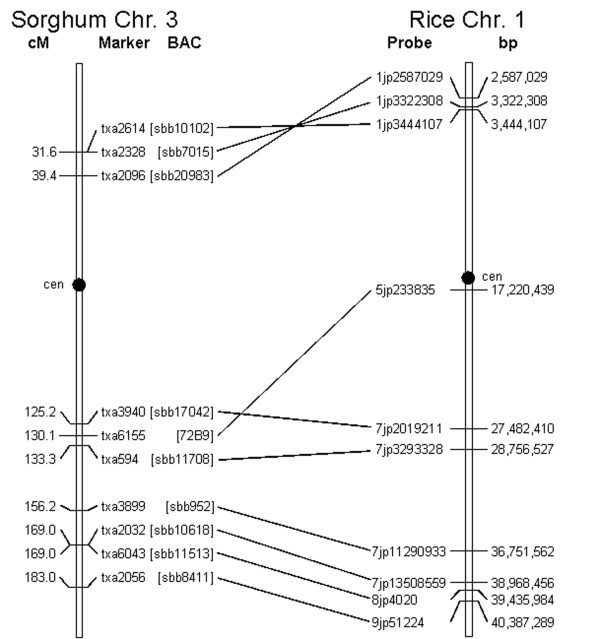
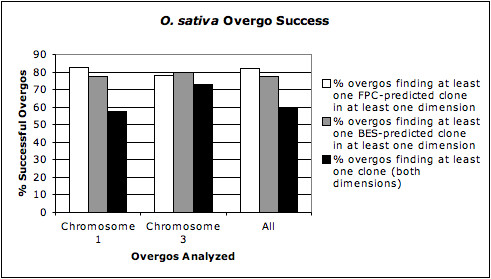
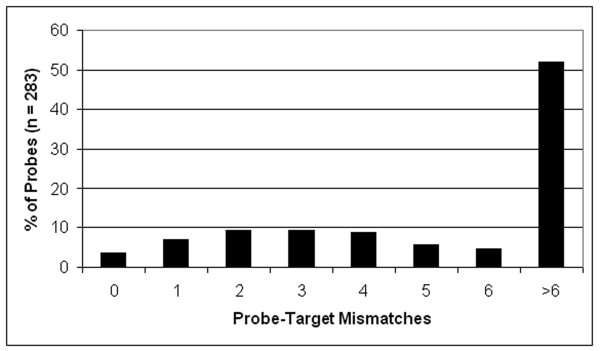
Overgo markers, in conjunction with fingerprint and BAC end sequence data, were used to build sequence-ready BAC contigs for two wild Oryza species. The markers drove contig merges to construct physical maps syntenic to rice chromosome 1 in the wild species and provided evidence for at least one rearrangement on chromosome 1 of the O. sativa versus Oryza officinalis comparative map. When rice overgos were aligned to available S. bicolor sequence, 29% of the overgos aligned with three or fewer mismatches; of these, 41% gave positive hybridization signals. Overgo hybridization patterns supported colinearity of loci in regions of sorghum chromosome 3 and rice chromosome 1 and suggested that a possible genomic inversion occurred in this syntenic region in one of the two genomes after the divergence of S. bicolor and O. sativa.
The results of this study emphasize the importance of identifying conserved sequences in the reference sequence when designing overgo probes in order for those probes to hybridize successfully in distantly related species. As interspecific markers, overgos can be used successfully to construct physical maps in species which diverged less than 8 million years ago, and can be used in a more limited fashion to examine colinearity among species which diverged as much as 40 million years ago. Additionally, overgos are able to provide evidence of genomic rearrangements in comparative physical mapping studies.
随着水稻(Oryza sativa L.)基因组序列的完成,水稻基因组学研究的重点已转向将水稻基因组与其他物种的基因组进行比较,以用于基因克隆、育种和进化研究。稻属包括23个物种,它们在800 - 1000万年前拥有一个共同祖先,这使其成为研究驯化过程潜在机制的理想模型,因为许多稻属物种仍在经历驯化过程。本研究将基于杂交的高通量标记与BAC末端序列和指纹数据相结合,构建了两个野生稻物种中水稻第1号染色体直系同源物的物理图谱。在高粱(Sorghum bicolor)中也进行了类似研究,高粱是一种在4000 - 5000万年前与栽培稻分化的物种。
重叠群标记与指纹和BAC末端序列数据一起用于构建两个野生稻物种的序列就绪BAC重叠群。这些标记推动重叠群合并,以构建与野生物种中水稻第1号染色体同线的物理图谱,并为栽培稻与药用野生稻比较图谱中第1号染色体上至少一次重排提供了证据。当水稻重叠群与可用的高粱序列比对时,29%的重叠群比对时错配数为三个或更少;其中,41%给出了阳性杂交信号。重叠群杂交模式支持高粱第3号染色体和水稻第1号染色体区域中基因座的共线性,并表明在高粱和栽培稻分化后,这一同线区域在两个基因组之一中可能发生了基因组倒位。
本研究结果强调了在设计重叠群探针时识别参考序列中保守序列的重要性,以便这些探针能在远缘物种中成功杂交。作为种间标记,重叠群可成功用于构建分化时间小于800万年的物种的物理图谱,并可在更有限的程度上用于检查分化时间长达4000万年的物种之间的共线性。此外,重叠群能够在比较物理图谱研究中提供基因组重排的证据。