Tiwari Neeraj, Adhikari C M S, Tewari Ajoy, Kandpal Vineeta
Department of Statistics, Kumaon University, S.S.J.Campus, Almora, Uttaranchal, India.
Int J Health Geogr. 2006 Aug 10;5:33. doi: 10.1186/1476-072X-5-33.
The World Health Organization has declared tuberculosis a global emergency in 1993. It has been estimated that one third of the world population is infected with Mycobacterium tuberculosis, the causative agent of tuberculosis. The emergence of TB/HIV co-infection poses an additional challenge for the control of tuberculosis throughout the world. The World Health Organization is supporting many developing countries to eradicate tuberculosis. It is an agony that one fifth of the tuberculosis patients worldwide are in India. The eradication of tuberculosis is the greatest public health challenge for this developing country. The aim of the present population based study on Mycobacterium tuberculosis is to test a large set of tuberculosis cases for the presence of statistically significant geographical clusters. A spatial scan statistic is used to identify purely spatial and space-time clusters of tuberculosis.
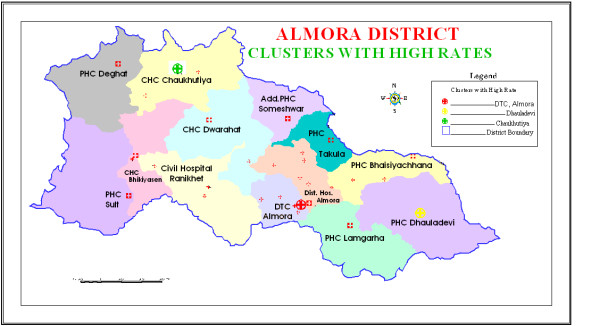
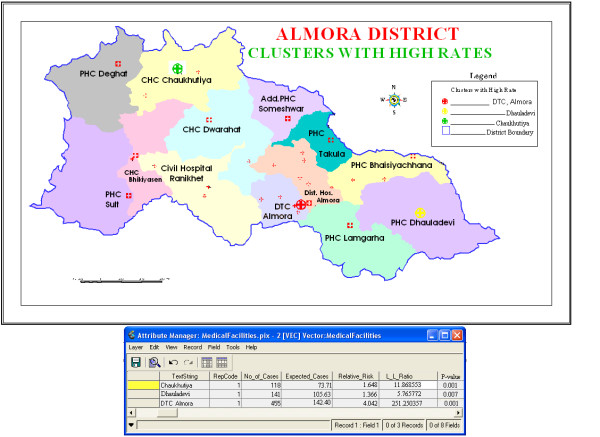
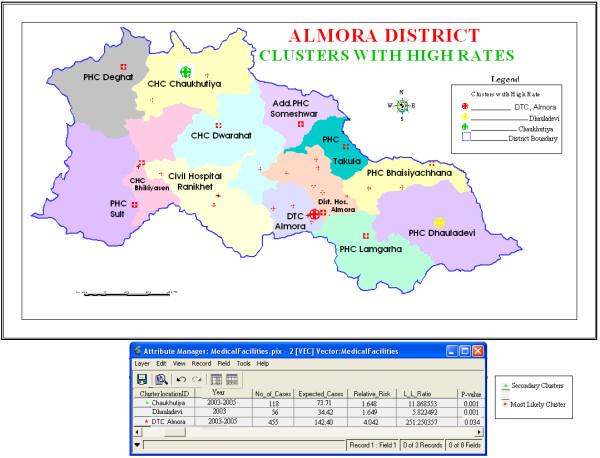
Significant (p < 0.05 for primary clusters and p < 0.1 for secondary clusters) high rate spatial and space-time clusters were identified in three areas of the district.
There is sufficient evidence about the existence of statistically significant tuberculosis clusters in Almora district of Uttaranchal, India. The spatial scan statistics methodology used in this study has a potential use in surveillance of tuberculosis for detecting the true clusters of the disease.
世界卫生组织于1993年宣布结核病为全球紧急情况。据估计,世界三分之一的人口感染了结核分枝杆菌,即结核病的病原体。结核病/艾滋病病毒合并感染的出现给全球结核病控制带来了额外挑战。世界卫生组织正在支持许多发展中国家消除结核病。令人痛苦的是,全球五分之一的结核病患者在印度。消除结核病是这个发展中国家面临的最大公共卫生挑战。本项基于人群的结核分枝杆菌研究的目的是对大量结核病病例进行检测,以确定是否存在具有统计学意义的地理聚集性。空间扫描统计用于识别结核病的纯空间和时空聚集性。
在该地区的三个区域发现了显著的(原发性聚集性p < 0.05,继发性聚集性p < 0.1)高发病率空间和时空聚集性。
有充分证据表明印度北阿坎德邦阿尔莫拉地区存在具有统计学意义的结核病聚集性。本研究中使用的空间扫描统计方法在结核病监测中具有检测该病真正聚集性的潜在用途。