Petrovici Dan A, Ritson Christopher
Kent Business School, University of Kent, Parkwood Road, Canterbury, Kent, CT2 7PE, UK.
BMC Public Health. 2006 Sep 1;6:222. doi: 10.1186/1471-2458-6-222.
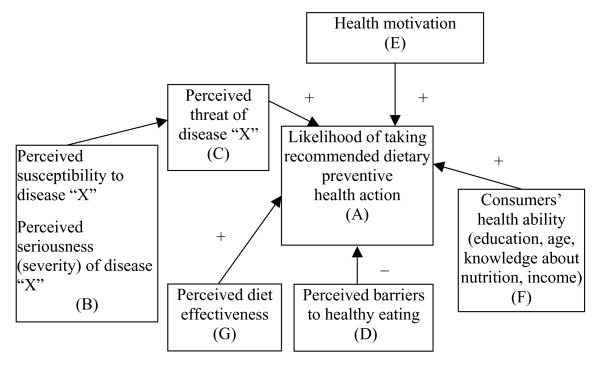
The deterioration of the health status of the Romanian population during the economic transition from a centrally planned to a free market economy has been linked to lifestyles factors (e.g. diet) regarded as a main determinants of the disparity in life expectancy between Eastern and Western Europe. Reforms in the health care system in this transition economy aim to focus on preventive action. The purpose of this study was to identify the factors that impact on the individual decision to engage in Dietary Health Preventive Behaviour (DHPB) and investigate their influence in the context of an adapted health cognition model.
A population-based study recruited 485 adult respondents using random route sampling and face-to-face administered questionnaires.
Respondents' health motivation, beliefs that diet can prevent disease, knowledge about nutrition, level of education attainment and age have a positive influence on DHPB. Perceived barriers to healthy eating have a negative impact on alcohol moderation. The information acquisition behaviour (frequency of reading food labels) is negatively predicted by age and positively predicted by health motivation, education, self-reported knowledge about nutrition and household financial status. A significant segment of respondents believe they are not susceptible to the elicited diseases. Health promotion strategies should aim to change the judgments of health risk.
The adaptation of the Health Belief Model and the Theory of Health Preventive Behaviour represents a valid framework of predicting DHPB. The negative sign of perceived threat of disease on DHPB may suggest that, under an income constraint, consumers tend to trade off long-term health benefits for short-term benefits. This cautions against the use of negative messages in public health campaigns. Raising the awareness of diet-disease relationships, knowledge about nutrition (particularly sources and risks associated with dietary fat and cholesterol) may induce people to adopt preventive dietary habits.
罗马尼亚人口在从中央计划经济向自由市场经济转型期间,健康状况恶化,这与被视为东欧和西欧预期寿命差距主要决定因素的生活方式因素(如饮食)有关。在这个转型经济体中,医疗保健系统改革旨在侧重于预防行动。本研究的目的是确定影响个人参与饮食健康预防行为(DHPB)决策的因素,并在适应性健康认知模型的背景下调查其影响。
一项基于人群的研究通过随机路线抽样和面对面问卷调查招募了485名成年受访者。
受访者的健康动机、饮食可预防疾病的信念、营养知识、教育程度和年龄对DHPB有积极影响。感知到的健康饮食障碍对适度饮酒有负面影响。信息获取行为(阅读食品标签的频率)受年龄负向预测,受健康动机、教育、自我报告的营养知识和家庭财务状况正向预测。很大一部分受访者认为自己不易患所引发的疾病。健康促进策略应旨在改变对健康风险的判断。
健康信念模型和健康预防行为理论的适应性调整是预测DHPB的有效框架。疾病感知威胁对DHPB的负向作用可能表明,在收入受限的情况下,消费者倾向于以短期利益换取长期健康利益。这警示在公共卫生运动中不要使用负面信息。提高对饮食与疾病关系的认识、营养知识(特别是与膳食脂肪和胆固醇相关的来源和风险)可能会促使人们养成预防性饮食习惯。