Xu Hui, Wu Long-Jun, Zhao Ming-Gao, Toyoda Hiroki, Vadakkan Kunjumon I, Jia Yongheng, Pinaud Raphael, Zhuo Min
Department of Physiology, Faculty of Medicine, University of Toronto, University of Toronto Centre for the Study of Pain, 1 King's College Circle, Toronto, Ontario M5S 1A8, Canada.
Mol Pain. 2006 Sep 1;2:29. doi: 10.1186/1744-8069-2-29.
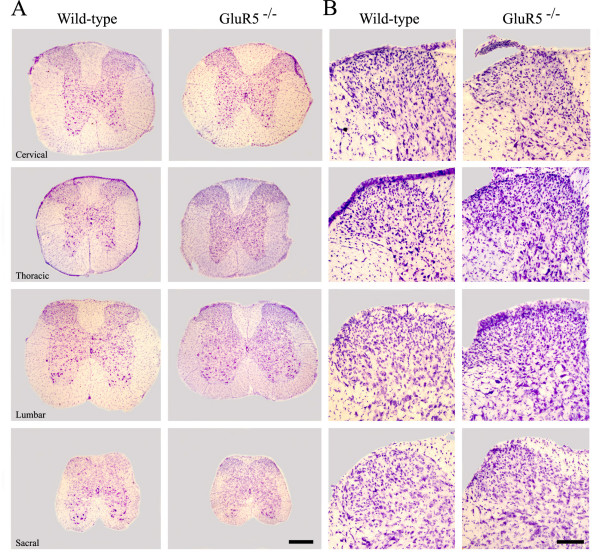
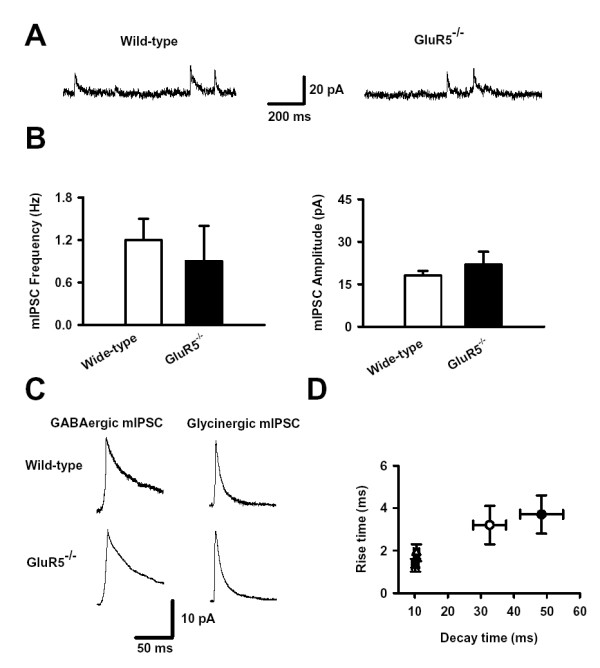
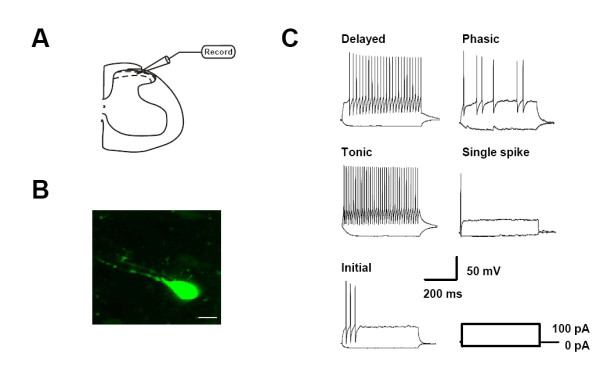
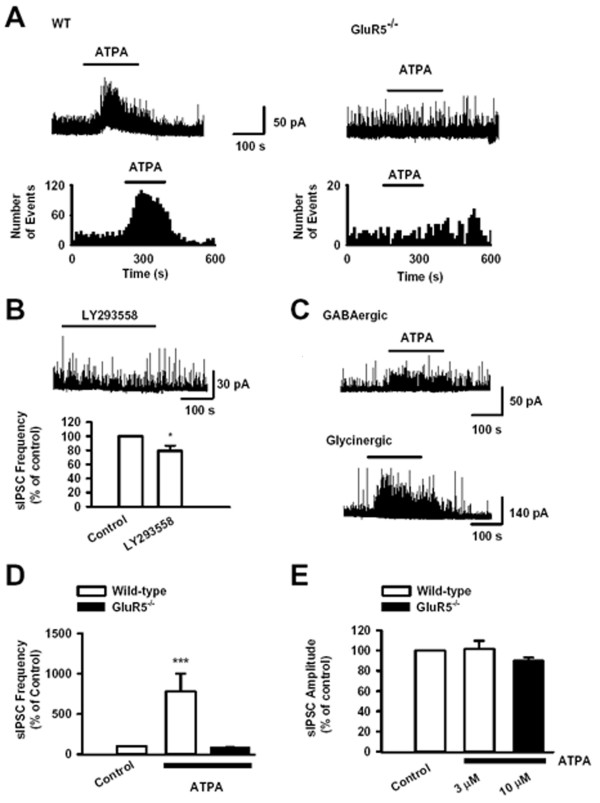
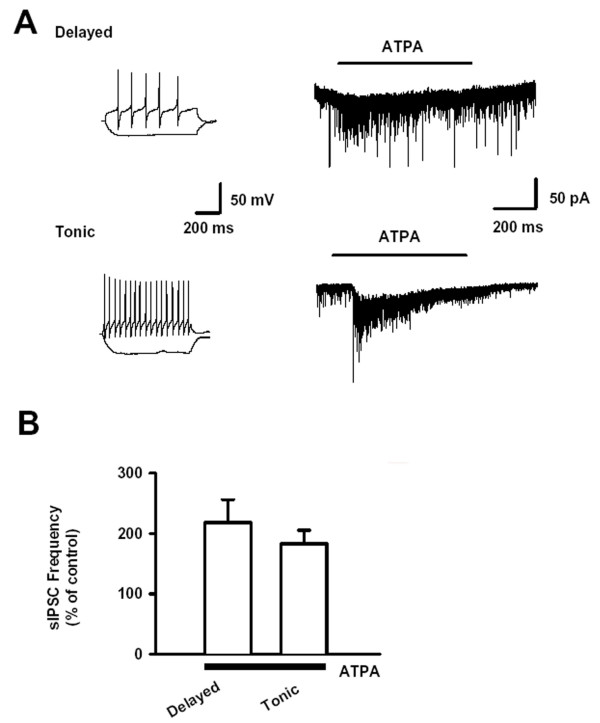
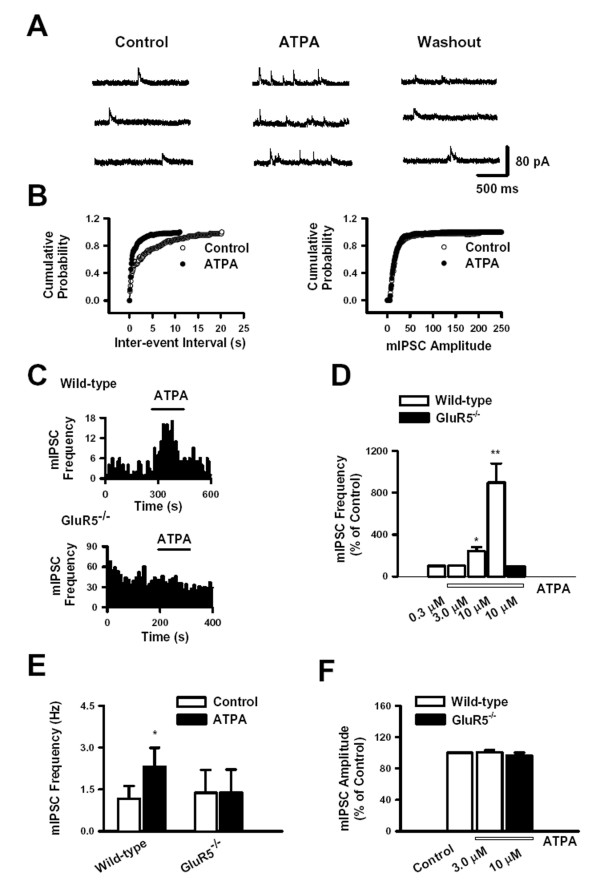
GluR5-containing kainate receptors (KARs) are known to be involved in nociceptive transmission. Our previous work has shown that the activation of presynaptic KARs regulates GABAergic and glycinergic synaptic transmission in cultured dorsal horn neurons. However, the role of GluR5-containing KARs in the modulation of inhibitory transmission in the spinal substantia gelatinosa (SG) in slices remains unknown. In the present study, pharmacological, electrophysiological and genetic methods were used to show that presynaptic GluR5 KARs are involved in the modulation of inhibitory transmission in the SG of spinal slices in vitro. The GluR5 selective agonist, ATPA, facilitated the frequency but not amplitude of spontaneous inhibitory postsynaptic currents (sIPSCs) in SG neurons. ATPA increased sIPSC frequency in all neurons with different firing patterns as delayed, tonic, initial and single spike patterns. The frequency of either GABAergic or glycinergic sIPSCs was significantly increased by ATPA. ATPA could also induce inward currents in all SG neurons recorded. The frequency, but not amplitude, of action potential-independent miniature IPSCs (mIPSCs) was also facilitated by ATPA in a concentration-dependent manner. However, the effect of ATPA on the frequency of either sIPSCs or mIPSCs was abolished in GluR5-/- mice. Deletion of the GluR5 subunit gene had no effect on the frequency or amplitude of mIPSCs in SG neurons. However, GluR5 antagonist LY293558 reversibly inhibited sIPSC and mIPSC frequencies in spinal SG neurons. Taken together, these results suggest that GluR5 KARs, which may be located at presynaptic terminals, contribute to the modulation of inhibitory transmission in the SG. GluR5-containing KARs are thus important for spinal sensory transmission/modulation in the spinal cord.
已知含GluR5的红藻氨酸受体(KARs)参与伤害性感受传递。我们之前的研究表明,突触前KARs的激活可调节培养的背角神经元中的GABA能和甘氨酸能突触传递。然而,含GluR5的KARs在脊髓切片中对脊髓胶状质(SG)抑制性传递的调节作用仍不清楚。在本研究中,采用药理学、电生理学和遗传学方法表明,突触前GluR5 KARs参与体外脊髓切片SG中抑制性传递的调节。GluR5选择性激动剂ATPA促进了SG神经元中自发性抑制性突触后电流(sIPSCs)的频率,但不影响其幅度。ATPA增加了所有具有不同放电模式(如延迟、紧张、初始和单峰模式)的神经元的sIPSC频率。GABA能或甘氨酸能sIPSCs的频率均被ATPA显著增加。ATPA还可在所有记录的SG神经元中诱导内向电流。动作电位非依赖性微小抑制性突触后电流(mIPSCs)的频率也以浓度依赖性方式被ATPA促进,但幅度不受影响。然而,在GluR5基因敲除小鼠中,ATPA对sIPSCs或mIPSCs频率的影响被消除。GluR5亚基基因的缺失对SG神经元中mIPSCs的频率或幅度没有影响。然而,GluR5拮抗剂LY293558可可逆地抑制脊髓SG神经元中的sIPSC和mIPSC频率。综上所述,这些结果表明,可能位于突触前终末的GluR5 KARs有助于调节SG中的抑制性传递。因此,含GluR5的KARs对脊髓中的脊髓感觉传递/调节很重要。