von Mach Marc A, Burhenne Jürgen, Weilemann Ludwig S
Division of Intensive Care Medicine and Clinical Toxicology, II. Medical Department, University of Mainz, Langenbeckstr. 1, 55131 Mainz, Germany.
BMC Clin Pharmacol. 2006 Sep 18;6:6. doi: 10.1186/1472-6904-6-6.
Voriconazole was introduced for the treatment of life-threatening fungal infections. The intravenous form includes the solvent vehicle sulphobutylether beta cyclodextrin sodium which shows an impaired clearance under intermittent dialysis therapy. This investigation aimed to determine first clinical data on sulphobutylether beta cyclodextrin sodium blood levels to verify the risk for accumulation.
In four patients suffering from renal insufficiency and intermittent dialysis therapy who needed a treatment with intravenous voriconazole as a reserve antifungal at the intensive care unit of the Mainz University Hospital the trough levels of voriconazole and sulphobutylether beta cyclodextrin sodium were measured.
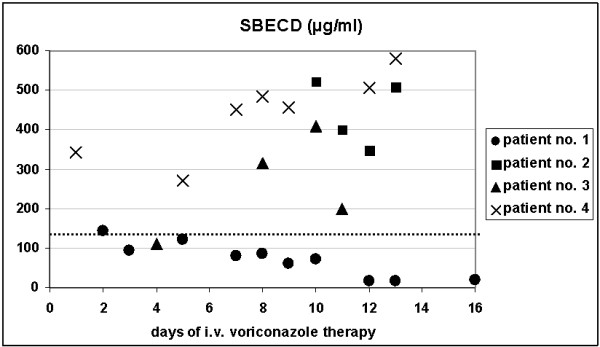
A 75-year-old woman showed a maximal sulphobutylether beta cyclodextrin sodium plasma level of 145 microg/ml in the initial phase. After a few days renal function recovered and the plasma levels came down to less than 20 microg/ml. In contrast to this patient with a recovery of renal function the remaining three patients showed renal failure during the complete period of intravenous treatment with voriconazole. In these patients an accumulation of sulphobutylether beta cyclodextrin sodium plasma levels was determined with a maximum of 523 mug/ml in a 18-year-old man, 409 microg/ml in a 57-year-old man, and 581 microg/ml in a 47-year-old man.
The present data indicate an accumulation of sulphobutylether beta cyclodextrin sodium in patients treated with intravenous voriconazole and dialysis therapy. Fortunately, no toxic effects were observed, although the accumulated dose values were lower but comparable with those used in previous toxicity studies with animals.
伏立康唑被用于治疗危及生命的真菌感染。静脉制剂含有溶剂辅料磺丁基醚-β-环糊精钠,在间歇性透析治疗时其清除率受损。本研究旨在确定磺丁基醚-β-环糊精钠血药浓度的首批临床数据,以验证蓄积风险。
在美因茨大学医院重症监护病房,对4例肾功能不全且接受间歇性透析治疗、需要静脉使用伏立康唑作为备用抗真菌药物治疗的患者,测定伏立康唑和磺丁基醚-β-环糊精钠的谷浓度。
一名75岁女性在初始阶段磺丁基醚-β-环糊精钠血浆水平最高达145微克/毫升。几天后肾功能恢复,血浆水平降至20微克/毫升以下。与这名肾功能恢复的患者不同,其余3例患者在静脉使用伏立康唑的整个治疗期间均出现肾衰竭。在这些患者中,测定到磺丁基醚-β-环糊精钠血浆水平有蓄积,一名18岁男性最高达523微克/毫升,一名57岁男性为409微克/毫升,一名47岁男性为581微克/毫升。
目前的数据表明,接受静脉伏立康唑治疗和透析治疗的患者会出现磺丁基醚-β-环糊精钠蓄积。幸运的是,尽管蓄积剂量值较低,但与先前动物毒性研究中使用的剂量相当,未观察到毒性作用。