Tsaganos Thomas, Giamarellos-Bourboulis Evangelos J, Kollias Spyridon, Zervakis Dimitrios, Karagianni Vassiliki, Pelekanou Aimilia, Tampaki Ekaterini-Christina, Kontogiorgi Marina, Koroneos Apostolos, Drakoulis Nikolaos, Armaganidis Apostolos, Roussos Charis, Giamarellou Helen
4th Department of Internal Medicine, University of Athens, Medical School, Greece.
BMC Infect Dis. 2006 Sep 18;6:142. doi: 10.1186/1471-2334-6-142.
Current theories underline the crucial role of pro-inflammatory mediators produced by monocytes for the pathogenesis of sepsis. Since monocytes derive from progenitor hemopoetic cells, the kinetics of stem cells was studied in peripheral blood of patients with sepsis.
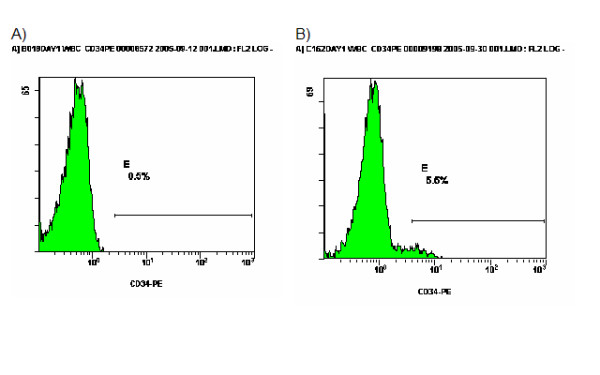
Blood was sampled from 44 patients with septic syndrome due to ventilator-associated pneumonia on days 1, 3, 5 and 7 upon initiation of symptoms. Concentrations of tumour necrosis factor-alpha (TNFalpha), interleukin (IL)-6, IL-8 and G-CSF were estimated by ELISA. CD34/CD45 cells were determined after incubation with anti-CD45 FITC and anti-CD34 PE monocloncal antibodies and flow cytometric analysis. Samples from eight healthy volunteers served as controls.
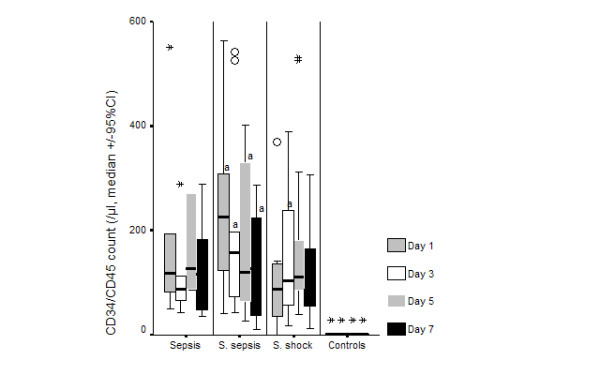
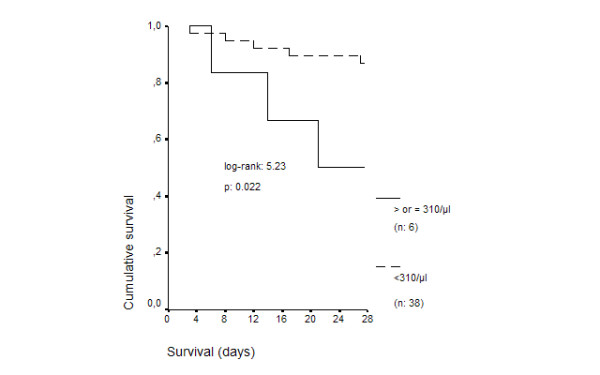
Median of CD34/CD45 absolute count of controls was 1.0/mul. Respective values of the total study population were 123.4, 112.4, 121.5 and 120.9/mul on days 1, 3, 5 and 7 (p < 0.0001 compared to controls). Positive correlations were found between the absolute CD34/CD45 count and the absolute monocyte count on days 1, 5 and 7. Survival was prolonged among patients with less than 310/microl CD34/CD45 cells on day 1 compared to those with more than 310/microl of CD34/CD45 cells (p: 0.022). Hazard ratio for death due to sepsis was 5.47 (p: 0.039) for CD34/CD45 cells more than 310/microl. Median IL-6 on day 1 was 56.78 and 233.85 pg/ml respectively for patients with less than 310/microl and more than 310/microl CD34/CD45 cells (p: 0.021).
Stem cells are increased in peripheral blood over all days of follow-up compared to healthy volunteers. Patients with counts on day 1 less than 310/microl are accompanied by increased survival compared to patients with more than 310/microl.
当前理论强调单核细胞产生的促炎介质在脓毒症发病机制中的关键作用。由于单核细胞源自造血祖细胞,因此对脓毒症患者外周血中的干细胞动力学进行了研究。
对44例因呼吸机相关性肺炎导致脓毒症综合征的患者在症状出现后的第1、3、5和7天采集血液样本。通过酶联免疫吸附测定法(ELISA)估算肿瘤坏死因子-α(TNFα)、白细胞介素(IL)-6、IL-8和粒细胞集落刺激因子(G-CSF)的浓度。在用抗CD45异硫氰酸荧光素(FITC)和抗CD34藻红蛋白(PE)单克隆抗体孵育并进行流式细胞术分析后,测定CD34/CD45细胞。来自8名健康志愿者的样本用作对照。
对照组CD34/CD45绝对计数的中位数为1.0/μl。在第1、3、5和7天,整个研究人群的相应值分别为123.4、112.4、121.5和120.9/μl(与对照组相比,p < 0.0001)。在第1、5和7天,CD34/CD45绝对计数与单核细胞绝对计数之间存在正相关。与第1天CD34/CD45细胞数超过310/μl的患者相比,第1天CD34/CD45细胞数少于310/μl的患者生存期延长(p:0.022)。对于CD34/CD45细胞数超过310/μl的患者,因脓毒症死亡的风险比为5.47(p:0.039)。第1天,CD34/CD45细胞数少于310/μl和超过310/μl的患者的IL-6中位数分别为56.78和233.85 pg/ml(p:0.021)。
与健康志愿者相比,在随访的所有天数中,外周血中的干细胞均增加。与第1天细胞数超过310/μl的患者相比,第1天细胞数少于310/μl的患者生存期增加。