Mohan Arumugam, Murhekar Manoj V, Wairgkar Niteen S, Hutin Yvan J, Gupte Mohan D
Field Epidemiology Training Programme, National Institute of Epidemiology (ICMR), Chennai, India.
BMC Infect Dis. 2006 Sep 19;6:143. doi: 10.1186/1471-2334-6-143.
On 26 December 2004, a tsunami struck the coast of the state of Tamil Nadu, India, where one-dose measles coverage exceeded 95%. On 29 December, supplemental measles immunization activities targeted children 6 to 60 months of age in affected villages. On 30 December, Cuddalore, a tsunami-affected district in Tamil Nadu reported a cluster of measles cases. We investigated this cluster to estimate the magnitude of the problem and to propose recommendations for control.
We received notification of WHO-defined measles cases through stimulated passive surveillance. We collected information regarding date of onset, age, sex, vaccination status and residence. We collected samples for IgM antibodies and genotype studies. We modeled the accumulation of susceptible individuals over the time on the basis of vaccination coverage, vaccine efficacy and birth rate.
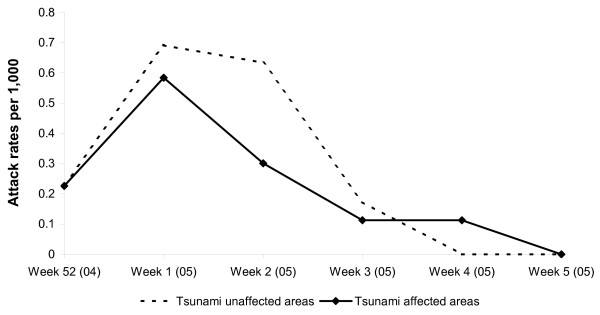
We identified 101 measles cases and detected IgM antibodies against measles virus in eight of 11 sera. Cases were reported from tsunami-affected (n = 71) and unaffected villages (n = 30) with attack rates of 1.3 and 1.7 per 1000, respectively. 42% of cases in tsunami-affected villages had an onset date within 14 days of the tsunami. The median ages of case-patients in tsunami-affected and un-affected areas were 54 months and 60 months respectively (p = 0.471). 36% of cases from tsunami-affected areas were above 60 months of age. Phylogenetic analyses indicated that the sequences of virus belonged to genotype D8 that circulated in Tamil Nadu.
Measles virus circulated in Cuddalore district following the tsunami, although there was no association between the two events. Transmission despite high one-dose vaccination coverage pointed to the limitations of this vaccination strategy. A second opportunity for measles immunization may help reducing measles mortality and morbidity in such areas. Children from 6 month to 14 years of age must be targeted for supplemental immunization during complex emergencies.
2004年12月26日,一场海啸袭击了印度泰米尔纳德邦海岸,该地区一剂次麻疹疫苗接种覆盖率超过95%。12月29日,在受影响村庄针对6至60月龄儿童开展了补充麻疹免疫活动。12月30日,泰米尔纳德邦受海啸影响的库达洛尔区报告了一批麻疹病例。我们对这批病例进行了调查,以评估问题的严重程度并提出控制建议。
我们通过强化被动监测收到了世界卫生组织定义的麻疹病例通报。我们收集了发病日期、年龄、性别、疫苗接种状况和居住地等信息。我们采集了用于IgM抗体和基因型研究的样本。我们根据疫苗接种覆盖率、疫苗效力和出生率对易感个体随时间的累积情况进行了建模。
我们确定了101例麻疹病例,并在11份血清中的8份中检测到了抗麻疹病毒的IgM抗体。病例来自受海啸影响的村庄(n = 71)和未受影响的村庄(n = 30),发病率分别为每1000人1.3例和1.7例。受海啸影响村庄中42%的病例发病日期在海啸发生后的14天内。受海啸影响地区和未受影响地区病例患者的中位年龄分别为54个月和60个月(p = 0.471)。受海啸影响地区36%的病例年龄在60个月以上。系统发育分析表明,病毒序列属于在泰米尔纳德邦传播的D8基因型。
海啸过后麻疹病毒在库达洛尔区传播,尽管这两个事件之间没有关联。尽管一剂次疫苗接种覆盖率很高,但仍有传播,这表明该疫苗接种策略存在局限性。再次进行麻疹免疫接种可能有助于降低此类地区的麻疹死亡率和发病率。在复杂紧急情况期间,必须将6月龄至14岁的儿童作为补充免疫接种的目标人群。