Labrecque Michel, Hays Melissa, Chen-Mok Mario, Barone Mark A, Sokal David
Evaluation Research Unit, D1-724, Centre de recherche du Centre Hospitalier Universitaire de Québec (CHUQ), Hôpital Saint-François d'Assise, 10, rue de l'Espinay, Québec, Canada.
BMC Urol. 2006 Sep 19;6:25. doi: 10.1186/1471-2490-6-25.
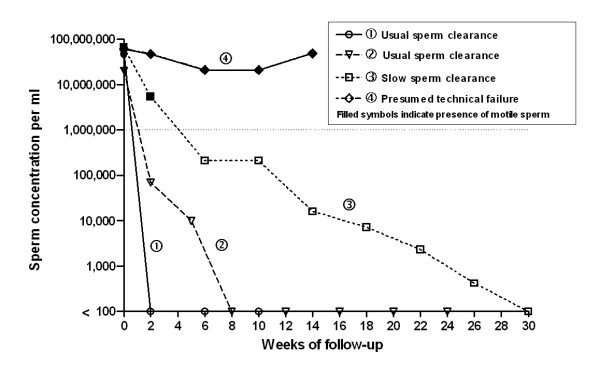
Our understanding of early post-vasectomy recanalization is limited to histopathological studies. The objective of this study was to estimate the frequency and to describe semen analysis patterns of early recanalization after vasectomy.
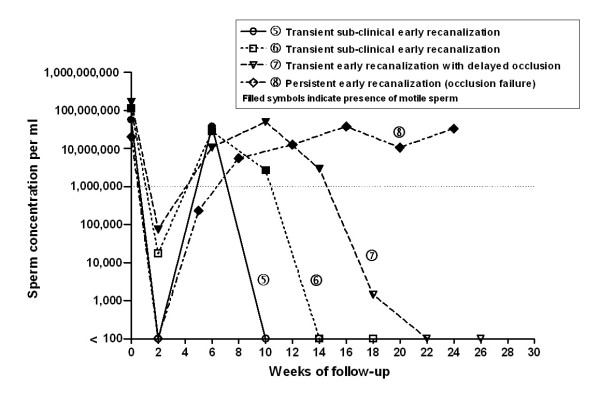
Charts displaying serial post-vasectomy semen analyses were created using the semen analysis results from 826 and 389 men participating in a randomized trial of fascial interposition (FI) and an observational study of cautery, respectively. In the FI trial, participants were randomly allocated to vas occlusion by ligation and excision with or without FI. In the cautery study, sites used their usual cautery occlusion technique, two with and two without FI. Presumed early recanalization was based on the assessment of individual semen analysis charts by three independent reviewers. Discrepancies were resolved by consensus.
Presumed early recanalization was characterized by a very low sperm concentration within two weeks after vasectomy followed by return to large numbers of sperm over the next few weeks. The overall proportion of men with presumed early recanalization was 13% (95% CI 12%-15%). The risk was highest with ligation and excision without FI (25%) and lowest for thermal cautery with FI (0%). The highest proportion of presumed early recanalization was observed among men classified as vasectomy failures.
Early recanalization, occurring within the first weeks after vasectomy, is more common than generally recognized. Its frequency depends on the occlusion technique performed.
我们对输精管结扎术后早期再通的了解仅限于组织病理学研究。本研究的目的是评估输精管结扎术后早期再通的发生率,并描述其精液分析模式。
分别使用参与筋膜插入术(FI)随机试验的826名男性和电灼术观察性研究的389名男性的精液分析结果,创建显示输精管结扎术后系列精液分析的图表。在FI试验中,参与者被随机分配接受结扎和切除加或不加FI的输精管闭塞术。在电灼术研究中,各研究地点采用其常用的电灼闭塞技术,其中两个采用了FI,两个未采用FI。假定的早期再通是基于三位独立评审员对个体精液分析图表的评估。通过达成共识解决分歧。
假定的早期再通的特征是输精管结扎术后两周内精子浓度极低,随后在接下来的几周内精子数量恢复到大量。假定有早期再通的男性总体比例为13%(95%CI 12%-15%)。结扎和切除且未行FI的风险最高(25%),而热灼术加FI的风险最低(0%)。在被归类为输精管结扎术失败的男性中,假定早期再通的比例最高。
输精管结扎术后第一周内发生的早期再通比普遍认为的更为常见。其发生率取决于所采用的闭塞技术。