Hong Eui-Ju, Park Se-Hyung, Choi Kyung-Chul, Leung Peter C K, Jeung Eui-Bae
Laboratory of Veterinary Biochemistry and Molecular Biology, College of Veterinary Medicine, Chungbuk National University, Cheongju, Chungbuk, 361-763, Republic of Korea.
Reprod Biol Endocrinol. 2006 Sep 29;4:49. doi: 10.1186/1477-7827-4-49.
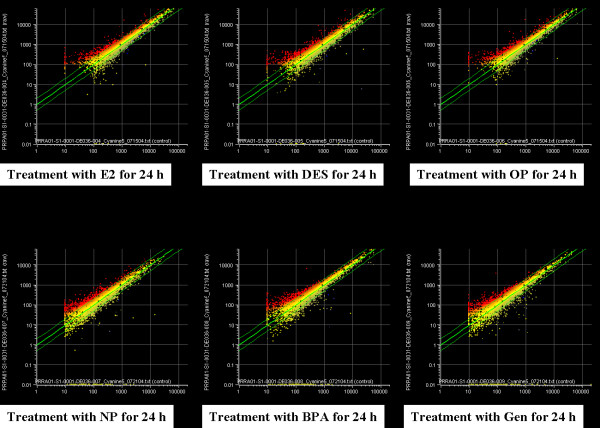
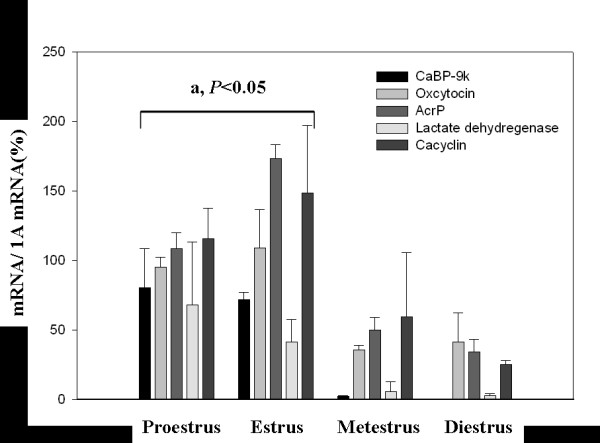
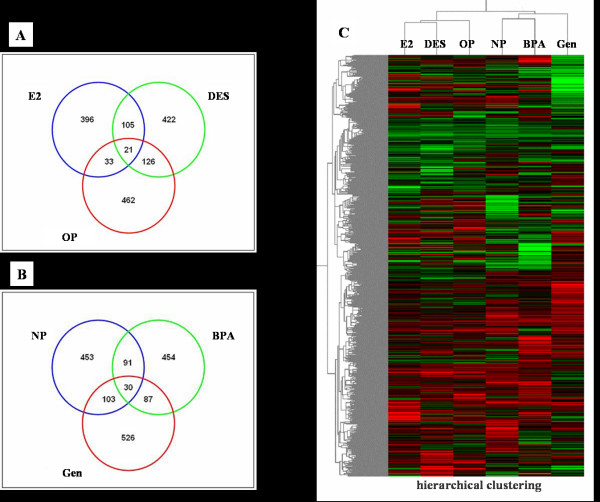
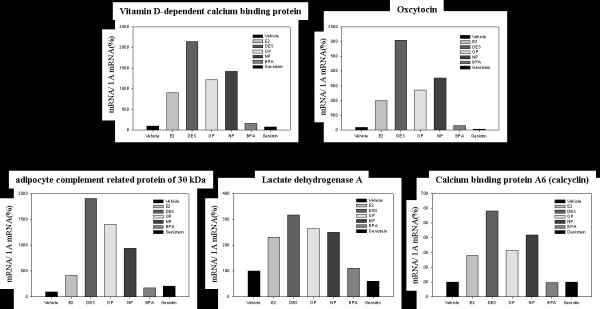
Environmental estrogenic compounds which bind to the estrogen receptor (ER) can block or alter endogenous functions of estrogen in reproductive and developmental stages. A microarray technology is a very valuable method for the prediction of hormone-responsive activities in various gene expressions. Thus, we investigated the altered gene expression by estrogen and endocrine disruptors (EDs) using microarray technology in the uterus of immature rats. In this study, the expression levels of only 555 genes (7.42%) among the 7636 genes spotted on microarray chips were enhanced by more than two-fold following treatment with estradiol (E2), suggesting that direct or rapid response to E2 is widespread at the mRNA levels in these genes. In addition, elevated expression levels of the genes (over 2-fold) were observed by diethylstilbestrol (DES; 9.01%), octyl-phenol (OP; 8.81%), nonyl-phenol (NP; 9.51%), bisphenol-A (BPA; 8.26%) or genistein (9.97%) in the uterus of immature rats. The expression levels of representative genes, i.e., calbindin-D9k (CaBP-9k; vitamin D-dependent calcium-binding protein), oxytocin, adipocyte complement related protein (MW 30 kDa), lactate dehydrogenase A and calcium binding protein A6 (S100a6; calcyclin), were confirmed in these tissues by real-time PCR. In addition, the mRNA levels of these genes by real-time PCR were increased at follicular phase when E2 level was elevated during estrous cycle of adult female rats. In conclusion, these results indicate distinct altered expression of responsive genes following exposure to E2 and estrogenic compounds, and implicate distinct effects of endogenous E2 and environmental endocrine disrupting chemicals in the uterus of immature rats.
与雌激素受体(ER)结合的环境雌激素化合物可在生殖和发育阶段阻断或改变雌激素的内源性功能。微阵列技术是预测各种基因表达中激素反应活性的一种非常有价值的方法。因此,我们使用微阵列技术研究了雌激素和内分泌干扰物(EDs)对未成熟大鼠子宫中基因表达的影响。在本研究中,微阵列芯片上点样的7636个基因中,只有555个基因(7.42%)的表达水平在雌二醇(E2)处理后提高了两倍以上,这表明这些基因在mRNA水平上对E2的直接或快速反应很普遍。此外,在未成熟大鼠子宫中,己烯雌酚(DES;9.01%)、辛基酚(OP;8.81%)、壬基酚(NP;9.51%)、双酚A(BPA;8.26%)或染料木黄酮(9.97%)处理后,观察到基因表达水平升高(超过2倍)。通过实时PCR在这些组织中证实了代表性基因的表达水平,即钙结合蛋白-D9k(CaBP-9k;维生素D依赖性钙结合蛋白)、催产素、脂肪细胞补体相关蛋白(分子量30 kDa)、乳酸脱氢酶A和钙结合蛋白A6(S100a6;钙周期蛋白)。此外,在成年雌性大鼠发情周期中E2水平升高的卵泡期,通过实时PCR检测到这些基因的mRNA水平升高。总之,这些结果表明暴露于E2和雌激素化合物后反应性基因的表达明显改变,并且表明内源性E2和环境内分泌干扰化学物质在未成熟大鼠子宫中有不同的作用。