Zhou Sheng, Wang Guo-Ping, Liu Cong, Zhou Muxiang
Department of Pathology, Tongji Hospital, Tongji Medical College, Huazhong University of Science and Technology, Wuhan, Hubei, PR China.
BMC Cancer. 2006 Sep 30;6:231. doi: 10.1186/1471-2407-6-231.
The overexpression of eukaryotic translation initiation factor 4E (eIF4E), a key regulator of protein synthesis, is involved in the malignant progression of human breast cancer. This study investigates the relationship between eIF4E and angiogenesis, as well as their prognostic impact in patients with human breast cancer.
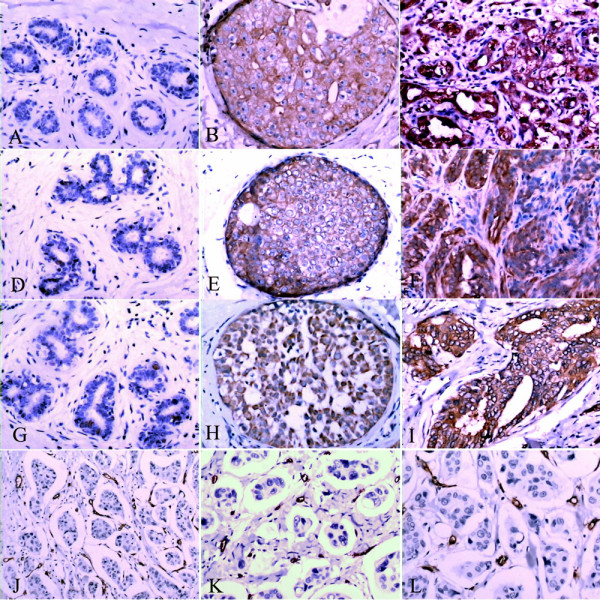
Immunohistochemical staining was used to determine protein expression of eIF4E, vascular endothelial growth factor (VEGF), interleukin-8 (IL-8), and CD105 in a set of 122 formalin-fixed, paraffin-embedded primary breast cancer tissues. Expression of eIF4E in positive cells was characterized by cytoplasmic staining. Evaluation of VEGF and IL-8 in the same tissue established the angiogenic profiles, while CD105 was used as an indicator of microvessel density (MVD).
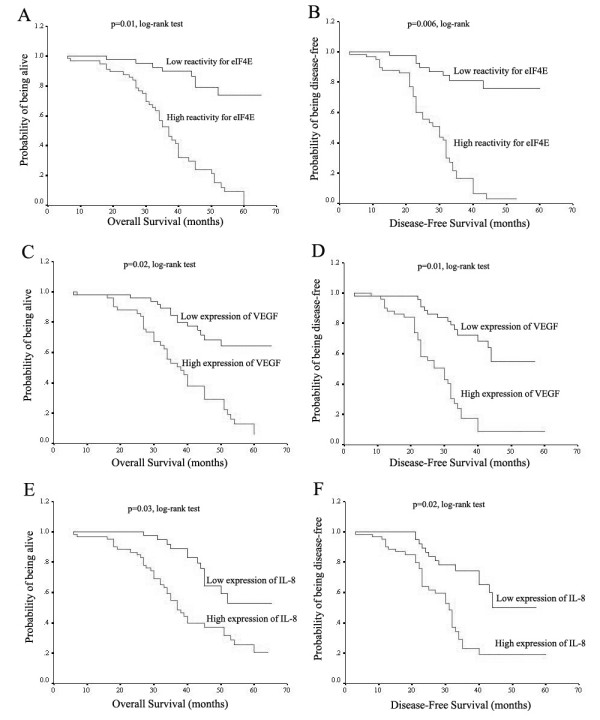
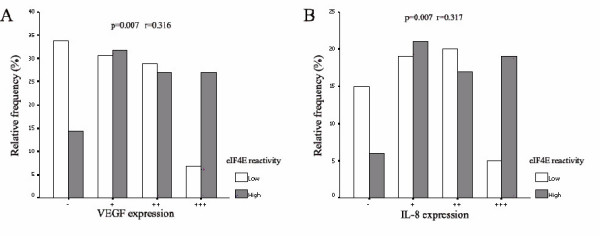
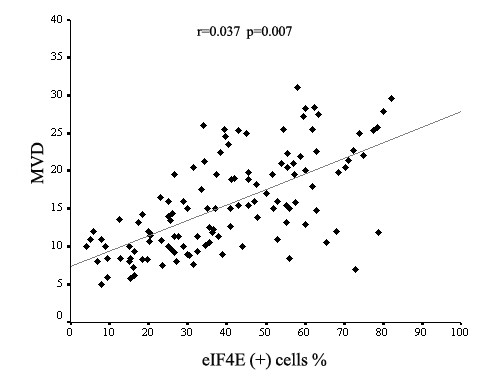
A significant relationship was found between the level of eIF4E expression and histological grade (P = 0.016). VEGF, IL-8, and MVD were closely related to tumor grade (P = 0.003, P = 0.022, and P < 0.001, respectively) and clinical stage (P = 0.007, P = 0.048, and P < 0.001, respectively). Expression of eIF4E was also significantly correlated with VEGF (P = 0.007), IL-8 (P = 0.007), and MVD (P = 0.006). Patients overexpressing eIF4E had significantly worse overall (P = 0.01) and disease-free survival (P = 0.006). When eIF4E, histological grade, tumor stage, ER, PR, Her-2 status and the levels of VEGF, IL-8, MVD were included in a multivariate Cox regression analysis, eIF4E emerged as an independent prognostic factor for breast cancer (P = 0.001), along with stage (P = 0.005), node status (P = 0.046), and MVD (P = 0.004).
These results suggest that higher eIF4E expression correlates with both angiogenesis and vascular invasion of cancer cells, and could therefore serve as a useful histological predictor for less favorable outcome in breast cancer patients, as well as represent a potential therapeutic target.
真核生物翻译起始因子4E(eIF4E)作为蛋白质合成的关键调节因子,其过表达参与人类乳腺癌的恶性进展。本研究旨在探讨eIF4E与血管生成之间的关系,以及它们对人类乳腺癌患者的预后影响。
采用免疫组织化学染色法检测122例福尔马林固定、石蜡包埋的原发性乳腺癌组织中eIF4E、血管内皮生长因子(VEGF)、白细胞介素-8(IL-8)和CD105的蛋白表达。eIF4E在阳性细胞中的表达以细胞质染色为特征。评估同一组织中的VEGF和IL-8以确定血管生成谱,而CD105用作微血管密度(MVD)的指标。
发现eIF4E表达水平与组织学分级之间存在显著关系(P = 0.016)。VEGF、IL-8和MVD与肿瘤分级密切相关(分别为P = 0.003、P = 0.022和P < 0.001)以及临床分期(分别为P = 0.007、P = 0.048和P < 0.001)。eIF4E的表达也与VEGF(P = 0.007)、IL-8(P = 0.007)和MVD(P = 0.006)显著相关。eIF4E过表达的患者总生存期(P = 0.01)和无病生存期(P = 0.006)明显更差。当将eIF4E、组织学分级、肿瘤分期、雌激素受体(ER)、孕激素受体(PR)、人表皮生长因子受体2(Her-2)状态以及VEGF、IL-8、MVD水平纳入多变量Cox回归分析时,eIF4E与分期(P = 0.005)、淋巴结状态(P = 0.046)和MVD(P = 0.004)一起成为乳腺癌的独立预后因素(P = 0.001)。
这些结果表明,较高的eIF4E表达与癌细胞的血管生成和血管侵袭均相关,因此可作为乳腺癌患者预后不良的有用组织学预测指标,并且代表一个潜在的治疗靶点。