Juling Katrin, Schwarzenbacher Hermann, Williams John L, Fries Ruedi
Technical University of Munich, Hochfeldweg 1, 85354 Freising-Weihenstephan, Germany.
BMC Biol. 2006 Oct 2;4:33. doi: 10.1186/1741-7007-4-33.
Coding variants of the prion protein gene (PRNP) have been shown to be major determinants for the susceptibility to transmitted prion diseases in humans, mice and sheep. However, to date, the effects of polymorphisms in the coding and regulatory regions of bovine PRNP on bovine spongiform encephalopathy (BSE) susceptibility have been considered marginal or non-existent. Here we analysed two insertion/deletion (indel) polymorphisms in the regulatory region of bovine PRNP in BSE affected animals and controls of four independent cattle populations from UK and Germany.
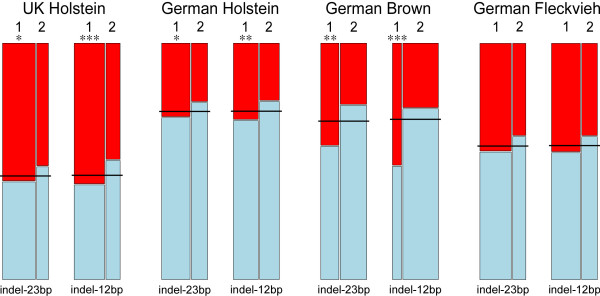
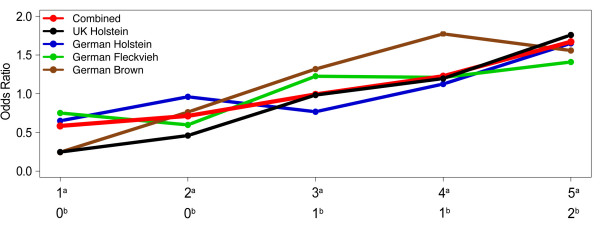
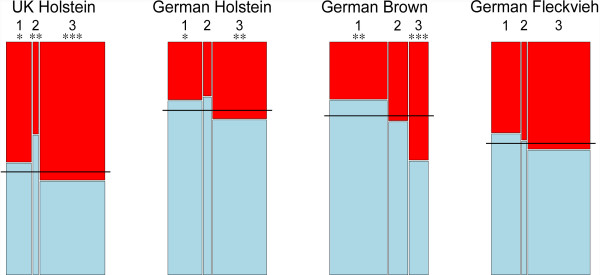
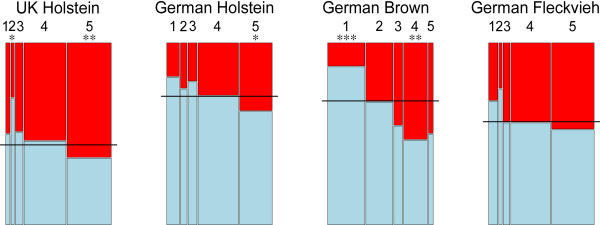
In the present report, we show that two previously reported 23- and 12-bp insertion/deletion (indel) polymorphisms in the regulatory region of bovine PRNP are strongly associated with BSE incidence in cattle. Genotyping of BSE-affected and control animals of UK Holstein, German Holstein, German Brown and German Fleckvieh breeds revealed a significant overrepresentation of the deletion alleles at both polymorphic sites in diseased animals (P = 2.01 x 10(-3) and P = 8.66 x 10(-5), respectively). The main effect on susceptibility is associated with the 12-bp indel polymorphism. Compared with non-carriers, heterozygous and homozygous carriers of the 12-bp deletion allele possess relatively higher risks of having BSE, ranging from 1.32 to 4.01 and 1.74 to 3.65 in the different breeds. These values correspond to population attributable risks ranging from 35% to 53%.
Our results demonstrate a substantial genetic PRNP associated component for BSE susceptibility in cattle. Although the BSE risk conferred by the deletion allele of the 12-bp indel in the regulatory region of PRNP is substantial, the main risk factor for BSE in cattle is environmental, i.e. exposure to feedstuffs contaminated with the infectious agent.
朊病毒蛋白基因(PRNP)的编码变异已被证明是人类、小鼠和绵羊对传播性朊病毒疾病易感性的主要决定因素。然而,迄今为止,牛PRNP编码区和调控区的多态性对牛海绵状脑病(BSE)易感性的影响被认为是微不足道或不存在的。在此,我们分析了来自英国和德国的四个独立牛群中患BSE的动物和对照动物的牛PRNP调控区的两个插入/缺失(indel)多态性。
在本报告中,我们表明,先前报道的牛PRNP调控区的两个23 bp和12 bp插入/缺失(indel)多态性与牛的BSE发病率密切相关。对英国荷斯坦牛、德国荷斯坦牛、德国褐牛和德国弗莱维赫牛品种的BSE患病动物和对照动物进行基因分型,结果显示,在两个多态位点,患病动物中缺失等位基因的比例均显著过高(P值分别为2.01×10⁻³和8.66×10⁻⁵)。对易感性的主要影响与12 bp indel多态性有关。与非携带者相比,12 bp缺失等位基因的杂合子和纯合子携带者患BSE的风险相对较高,在不同品种中,风险范围为1.32至4.01以及1.74至3.65。这些值对应的人群归因风险范围为35%至53%。
我们的结果表明,牛对BSE的易感性存在一个与PRNP相关的重要遗传成分。尽管PRNP调控区12 bp indel的缺失等位基因赋予的BSE风险很大,但牛患BSE的主要风险因素是环境因素,即接触被感染因子污染的饲料。