Weschler Charles J
Environmental and Occupational Health Sciences Institute, University of Medicine and Dentistry of New Jersey-Robert Wood Johnson Medical School and Rutgers University, Piscataway, New Jersey 08854, USA.
Environ Health Perspect. 2006 Oct;114(10):1489-96. doi: 10.1289/ehp.9256.
The associations between ozone concentrations measured outdoors and both morbidity and mortality may be partially due to indoor exposures to ozone and ozone-initiated oxidation products. In this article I examine the contributions of such indoor exposures to overall ozone-related health effects by extensive review of the literature as well as further analyses of published data.
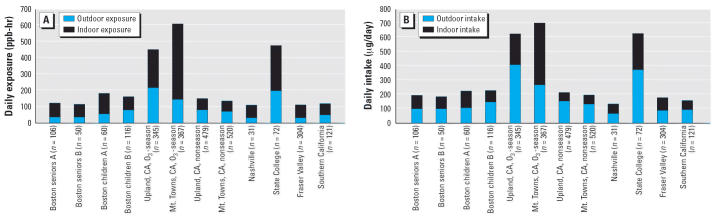
Daily inhalation intakes of indoor ozone (micrograms per day) are estimated to be between 25 and 60% of total daily ozone intake. This is especially noteworthy in light of recent work indicating little, if any, threshold for ozone's impact on mortality. Additionally, the present study estimates that average daily indoor intakes of ozone oxidation products are roughly one-third to twice the indoor inhalation intake of ozone alone. Some of these oxidation products are known or suspected to adversely affect human health (e.g., formaldehyde, acrolein, hydroperoxides, fine and ultrafine particles). Indirect evidence supports connections between morbidity/mortality and exposures to indoor ozone and its oxidation products. For example, cities with stronger associations between outdoor ozone and mortality tend to have residences that are older and less likely to have central air conditioning, which implies greater transport of ozone from outdoors to indoors.
Indoor exposures to ozone and its oxidation products can be reduced by filtering ozone from ventilation air and limiting the indoor use of products and materials whose emissions react with ozone. Such steps might be especially valuable in schools, hospitals, and childcare centers in regions that routinely experience elevated outdoor ozone concentrations.
室外测量的臭氧浓度与发病率和死亡率之间的关联,可能部分归因于室内接触臭氧及其引发的氧化产物。在本文中,我通过广泛查阅文献以及对已发表数据的进一步分析,研究了此类室内接触对与臭氧相关的总体健康影响的贡献。
估计室内臭氧的每日吸入量(微克/天)占每日臭氧总摄入量的25%至60%。鉴于最近的研究表明臭氧对死亡率的影响几乎没有阈值(如果有阈值的话),这一点尤其值得注意。此外,本研究估计,臭氧氧化产物的平均每日室内摄入量大约是仅臭氧室内吸入量的三分之一到两倍。其中一些氧化产物已知或疑似会对人体健康产生不利影响(例如甲醛、丙烯醛、氢过氧化物、细颗粒物和超细颗粒物)。间接证据支持发病率/死亡率与室内臭氧及其氧化产物接触之间的联系。例如,室外臭氧与死亡率之间关联较强的城市,往往住宅较旧,且不太可能配备中央空调,这意味着从室外向室内传输的臭氧更多。
通过过滤通风空气中的臭氧以及限制室内使用其排放物与臭氧发生反应的产品和材料,可以减少室内对臭氧及其氧化产物的接触。在经常出现室外臭氧浓度升高的地区,这些措施在学校、医院和儿童保育中心可能特别有价值。