Meyer Kristy J, Reif John S, Veeramachaneni D N Rao, Luben Thomas J, Mosley Bridget S, Nuckols John R
Department of Environmental and Radiological Health Sciences, Colorado State University, Fort Collins, Colorado 80523-1681, USA.
Environ Health Perspect. 2006 Oct;114(10):1589-95. doi: 10.1289/ehp.9146.
We assessed the relationship between hypospadias and proximity to agricultural pesticide applications using a GIS-based exposure method.
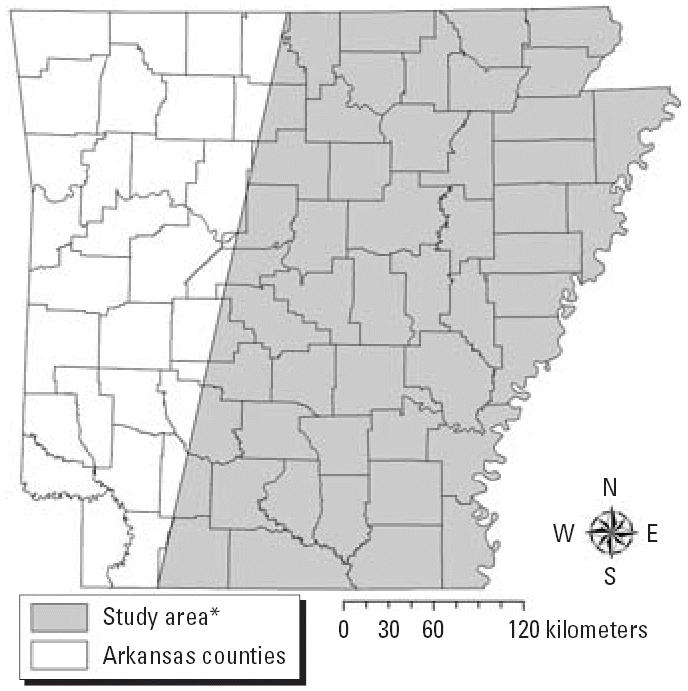
We obtained information for 354 cases of hypospadias born between 1998 and 2002 in eastern Arkansas; 727 controls were selected from birth certificates. We classified exposure on pounds of pesticides (estimated by crop type) applied or persisting within 500 m of each subject's home during gestational weeks 6 to 16. We restricted our analyses to 38 pesticides with some evidence of reproductive, developmental, estrogenic, and/or antiandrogenic effects. We estimated timing of pesticide applications using crop phenology and published records.
Gestational age at birth [odds ratio (OR) = 0.91; 95% confidence interval (CI), 0.83-0.99], parity (OR = 0.79; 95% CI, 0.65-0.95), and delaying prenatal care until the third trimester (OR = 4.04; 95% CI, 1.46-11.23) were significantly associated with hypospadias. Risk of hypospadias increased by 8% for every 0.05-pound increase in estimated exposure to diclofop-methyl use (OR = 1.08; 95% CI, 1.01-1.15). Pesticide applications in aggregate (OR = 0.82; 95% CI, 0.70-0.96) and applications of alachlor (OR = 0.56; 95% CI, 0.35-0.89) and permethrin (OR = 0.37; 95% CI, 0.16-0.86) were negatively associated with hypospadias.
Except for diclofop-methyl, we did not find evidence that estimated exposure to pesticides known to have reproductive, developmental, or endocrine-disrupting effects increases risk of hypospadias. Further research on the potential effects of exposure to diclofop-methyl is recommended.
我们使用基于地理信息系统(GIS)的暴露方法评估了尿道下裂与农业农药施用距离之间的关系。
我们获取了1998年至2002年在阿肯色州东部出生的354例尿道下裂病例的信息;从出生证明中选取了727名对照。我们根据妊娠第6至16周期间在每个研究对象家500米范围内施用或残留的农药磅数(按作物类型估算)对暴露情况进行分类。我们将分析限制在38种有生殖、发育、雌激素和/或抗雄激素作用证据的农药。我们利用作物物候学和已发表记录估算农药施用时间。
出生时的孕周[比值比(OR)=0.91;95%置信区间(CI),0.83 - 0.99]、产次(OR = 0.79;95% CI,0.65 - 0.95)以及将产前检查推迟到孕晚期(OR = 4.04;95% CI,1.46 - 11.23)与尿道下裂显著相关。每增加0.05磅的精稳杀得使用估计暴露量,尿道下裂风险增加8%(OR = 1.08;95% CI,1.01 - 1.15)。农药施用总量(OR = 0.82;95% CI,0.70 - 0.96)以及甲草胺(OR = 0.56;95% CI,0.35 - 0.89)和氯菊酯(OR = 0.37;95% CI,0.16 - 0.86)的施用与尿道下裂呈负相关。
除精稳杀得外,我们未发现有证据表明已知具有生殖、发育或内分泌干扰作用的农药估计暴露量会增加尿道下裂风险。建议对精稳杀得暴露的潜在影响进行进一步研究。