van den Berg Michael J, Cardol Mieke, Bongers Frans J M, de Bakker Dinny H
NIVEL, Netherlands Institute for Health Services Research, Utrecht, The Netherlands.
BMC Fam Pract. 2006 Oct 17;7:58. doi: 10.1186/1471-2296-7-58.
In most European countries and North America the number of home visits carried out by GPs has been decreasing sharply. This has been influenced by non-medical factors such as mobility and pressures on time. The objective of this study was to investigate changes in home visiting rates, looking at the level of diagnoses in 1987 and in 2001.
We analysed routinely collected data on diagnoses in home visits and surgery consultations from electronic medical records by general practitioners. Data were used from 246,738 contacts among 124,791 patients in 103 practices in 1987, and 77,167 contacts among 58,345 patients in 80 practices in 2001. There were 246 diagnoses used. The main outcome measure was the proportion of home visits per diagnosis in 2001.
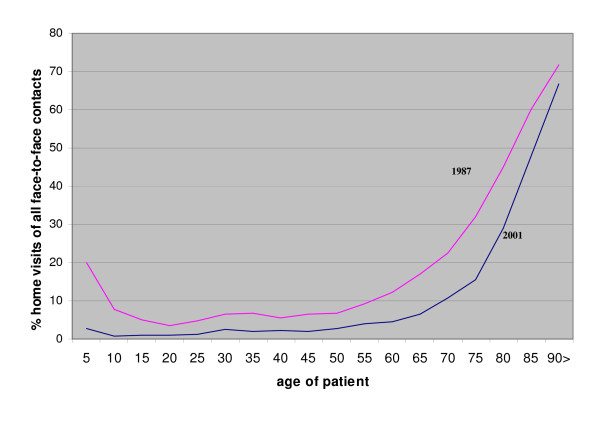
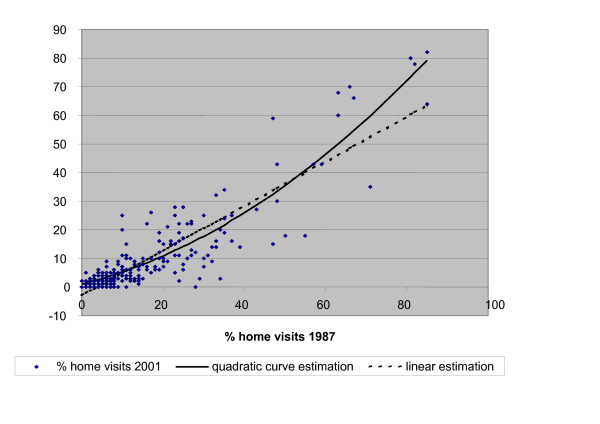
Within the period studied, the proportion of home visits decreased strongly. The size of this decrease varied across diagnoses. The relation between the proportion of home visits for a diagnosis in 1987 and the same proportion in 2001 is curvilinear (J-shaped), indicating that the decrease is weaker at the extreme points and stronger in the middle.
By comparison with 1987, the proportion of home visits shows a distinct decline. However, the results show that this decline is not necessarily a problem. The finding that this decline varied mainly between diagnoses for which home visits are not always urgent, shows that medical considerations still play an important role in the decision about whether or not to carry out a home visit.
在大多数欧洲国家和北美,全科医生进行的家访次数一直在急剧下降。这受到了诸如流动性和时间压力等非医学因素的影响。本研究的目的是调查家访率的变化,观察1987年和2001年的诊断水平。
我们分析了全科医生从电子病历中常规收集的家访和门诊会诊诊断数据。使用了1987年103家诊所中124,791名患者的246,738次接触数据,以及2001年80家诊所中58,345名患者的77,167次接触数据。共使用了246种诊断。主要观察指标是2001年每种诊断的家访比例。
在所研究的时间段内,家访比例大幅下降。这种下降幅度因诊断而异。1987年某诊断的家访比例与2001年同一比例之间的关系呈曲线(J形),表明在极端点下降较弱,在中间下降较强。
与1987年相比,家访比例明显下降。然而,结果表明这种下降不一定是个问题。家访下降主要在那些家访并非总是紧急的诊断之间有所不同,这一发现表明医学考量在决定是否进行家访时仍起着重要作用。