Schneider Armin, Wysocki Rainer, Pitzer Claudia, Krüger Carola, Laage Rico, Schwab Stefan, Bach Alfred, Schäbitz Wolf-Rüdiger
Axaron Bioscience AG, Im Neuenheimer Feld 515, 69120 Heidelberg, Germany.
BMC Biol. 2006 Oct 18;4:36. doi: 10.1186/1741-7007-4-36.
Granulocyte-colony stimulating factor (G-CSF) is known as a powerful regulator of white blood cell proliferation and differentiation in mammals. We, and others, have shown that G-CSF is effective in treating cerebral ischemia in rodents, both relating to infarct size as well as functional recovery. G-CSF and its receptor are expressed by neurons, and G-CSF regulates apoptosis and neurogenesis, providing a rational basis for its beneficial short- and long-term actions in ischemia. In addition, G-CSF may contribute to re-endothelialisation and arteriogenesis in the vasculature of the ischemic penumbra. In addition to these trophic effects, G-CSF is a potent neuroprotective factor reliably reducing infarct size in different stroke models.
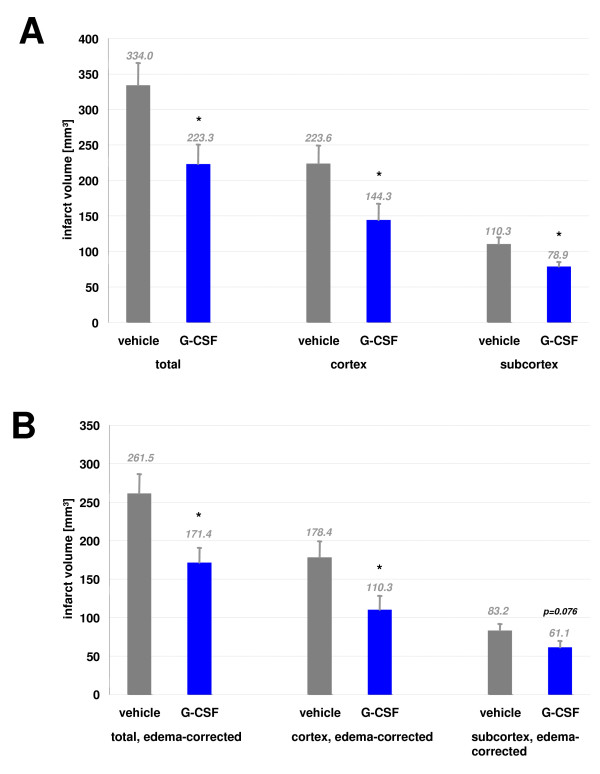
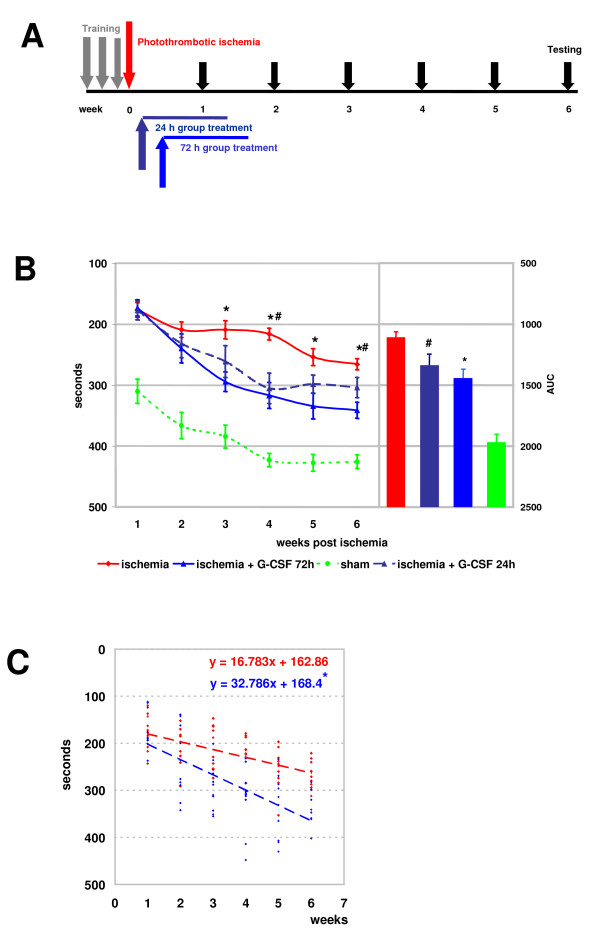
Here, we have further delayed treatment and studied effects of G-CSF on infarct volume in the middle cerebral artery occlusion (MCAO) model and functional outcome in the cortical photothrombotic model. In the MCAO model, we applied a single dose of 60 microg/kg bodyweight G-CSF in rats 4 h after onset of ischemia. Infarct volume was determined 24 h after onset of ischemia. In the rat photothrombotic model, we applied 10 microg/kg bodyweight G-CSF daily for a period of 10 days starting either 24 or 72 h after induction of ischemia. G-CSF both decreased acute infarct volume in the MCAO model, and improved recovery in the photothrombotic model at delayed timepoints.
These data further strengthen G-CSF's profile as a unique candidate stroke drug, and provide an experimental basis for application of G-CSF in the post-stroke recovery phase.
粒细胞集落刺激因子(G-CSF)是哺乳动物中白细胞增殖和分化的强大调节剂。我们和其他人已经表明,G-CSF在治疗啮齿动物脑缺血方面是有效的,这与梗死面积以及功能恢复都有关系。G-CSF及其受体由神经元表达,并且G-CSF调节细胞凋亡和神经发生,为其在缺血中的短期和长期有益作用提供了合理依据。此外,G-CSF可能有助于缺血半暗带血管系统中的再内皮化和动脉生成。除了这些营养作用外,G-CSF是一种有效的神经保护因子,能在不同的中风模型中可靠地减少梗死面积。
在这里,我们进一步延迟了治疗,并研究了G-CSF对大脑中动脉闭塞(MCAO)模型中梗死体积的影响以及对皮质光血栓形成模型中功能结局的影响。在MCAO模型中,我们在缺血发作后4小时给大鼠单次注射60微克/千克体重的G-CSF。在缺血发作后24小时测定梗死体积。在大鼠光血栓形成模型中,我们从缺血诱导后24小时或72小时开始,每天应用10微克/千克体重的G-CSF,持续10天。G-CSF既减少了MCAO模型中的急性梗死体积,又在延迟时间点改善了光血栓形成模型中的恢复情况。
这些数据进一步强化了G-CSF作为一种独特的候选中风药物的形象,并为G-CSF在中风后恢复阶段的应用提供了实验依据。