Chen I-Hsiung Brandon, Huber Michael, Guan Tinglu, Bubeck Anja, Gerace Larry
Department of Cell Biology, The Scripps Research Institute, La Jolla CA 92037, USA.
BMC Cell Biol. 2006 Oct 24;7:38. doi: 10.1186/1471-2121-7-38.
The nuclear lamina is a protein meshwork lining the inner nuclear membrane, which contains a polymer of nuclear lamins associated with transmembrane proteins of the inner nuclear membrane. The lamina is involved in nuclear structure, gene expression, and association of the cytoplasmic cytoskeleton with the nucleus. We previously identified a group of 67 novel putative nuclear envelope transmembrane proteins (NETs) in a large-scale proteomics analysis. Because mutations in lamina proteins have been linked to several human diseases affecting skeletal muscle, we examined NET expression during differentiation of C2C12 myoblasts. Our goal was to identify new nuclear envelope and lamina components whose expression is coordinated with muscle differentiation.
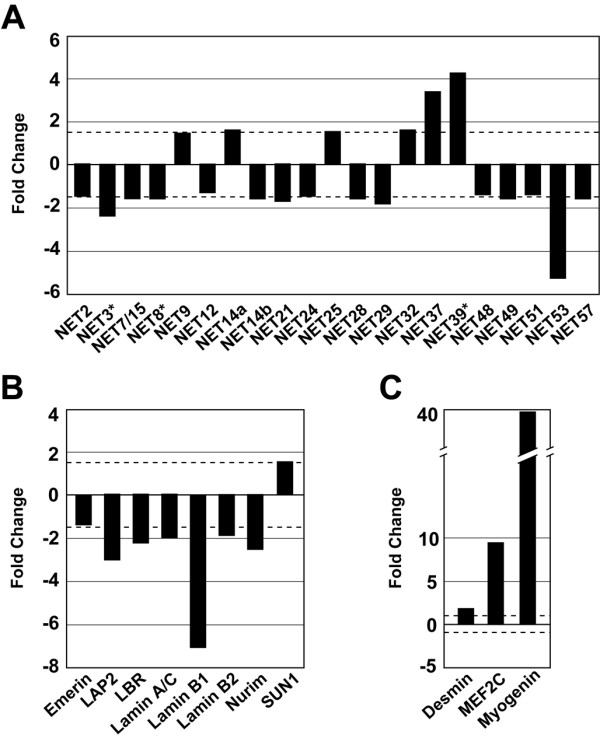
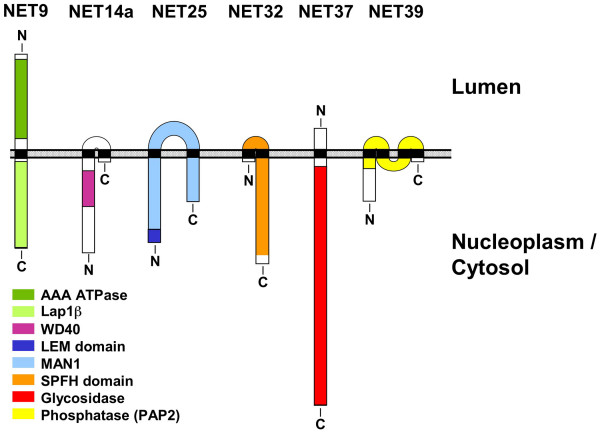
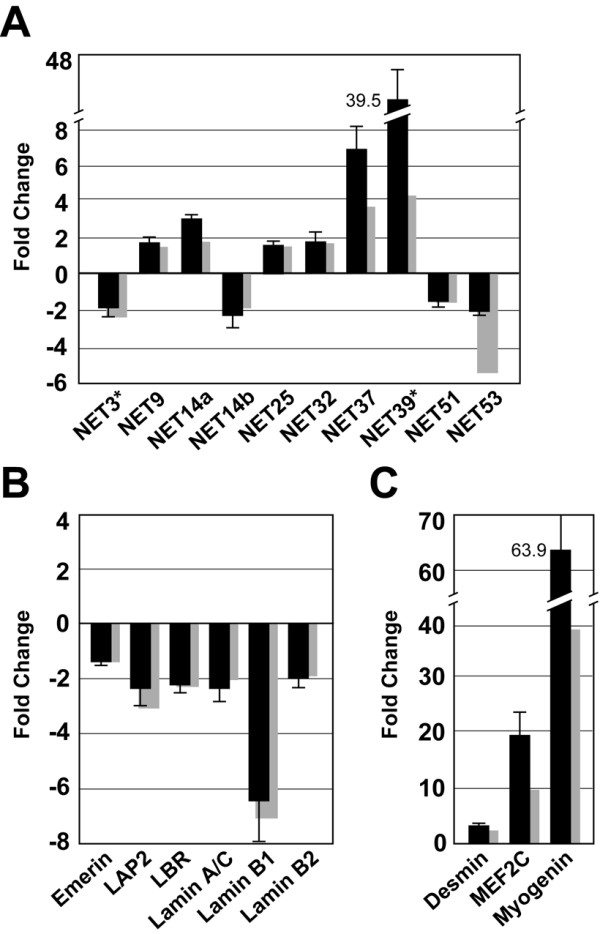
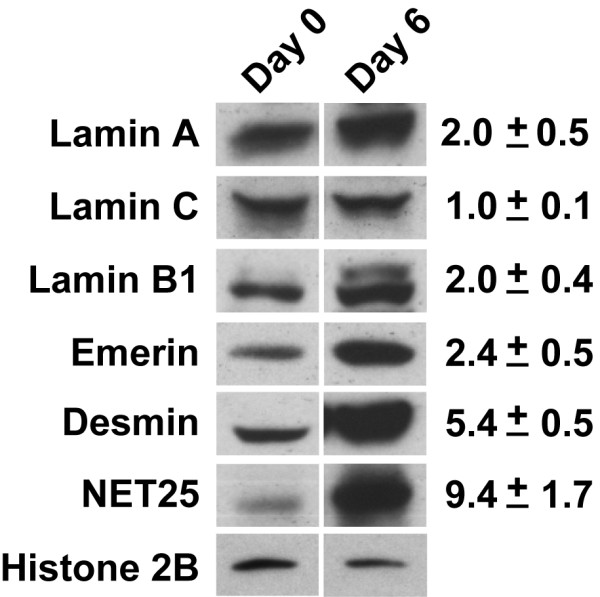
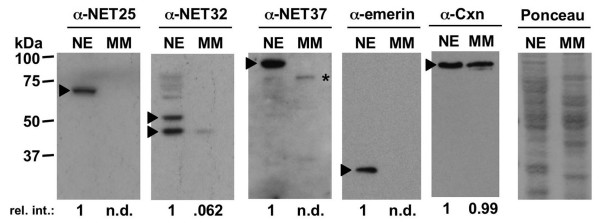
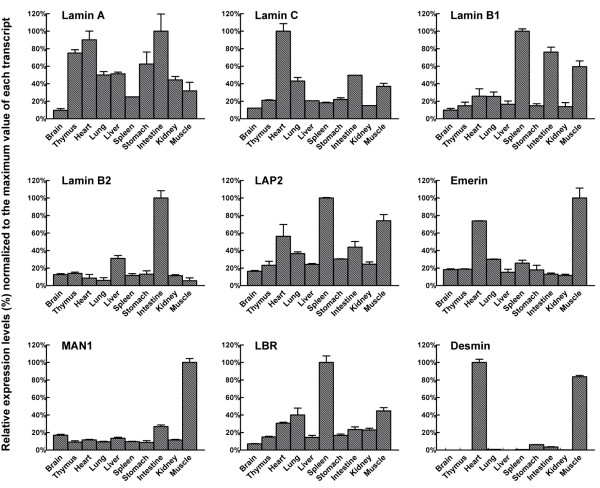
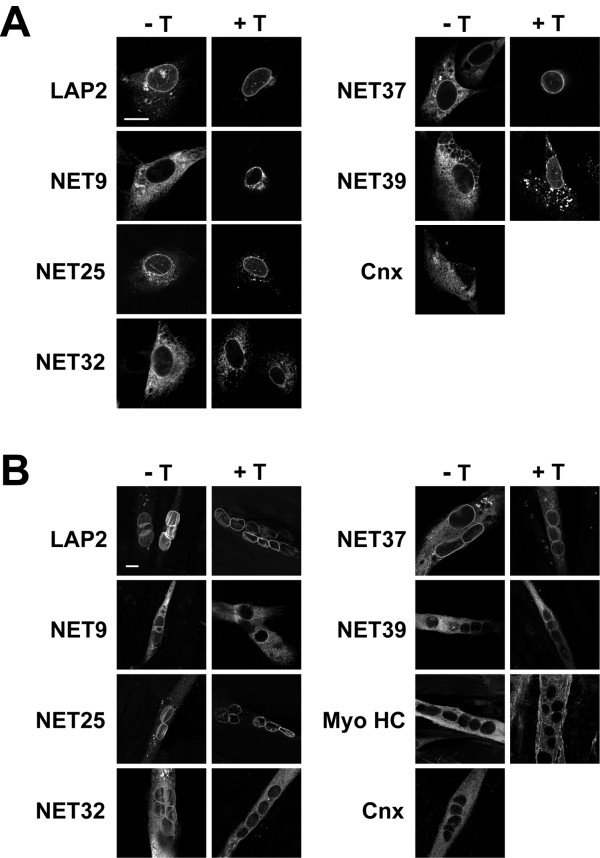
Using transcriptional microarray analysis, we found that expression of 6 of the NETs significantly increases during myoblast differentiation. We confirmed these results using quantitative RT-PCR, and furthermore, found that all 6 NETs are expressed at high levels in adult mouse skeletal muscle relative to 9 other tissues examined. Using epitope-tagged cDNAs, we determined that the 5 NETs we could analyze (NETs 9, 25, 32, 37 and 39) all target to the nuclear envelope in C2C12 cells. Furthermore, the 3 NETs that we could analyze by immunoblotting were highly enriched in nuclear envelopes relative to microsomal membranes purified from mouse liver. Database searches showed that 4 of the 6 up-regulated NETs contain regions of homology to proteins previously linked to signaling.
This work identified 6 NETs that are predicted to have important functions in muscle development and/or maintenance from their expression patterns during myoblast differentiation and in mouse tissues. We confirmed that 5 of these NETs are authentic nuclear envelope proteins. Four members of this group have potential signaling functions at the NE, based on their sequence homologies.
核纤层是位于内核膜内侧的蛋白质网络,它包含与内核膜跨膜蛋白相关的核纤层蛋白聚合物。核纤层参与核结构、基因表达以及细胞质细胞骨架与细胞核的关联。我们之前在大规模蛋白质组学分析中鉴定出一组67种新型假定的核膜跨膜蛋白(NETs)。由于核纤层蛋白的突变与几种影响骨骼肌的人类疾病有关,我们研究了C2C12成肌细胞分化过程中NET的表达。我们的目标是鉴定其表达与肌肉分化协调的新的核膜和核纤层成分。
通过转录微阵列分析,我们发现6种NET在成肌细胞分化过程中表达显著增加。我们使用定量RT-PCR证实了这些结果,此外,发现相对于其他9种检测的组织,所有6种NET在成年小鼠骨骼肌中均高水平表达。使用表位标记的cDNA,我们确定我们能够分析的5种NET(NETs 9、25、32、37和39)在C2C12细胞中均靶向核膜。此外,相对于从小鼠肝脏纯化的微粒体膜,我们能够通过免疫印迹分析的3种NET在核膜中高度富集。数据库搜索显示,6种上调的NET中有4种含有与先前与信号传导相关的蛋白质的同源区域。
这项工作从成肌细胞分化过程中和小鼠组织中的表达模式鉴定出6种预计在肌肉发育和/或维持中具有重要功能的NET。我们证实其中5种NET是真正的核膜蛋白。基于它们的序列同源性,该组中的4个成员在核膜处具有潜在的信号传导功能。