Pineda Sonia, Bago Juan, Gilperez Carmen, Climent Jose M
Department of Physical Medicine and Rehabilitation, Hospital Vall d'Hebron, Barcelona, Spain.
Scoliosis. 2006 Nov 8;1:18. doi: 10.1186/1748-7161-1-18.
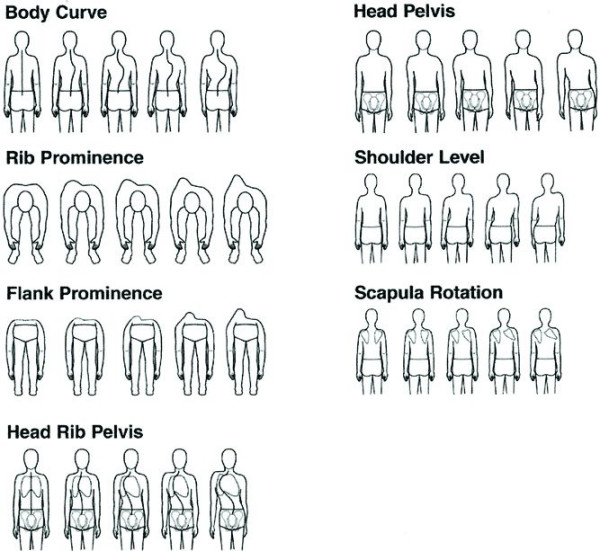
The Walter Reed Visual Assessment Scale (WRVAS) was designed to allow idiopathic scoliosis patients to describe their perception of their deformity. In a previous stduy, the scale has shown good correlation with magnitude of the curve
The study included 70 patients (60 women and 10 men), mean age 19.4 years (range 12-40), with idiopathic scoliosis. Each patient filled out the WRVAS and the SRS-22 questionnaire. Thoracic and lumbar curve angles were determined in standing X-rays and the largest was named Cobbmax. WRVAS internal consistency was assessed with Cronbach's alpha. Correlation coefficients were calculated between Cobbmax and the various WRVAS questions, and Cobbmax and the SRS-22 scales. The correlation between the WRVAS and SRS-22 was also determined
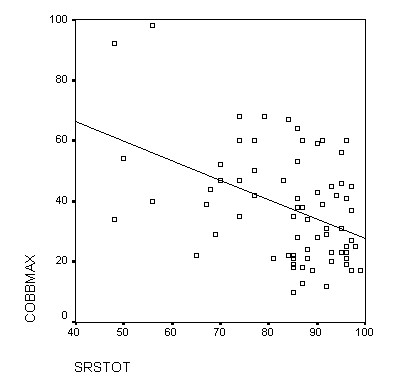
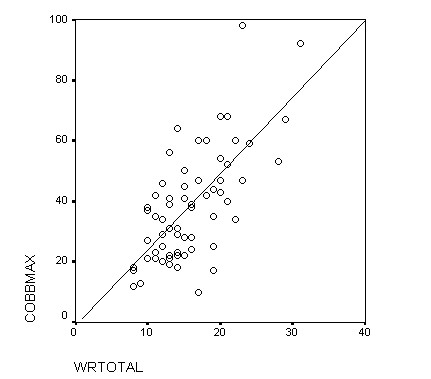
Mean magnitudes were thoracic curve, 36.6 degrees and lumbar curve, 33.2 degrees; average Cobbmax was 37.9 degrees. The mean total WRVAS score was 15.6. Mean scores for the various SRS-22 scales were function 4.6, pain 4.3, self-image 3.7, mental health 4.2, and total score 84.1. Internal consistency for the WRVAS was excellent (Cronbach's alpha, 0.9), and there were no signs of collinearity among the seven questions (tolerance range 0.2-0.5). All the items on the WRVAS correlated significantly with Cobbmax (correlation coefficients, 0.4 to 0.7). The correlation between the total WRVAS and total SRS-22 score was -0.54 (P = .0001) and between WRVAS total score and SRS-22 image domain score was -0.57 (p = 0.0001)
The WRVAS showed excellent internal consistency and absence of collinearity. There was a highly significant correlation between the results of the test and the magnitude of the deformity. The WRVAS correlated significantly with the SRS-22 image scale. The WRVAS is a valid instrument to assess scoliosis patients perception of their deformity.
沃尔特·里德视觉评估量表(WRVAS)旨在让特发性脊柱侧凸患者描述他们对自身畸形的认知。在之前的一项研究中,该量表已显示出与侧弯程度具有良好的相关性。
该研究纳入了70例特发性脊柱侧凸患者(60名女性和10名男性),平均年龄19.4岁(范围12 - 40岁)。每位患者填写了WRVAS和SRS - 22问卷。通过站立位X线片确定胸段和腰段侧弯角度,取其中最大者命名为Cobbmax。采用克朗巴哈系数评估WRVAS的内部一致性。计算Cobbmax与WRVAS各个问题之间、Cobbmax与SRS - 22各量表之间的相关系数。同时也确定了WRVAS与SRS - 22之间的相关性。
胸段侧弯平均度数为36.6度,腰段侧弯平均度数为33.2度;Cobbmax平均为37.9度。WRVAS总平均分为15.6分。SRS - 22各量表的平均分数分别为:功能4.6分、疼痛4.3分、自我形象3.7分、心理健康4.2分,总分84.1分。WRVAS的内部一致性极佳(克朗巴哈系数为0.9),七个问题之间无共线性迹象(容忍度范围为0.2 - 0.5)。WRVAS上的所有项目均与Cobbmax显著相关(相关系数为0.4至0.7)。WRVAS总分与SRS - 22总分之间的相关性为 - 0.54(P = 0.0001),WRVAS总分与SRS - 22形象领域分数之间的相关性为 - 0.57(P = 0.0001)。
WRVAS显示出极佳的内部一致性且无共线性。测试结果与畸形程度之间存在高度显著的相关性。WRVAS与SRS - 22形象量表显著相关。WRVAS是评估脊柱侧凸患者对自身畸形认知的有效工具。