Bago Juan, Sanchez-Raya Judith, Perez-Grueso Francisco Javier Sanchez, Climent Jose Maria
Spine Unit, Department of Orthopaedic Surgery, Hospital Vall d'Hebron, Universitat Autónoma de Barcelona, P degrees Vall d'Hebron, 119, 08035, Barcelona, Spain.
Scoliosis. 2010 Mar 25;5:6. doi: 10.1186/1748-7161-5-6.
Outcome assessment in idiopathic scoliosis should probably include patients' perception of their trunk deformity in addition to self-image. This can be accomplished with the Walter Reed Visual Assessment Scale (WRVAS). Nevertheless, this instrument has some shortcomings: the drawings are abstract and some figures do not relate to the corresponding radiological deformity. These considerations prompted us to design the Trunk Appearance Perception Scale (TAPS).
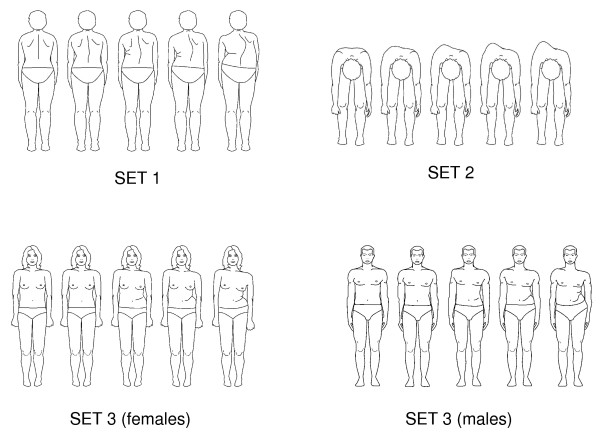
Patients with idiopathic scoliosis and no prior surgical treatment were included. Each patient completed the TAPS and SRS-22 questionnaire and underwent a complete radiographic study of the spine. The magnitude of the upper thoracic, main thoracic, and thoracolumbar/lumbar structural curves were recorded. The TAPS includes 3 sets of figures that depict the trunk from 3 viewpoints: looking toward the back, looking toward the head with the patient bending over and looking toward the front. Drawings are scored from 1 (greatest deformity) to 5 (smallest deformity), and a mean score is obtained.
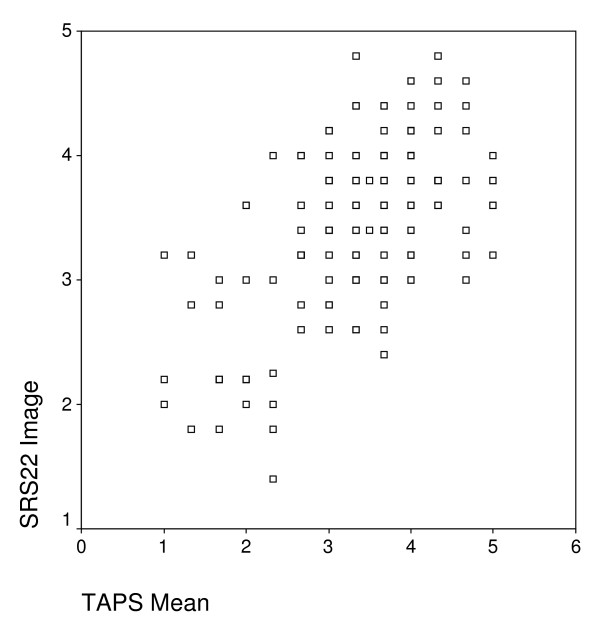
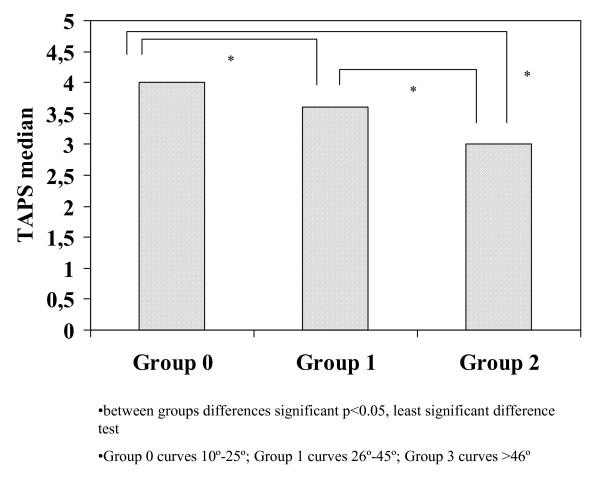
A total of 186 patients (86% females), with a mean age of 17.8 years participated. The mean of the largest curve (CMAX) was 40.2 degrees . The median of TAPS sum score was 3.6. The floor effect was 1.6% and ceiling effect 3.8%. Cronbach's alpha coefficient was 0.89; the ICC for the mean sum score was 0.92. Correlation coefficient of the TAPS mean sum and CMAX was -0.55 (P < 0.01). Correlation coefficients between TAPS mean sum score and SRS-22 scales were all statistically significant, ranging from 0.45 to 0.52 (P < 0.05).
The TAPS is a valid instrument for evaluating the perception patients have of their trunk deformity. It shows excellent distribution of scores, internal consistency, and test-retest reliability, and has good capacity to differentiate the severity of the disease. It is simple and easy to complete and score, the figures are natural, and a new frontal view is included.
特发性脊柱侧凸的疗效评估除自我形象外,可能还应包括患者对其躯干畸形的认知。这可以通过沃尔特·里德视觉评估量表(WRVAS)来实现。然而,该工具存在一些缺点:绘图抽象,一些图形与相应的放射学畸形不相关。这些考虑促使我们设计了躯干外观感知量表(TAPS)。
纳入未经手术治疗的特发性脊柱侧凸患者。每位患者完成TAPS和SRS - 22问卷,并接受脊柱的完整影像学检查。记录上胸椎、主胸椎和胸腰段/腰椎结构曲线的大小。TAPS包括3组图形,从3个视角描绘躯干:从背部看、患者弯腰时从头部方向看以及从正面看。绘图评分从1分(最严重畸形)到5分(最小畸形),并得出平均分。
共有186例患者(8%为女性)参与,平均年龄17.8岁。最大曲线(CMAX)的平均值为40.2度。TAPS总分中位数为3.6。地板效应为1.6%,天花板效应为3.8%。克朗巴哈α系数为0.89;平均分总和的组内相关系数为0.92。TAPS平均总分与CMAX的相关系数为 - 0.55(P < 0.01)。TAPS平均总分与SRS - 22量表之间的相关系数均具有统计学意义,范围为0.45至0.52(P < 0.05)。
TAPS是评估患者对其躯干畸形认知的有效工具。它具有出色的分数分布、内部一致性和重测信度,并且具有良好的区分疾病严重程度的能力。它简单易完成且易评分,图形自然,还包含了新的正面视图。