Kubo Tomohiro, Wada Tadashi, Yamaguchi Yuki, Shimizu Akira, Handa Hiroshi
Division of Systemic Life Science, Graduate School of Biostudies, Kyoto University, Kyoto, Japan.
Nucleic Acids Res. 2006;34(21):6264-71. doi: 10.1093/nar/gkl794. Epub 2006 Nov 10.
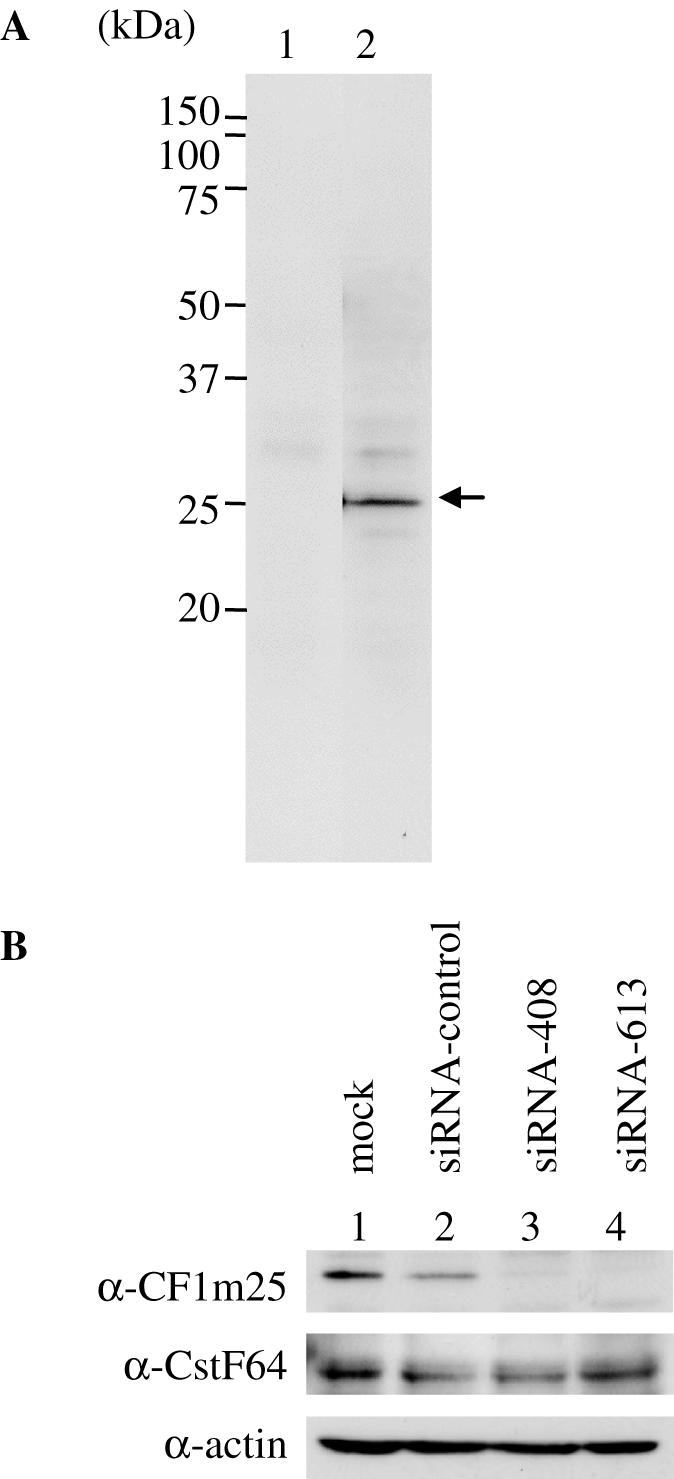
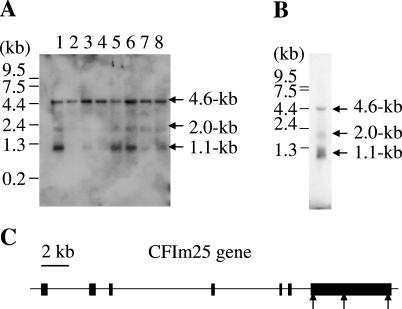
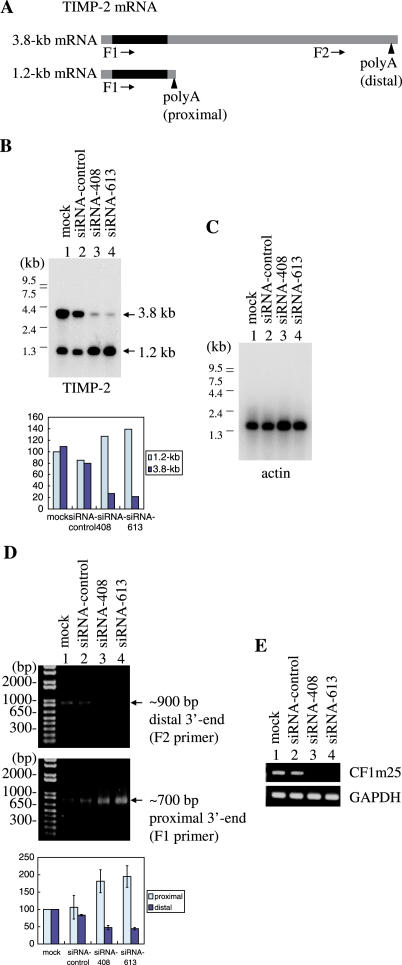
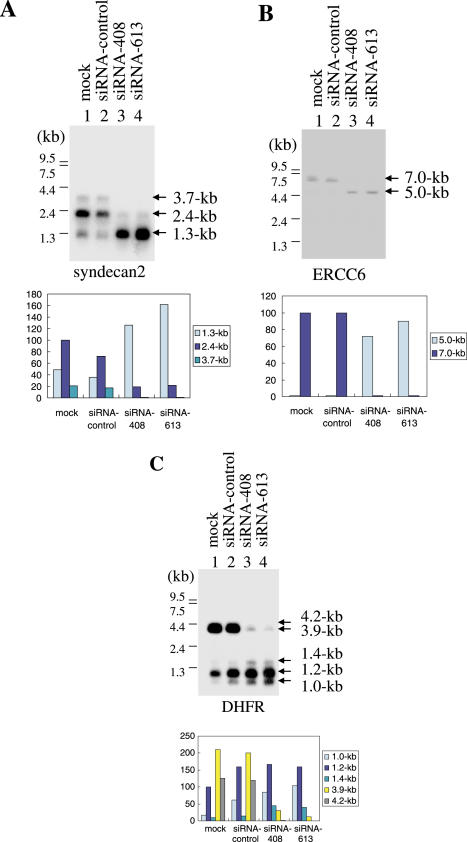
Alternative polyadenylation leads to mRNAs with variable 3' ends. Since a 3'-untranslated region (3'-UTR) often contains cis elements that impact stability or localization of mRNA or translation, selection of poly(A) sites in a 3'-UTR is regulated in mammalian cells. However, the molecular basis for alternative poly(A) site selection within a 3'-UTR has been unclear. Here we show involvement of cleavage factor Im (CFIm) in poly(A) site selection within a 3'-UTR. CFIm is a heterodimeric 3' end-processing complex, which functions to assemble other processing factors on pre-mRNA in vitro. We knocked down 25 kDa subunit of CFIm (CFIm25) in HeLa cells and analyzed alternative poly(A) site selection of TIMP-2, syndecan2, ERCC6 and DHFR genes by northern blotting. We observed changes in the distribution of mRNAs in CFIm25 depleted cells, suggesting a role for CFIm in alternative poly(A) site selection. Furthermore, tissue specific analysis demonstrated that the CFIm25 gene gave rise to 1.1, 2.0 and 4.6 kb mRNAs. The 4.6 kb mRNA was ubiquitously expressed, while the 1.1 and 2.0 kb mRNAs were expressed in a tissue specific manner. We found three likely poly(A) sites in the CFIm25 3'-UTR, suggesting alternative polyadenylation. Our results indicate that alternative poly(A) site selection is a well-regulated process in vivo.
可变聚腺苷酸化导致具有可变3'末端的mRNA。由于3'非翻译区(3'-UTR)通常包含影响mRNA稳定性、定位或翻译的顺式元件,因此哺乳动物细胞中3'-UTR内聚腺苷酸化位点的选择受到调控。然而,3'-UTR内可变聚腺苷酸化位点选择的分子基础尚不清楚。在此,我们展示了切割因子Im(CFIm)参与3'-UTR内的聚腺苷酸化位点选择。CFIm是一种异二聚体3'末端加工复合物,其在体外的功能是在mRNA前体上组装其他加工因子。我们在HeLa细胞中敲低了CFIm的25 kDa亚基(CFIm25),并通过Northern印迹分析了TIMP-2、Syndecan2、ERCC6和DHFR基因的可变聚腺苷酸化位点选择。我们观察到CFIm25缺失细胞中mRNA分布的变化,表明CFIm在可变聚腺苷酸化位点选择中发挥作用。此外,组织特异性分析表明,CFIm25基因产生1.1、2.0和4.6 kb的mRNA。4.6 kb的mRNA在所有组织中均有表达,而1.1和2.0 kb的mRNA以组织特异性方式表达。我们在CFIm25的3'-UTR中发现了三个可能的聚腺苷酸化位点,提示存在可变聚腺苷酸化。我们的结果表明,可变聚腺苷酸化位点选择在体内是一个受到良好调控的过程。