Tekaia Fredj, Yeramian Edouard
Unité de Génétique Moléculaire des Levures (URA 2171 CNRS and UFR927 Univ, P,M, Curie), Institut Pasteur, 25, Rue du Dr Roux, 75724 Paris Cedex 15, France.
BMC Genomics. 2006 Dec 5;7:307. doi: 10.1186/1471-2164-7-307.
The evolutionary characterization of species and lifestyles at global levels is nowadays a subject of considerable interest, particularly with the availability of many complete genomes. Are there specific properties associated with lifestyles and phylogenies? What are the underlying evolutionary trends? One of the simplest analyses to address such questions concerns characterization of proteomes at the amino acids composition level.
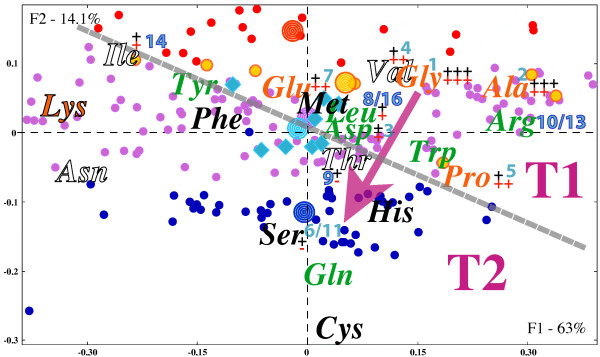
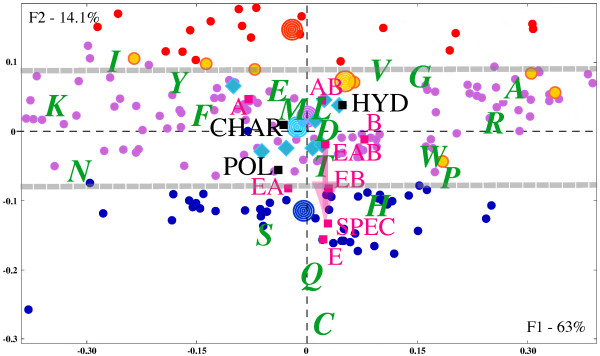
In this work, amino acid compositions of a large set of 208 proteomes, with significant number of representatives from the three phylogenetic domains and different lifestyles are analyzed, resorting to an appropriate multidimensional method: Correspondence analysis. The analysis reveals striking discrimination between eukaryotes, prokaryotic mesophiles and hyperthemophiles-themophiles, following amino acid usage. In sharp contrast, no similar discrimination is observed for psychrophiles. The observed distributional properties are compared with various inferred chronologies for the recruitment of amino acids into the genetic code. Such comparisons reveal correlations between the observed segregations of species following amino acid usage, and the separation of amino acids following early or late recruitment.
A simple description of proteomes according to amino acid compositions reveals striking signatures, with sharp segregations or on the contrary non-discriminations following phylogenies and lifestyles. The distribution of species, following amino acid usage, exhibits a discrimination between [high GC]-[high optimal growth temperatures] and [low GC]-[moderate temperatures] characteristics. This discrimination appears to coincide closely with the separation of amino acids following their inferred early or late recruitment into the genetic code. Taken together the various results provide a consistent picture for the evolution of proteomes, in terms of amino acid usage.
如今,在全球范围内对物种及其生活方式进行进化特征描述是一个备受关注的课题,尤其是随着众多完整基因组的可得性。是否存在与生活方式和系统发育相关的特定属性?潜在的进化趋势是什么?解决此类问题的最简单分析之一涉及在氨基酸组成水平上对蛋白质组进行特征描述。
在这项工作中,我们使用一种合适的多维方法——对应分析,分析了一大组208个蛋白质组的氨基酸组成,这些蛋白质组中有来自三个系统发育域且具有不同生活方式的大量代表性样本。分析揭示了真核生物、原核嗜温菌和嗜热菌(嗜高温菌)在氨基酸使用方面存在显著差异。形成鲜明对比的是,未观察到嗜冷菌有类似的差异。将观察到的分布特性与各种推断的氨基酸纳入遗传密码的时间顺序进行了比较。此类比较揭示了观察到的物种在氨基酸使用方面的分离与氨基酸根据早期或晚期纳入的分离之间的相关性。
根据氨基酸组成对蛋白质组进行的简单描述揭示了显著特征,根据系统发育和生活方式存在明显的分离或相反的无差异情况。物种在氨基酸使用方面的分布表现出[高GC含量]-[高最佳生长温度]和[低GC含量]-[中等温度]特征之间的差异。这种差异似乎与氨基酸根据其推断的早期或晚期纳入遗传密码的分离密切吻合。综合各种结果,就氨基酸使用而言,为蛋白质组的进化提供了一个一致的图景。