Usadel Björn, Nagel Axel, Steinhauser Dirk, Gibon Yves, Bläsing Oliver E, Redestig Henning, Sreenivasulu Nese, Krall Leonard, Hannah Matthew A, Poree Fabien, Fernie Alisdair R, Stitt Mark
Max Planck Institute of Molecular Plant Physiology, Am Mühlenberg 1, 14476 Potsdam, Germany.
BMC Bioinformatics. 2006 Dec 18;7:535. doi: 10.1186/1471-2105-7-535.
Microarray technology has become a widely accepted and standardized tool in biology. The first microarray data analysis programs were developed to support pair-wise comparison. However, as microarray experiments have become more routine, large scale experiments have become more common, which investigate multiple time points or sets of mutants or transgenics. To extract biological information from such high-throughput expression data, it is necessary to develop efficient analytical platforms, which combine manually curated gene ontologies with efficient visualization and navigation tools. Currently, most tools focus on a few limited biological aspects, rather than offering a holistic, integrated analysis.
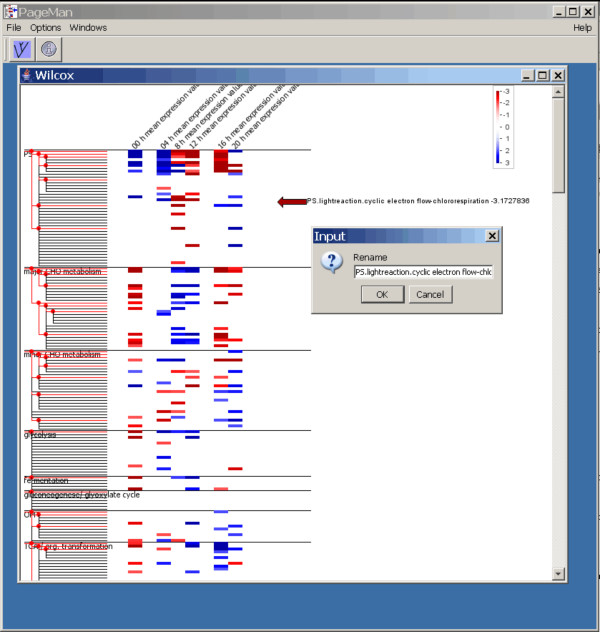
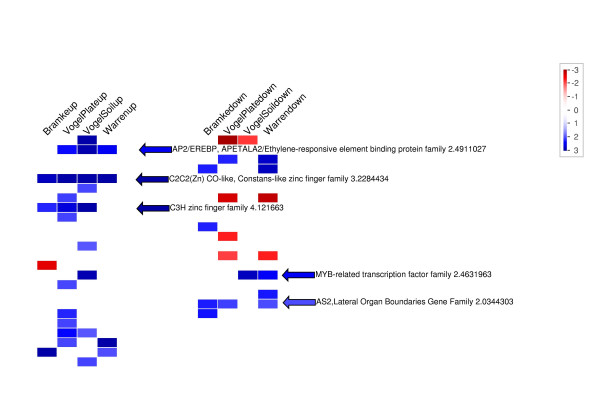
Here we introduce PageMan, a multiplatform, user-friendly, and stand-alone software tool that annotates, investigates, and condenses high-throughput microarray data in the context of functional ontologies. It includes a GUI tool to transform different ontologies into a suitable format, enabling the user to compare and choose between different ontologies. It is equipped with several statistical modules for data analysis, including over-representation analysis and Wilcoxon statistical testing. Results are exported in a graphical format for direct use, or for further editing in graphics programs.PageMan provides a fast overview of single treatments, allows genome-level responses to be compared across several microarray experiments covering, for example, stress responses at multiple time points. This aids in searching for trait-specific changes in pathways using mutants or transgenics, analyzing development time-courses, and comparison between species. In a case study, we analyze the results of publicly available microarrays of multiple cold stress experiments using PageMan, and compare the results to a previously published meta-analysis.PageMan offers a complete user's guide, a web-based over-representation analysis as well as a tutorial, and is freely available at http://mapman.mpimp-golm.mpg.de/pageman/.
PageMan allows multiple microarray experiments to be efficiently condensed into a single page graphical display. The flexible interface allows data to be quickly and easily visualized, facilitating comparisons within experiments and to published experiments, thus enabling researchers to gain a rapid overview of the biological responses in the experiments.
微阵列技术已成为生物学中广泛接受的标准化工具。最初开发的微阵列数据分析程序用于支持成对比较。然而,随着微阵列实验变得更加常规,大规模实验变得更加普遍,这些实验研究多个时间点或多组突变体或转基因。为了从此类高通量表达数据中提取生物学信息,有必要开发高效的分析平台,将人工整理的基因本体与高效的可视化和导航工具相结合。目前,大多数工具只关注少数有限的生物学方面,而不是提供全面、综合的分析。
在此我们介绍PageMan,这是一个多平台、用户友好的独立软件工具,可在功能本体的背景下注释、研究和浓缩高通量微阵列数据。它包括一个GUI工具,用于将不同的本体转换为合适的格式,使用户能够在不同的本体之间进行比较和选择。它配备了几个用于数据分析的统计模块,包括过表达分析和Wilcoxon统计检验。结果以图形格式导出,可直接使用,也可在图形程序中进一步编辑。PageMan提供了对单一处理的快速概述,允许在多个微阵列实验中比较基因组水平的反应,例如,多个时间点的应激反应。这有助于使用突变体或转基因搜索途径中特定性状的变化,分析发育时间进程,以及物种间的比较。在一个案例研究中,我们使用PageMan分析了多个冷应激实验的公开微阵列结果,并将结果与之前发表的荟萃分析进行了比较。PageMan提供了完整的用户指南、基于网络的过表达分析以及教程,可从http://mapman.mpimp-golm.mpg.de/pageman/免费获取。
PageMan允许将多个微阵列实验高效浓缩为单页图形显示。灵活的界面使数据能够快速轻松地可视化,便于在实验内部以及与已发表的实验进行比较,从而使研究人员能够快速了解实验中的生物学反应。