Premzl Marko, Gamulin Vera
Department of Molecular Biology, Rudjer Boskovic Institute, Zagreb, Croatia.
BMC Genomics. 2007 Jan 2;8:1. doi: 10.1186/1471-2164-8-1.
The homologues of human disease genes are expected to contribute to better understanding of physiological and pathogenic processes. We made use of the present availability of vertebrate genomic sequences, and we have conducted the most comprehensive comparative genomic analysis of the prion protein gene PRNP and its homologues, shadow of prion protein gene SPRN and doppel gene PRND, and prion testis-specific gene PRNT so far.
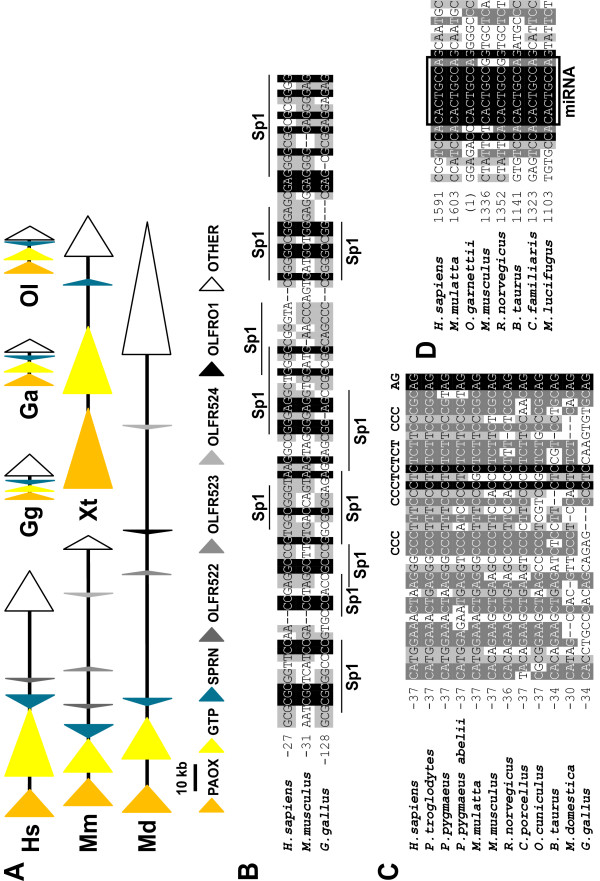
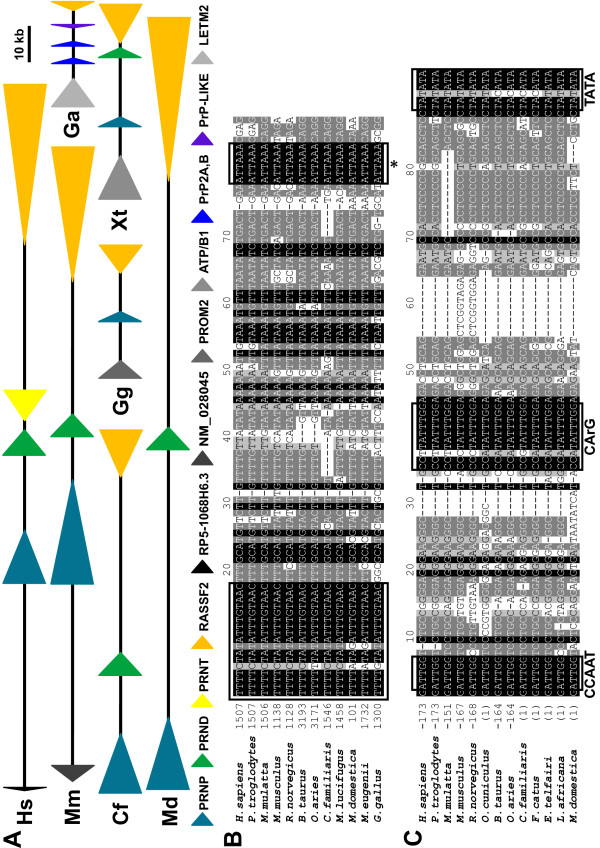
While the SPRN and PRNP homologues are present in all vertebrates, PRND is known in tetrapods, and PRNT is present in primates. PRNT could be viewed as a TE-associated gene. Using human as the base sequence for genomic sequence comparisons (VISTA), we annotated numerous potential cis-elements. The conserved regions in SPRNs harbour the potential Sp1 sites in promoters (mammals, birds), C-rich intron splicing enhancers and PTB intron splicing silencers in introns (mammals, birds), and hsa-miR-34a sites in 3'-UTRs (eutherians). We showed the conserved PRNP upstream regions, which may be potential enhancers or silencers (primates, dog). In the PRNP 3'-UTRs, there are conserved cytoplasmic polyadenylation element sites (mammals, birds). The PRND core promoters include highly conserved CCAAT, CArG and TATA boxes (mammals). We deduced 42 new protein primary structures, and performed the first phylogenetic analysis of all vertebrate prion genes. Using the protein alignment which included 122 sequences, we constructed the neighbour-joining tree which showed four major clusters, including shadoos, shadoo2s and prion protein-likes (cluster 1), fish prion proteins (cluster 2), tetrapode prion proteins (cluster 3) and doppels (cluster 4). We showed that the entire prion protein conformationally plastic region is well conserved between eutherian prion proteins and shadoos (18-25% identity and 28-34% similarity), and there could be a potential structural compatibility between shadoos and the left-handed parallel beta-helical fold.
It is likely that the conserved genomic elements identified in this analysis represent bona fide cis-elements. However, this idea needs to be confirmed by functional assays in transgenic systems.
人类疾病基因的同源物有望有助于更好地理解生理和致病过程。我们利用了目前可用的脊椎动物基因组序列,并且进行了迄今为止朊病毒蛋白基因PRNP及其同源物、朊病毒蛋白基因影子SPRN和多配体基因PRND以及朊病毒睾丸特异性基因PRNT最全面的比较基因组分析。
虽然SPRN和PRNP同源物存在于所有脊椎动物中,但PRND在四足动物中已知,而PRNT存在于灵长类动物中。PRNT可被视为一个与转座元件相关的基因。以人类作为基因组序列比较(VISTA)的基础序列,我们注释了众多潜在的顺式元件。SPRN中的保守区域在启动子中含有潜在的Sp1位点(哺乳动物、鸟类),在内含子中含有富含C的内含子剪接增强子和PTB内含子剪接沉默子(哺乳动物、鸟类),在3'-UTR中含有hsa-miR-34a位点(真兽类)。我们展示了PRNP上游的保守区域,其可能是潜在的增强子或沉默子(灵长类动物、狗)。在PRNP的3'-UTR中,存在保守的细胞质聚腺苷酸化元件位点(哺乳动物、鸟类)。PRND的核心启动子包括高度保守的CCAAT、CArG和TATA框(哺乳动物)。我们推导了42种新的蛋白质一级结构,并对所有脊椎动物的朊病毒基因进行了首次系统发育分析。利用包含122个序列的蛋白质比对,我们构建了邻接树,该树显示出四个主要聚类,包括影子蛋白、影子蛋白2和朊病毒蛋白样(聚类1)、鱼类朊病毒蛋白(聚类2)、四足动物朊病毒蛋白(聚类3)和多配体蛋白(聚类4)。我们表明,在真兽类朊病毒蛋白和影子蛋白之间,整个朊病毒蛋白的构象可塑性区域具有良好的保守性(同一性为18 - 25%,相似性为28 - 34%),并且影子蛋白与左手平行β-螺旋折叠之间可能存在潜在的结构兼容性。
在本分析中鉴定出的保守基因组元件很可能代表真正的顺式元件。然而,这一观点需要通过转基因系统中的功能试验来证实。