Lampo Evelyne, Van Poucke Mario, Hugot Karine, Hayes Hélène, Van Zeveren Alex, Peelman Luc J
Department of Nutrition, Genetics and Ethology, Faculty of Veterinary Medicine, Ghent University, Merelbeke, Belgium.
BMC Genomics. 2007 May 30;8:138. doi: 10.1186/1471-2164-8-138.
TSEs are a group of fatal neurodegenerative diseases occurring in man and animals. They are caused by prions, alternatively folded forms of the endogenous prion protein, encoded by PRNP. Since differences in the sequence of PRNP can not explain all variation in TSE susceptibility, there is growing interest in other genes that might have an influence on this susceptibility. One of these genes is SPRN, a gene coding for a protein showing remarkable similarities with the prion protein. Until now, SPRN has not been described in sheep, a highly relevant species in prion matters.
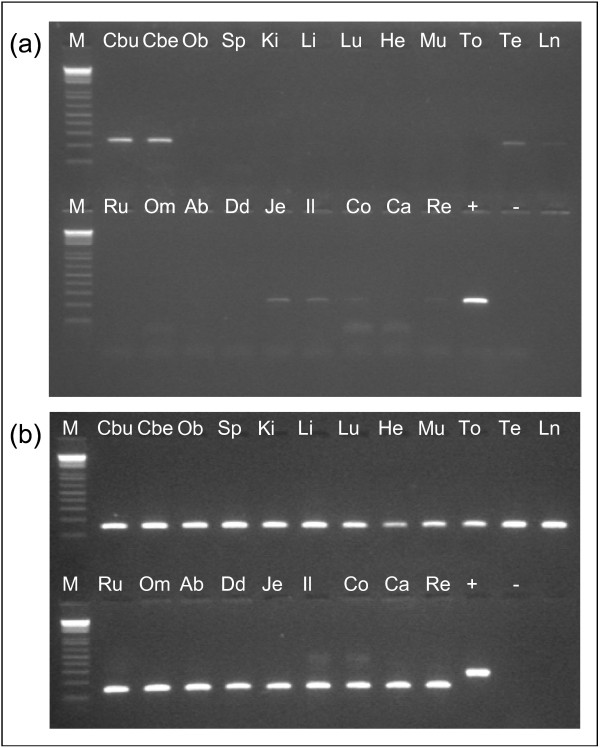
In order to characterize the genomic region containing SPRN in sheep, a BAC mini-contig was built, covering approximately 200,000 bp and containing the genes ECHS1, PAOX, MTG1, SPRN, LOC619207, CYP2E1 and at least partially SYCE1. FISH mapping of the two most exterior BAC clones of the contig positioned this contig on Oari22q24. A fragment of 4,544 bp was also sequenced, covering the entire SPRN gene and 1206 bp of the promoter region. In addition, the transcription profile of SPRN in 21 tissues was determined by RT-PCR, showing high levels in cerebrum and cerebellum, and low levels in testis, lymph node, jejunum, ileum, colon and rectum.
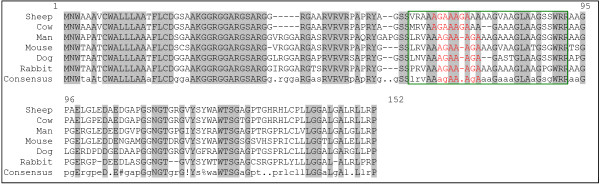
Annotation of a mini-contig including SPRN suggests conserved linkage between Oari22q24 and Hsap10q26. The ovine SPRN sequence, described for the first time, shows a high level of homology with the bovine, and to a lesser extent with the human SPRN sequence. In addition, transcription profiling in sheep reveals main expression of SPRN in brain tissue, as in rat, cow, man and mouse.
传染性海绵状脑病(TSEs)是发生在人和动物身上的一组致命性神经退行性疾病。它们由朊病毒引起,朊病毒是内源性朊蛋白的另一种折叠形式,由PRNP编码。由于PRNP序列的差异无法解释TSE易感性的所有变化,因此人们对其他可能影响这种易感性 的基因越来越感兴趣。其中一个基因是SPRN,该基因编码一种与朊蛋白具有显著相似性的蛋白质。到目前为止,尚未在绵羊(朊病毒研究中一个高度相关的物种)中描述过SPRN。
为了表征绵羊中包含SPRN的基因组区域,构建了一个BAC微克隆连续群,其覆盖约200,000 bp,包含ECHS1、PAOX、MTG1、SPRN、LOC619207、CYP2E1基因以及至少部分的SYCE1基因。对该连续群中两个最外部的BAC克隆进行荧光原位杂交(FISH)定位,将该连续群定位在绵羊22号染色体q24区域。还对一个4544 bp的片段进行了测序,该片段覆盖了整个SPRN基因和1206 bp的启动子区域。此外,通过逆转录聚合酶链反应(RT-PCR)测定了SPRN在21种组织中的转录谱,结果显示在大脑和小脑中表达水平高,而在睾丸、淋巴结、空肠、回肠、结肠和直肠中表达水平低。
对包含SPRN的微克隆连续群的注释表明,绵羊22号染色体q24区域与人类10号染色体q26区域之间存在保守的连锁关系。首次描述的绵羊SPRN序列与牛的SPRN序列具有高度同源性,与人类SPRN序列的同源性较低。此外,绵羊中的转录谱分析表明,与大鼠、牛、人和小鼠一样,SPRN在脑组织中主要表达。