Davis Jennifer A, Gould Thomas J
Department of Psychology, Temple University, Philadelphia, PA 19122, USA.
Neuropsychopharmacology. 2007 Sep;32(9):2011-9. doi: 10.1038/sj.npp.1301315. Epub 2007 Jan 17.
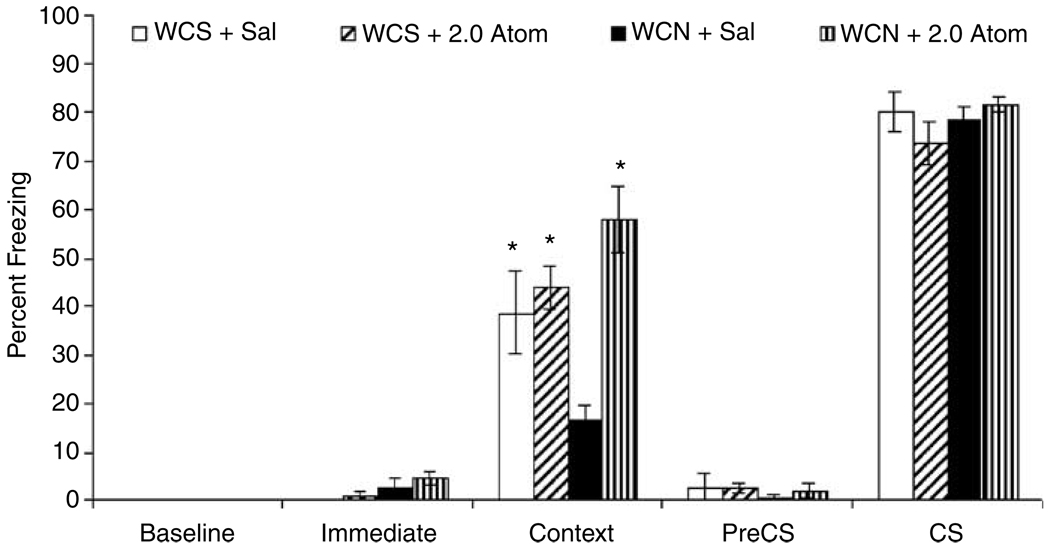
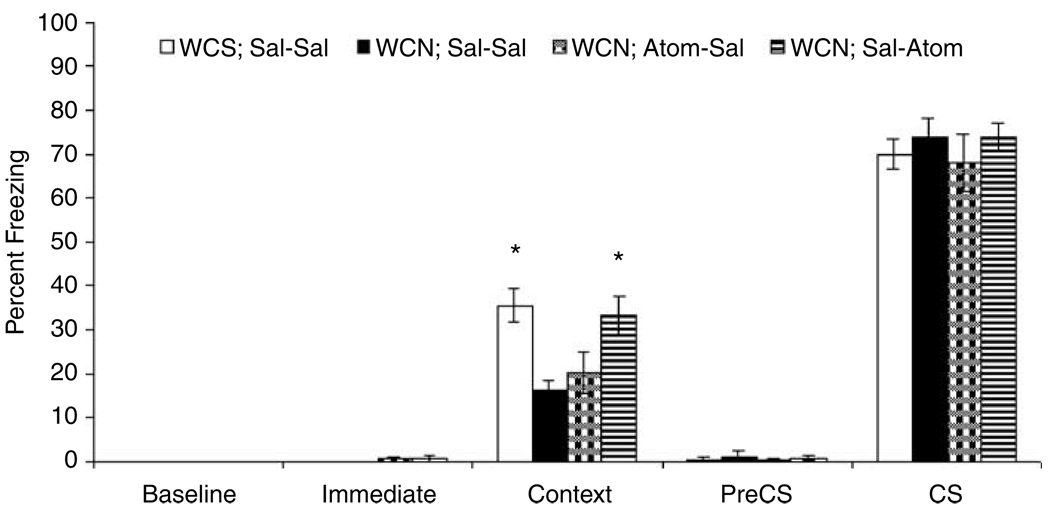
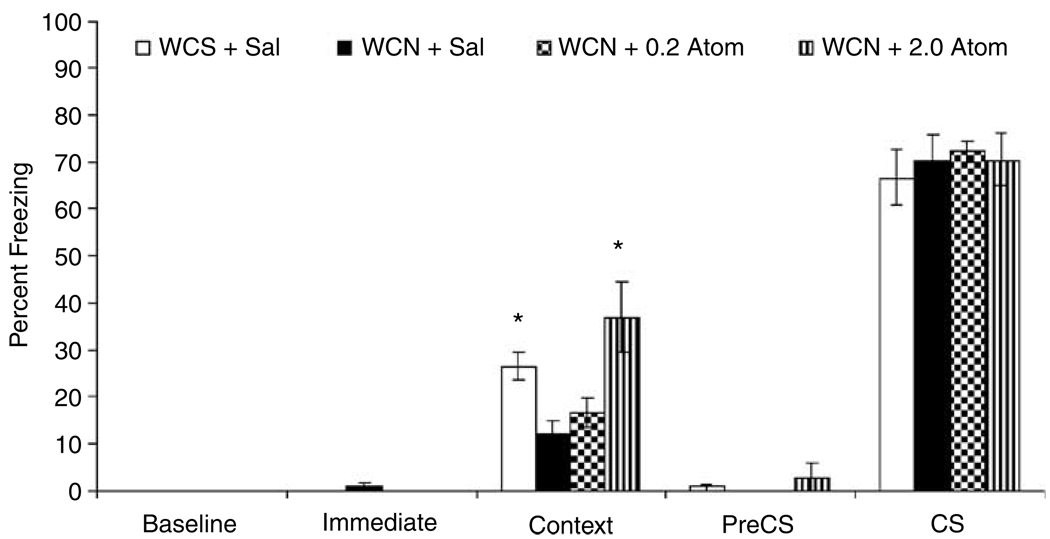
Recent evidence suggests that the cognitive symptoms of nicotine withdrawal and the cognitive symptoms of attention deficit hyperactivity disorder (ADHD) may share neural correlates. Thus, therapeutics that ameliorate ADHD symptoms may also ameliorate nicotine-withdrawal symptoms. The present research tested this hypothesis in an animal model of nicotine withdrawal-associated cognitive deficits using atomoxetine, a norepinephrine reuptake inhibitor that is approved by the FDA to treat the symptoms of ADHD. C57BL/6 mice were prepared with osmotic minipumps that administered 6.3 mg/kg/day of nicotine or saline, and the minipumps were removed after 12 days of continuous treatment. Twenty-four hours later, mice were trained in delay fear conditioning using two paired presentations of an auditory conditioned stimulus (CS) with a footshock unconditioned stimulus. Testing for freezing in response to the training context and for freezing in response to the CS occurred the next day. Nicotine-withdrawn mice and their saline-treated counterparts received either saline or atomoxetine before training and the context test. Consistent with previous research, the results indicate that mice withdrawn from chronic nicotine demonstrated lower levels of contextual fear conditioning than mice that were not withdrawn from chronic nicotine. Atomoxetine dose-dependently reversed the deficit, suggesting that nicotine withdrawal may be associated with changes in noradrenergic function, acetylcholinergic function, and/or with changes in cell signaling cascades that are activated by both nicotine and norepinephrine. These data suggest that atomoxetine may be efficacious for treating nicotine withdrawal-associated cognitive deficits that promote relapse in abstinent smokers.
最近的证据表明,尼古丁戒断的认知症状与注意力缺陷多动障碍(ADHD)的认知症状可能存在神经相关性。因此,改善ADHD症状的疗法也可能改善尼古丁戒断症状。本研究使用托莫西汀(一种经美国食品药品监督管理局批准用于治疗ADHD症状的去甲肾上腺素再摄取抑制剂),在尼古丁戒断相关认知缺陷的动物模型中验证了这一假设。给C57BL/6小鼠植入渗透微型泵,持续12天每天给予6.3mg/kg的尼古丁或生理盐水,12天后取出微型泵。24小时后,使用听觉条件刺激(CS)与足部电击非条件刺激的两次配对呈现对小鼠进行延迟恐惧条件训练。第二天测试小鼠对训练环境的僵立反应以及对CS的僵立反应。尼古丁戒断小鼠及其接受生理盐水处理的对照组在训练和环境测试前接受生理盐水或托莫西汀处理。与先前的研究一致,结果表明,与未进行慢性尼古丁戒断的小鼠相比,进行慢性尼古丁戒断的小鼠表现出较低水平的情境恐惧条件反射。托莫西汀剂量依赖性地逆转了这一缺陷,表明尼古丁戒断可能与去甲肾上腺素能功能、乙酰胆碱能功能的变化和/或与由尼古丁和去甲肾上腺素激活的细胞信号级联反应的变化有关。这些数据表明,托莫西汀可能对治疗促进戒烟者复吸的尼古丁戒断相关认知缺陷有效。