Zlebnik Natalie E, Carroll Marilyn E
Graduate Program in Neuroscience, University of Minnesota Medical School, Jackson Hall, 321 Church St. SE, Minneapolis, MN, 55455, USA,
Psychopharmacology (Berl). 2015 Mar;232(6):1049-59. doi: 10.1007/s00213-014-3744-6. Epub 2014 Sep 26.
Aerobic exercise and the attention-deficit/hyperactivity disorder medication, atomoxetine (ATO), are two monotherapies that have been shown to suppress reinstatement of cocaine-seeking in an animal model of relapse. The present study investigated the effects of combining wheel running and ATO versus each treatment alone on cocaine-seeking precipitated by cocaine and cocaine-paired cues in rats with differing susceptibility to drug abuse (i.e., high vs. low impulsive).
Rats were screened for high (HiI) or low impulsivity (LoI) based on their performance on a delay-discounting task and then trained to self-administer cocaine (0.4 mg/kg/inf) for 10 days. Following 14 days of extinction, both groups were tested for reinstatement of cocaine-seeking precipitated by cocaine or cocaine-paired cues in the presence of concurrent running wheel access (W), pretreatment with ATO, or both (W+ATO).
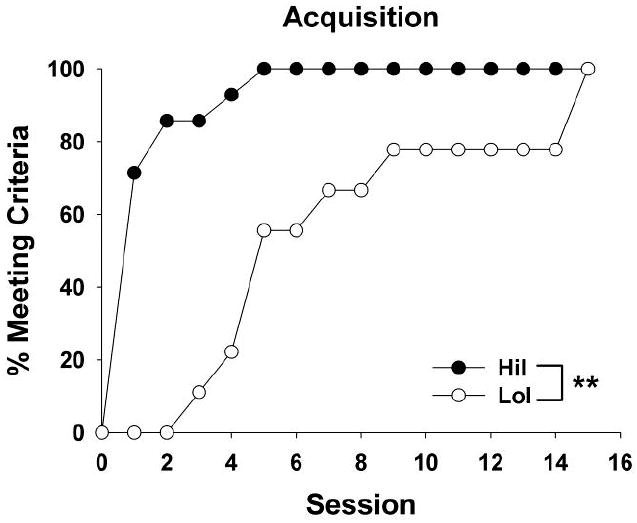
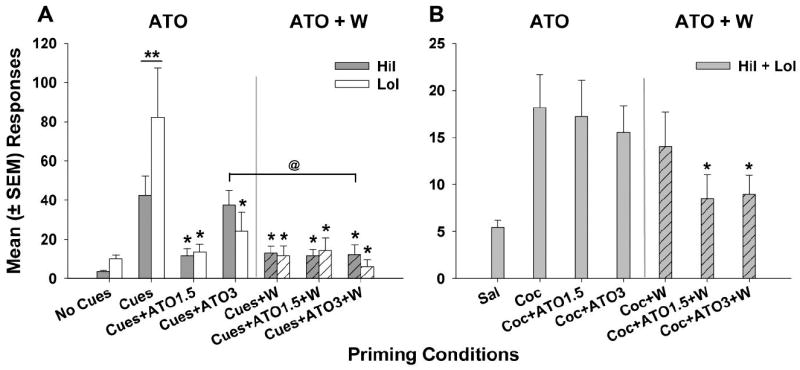
HiI rats acquired cocaine self-administration more quickly than LoI rats. While both individual treatments and W+ATO significantly attenuated cue-induced cocaine seeking in HiI and LoI rats, only W+ATO was effective in reducing cocaine-induced reinstatement compared with vehicle treatment. There were dose-dependent and phenotype-specific effects of ATO with HiI rats responsive to the low but not high ATO dose. Floor effects of ATO and W on cue-induced reinstatement prevented the assessment of combined treatment effects.
These findings demonstrated greater attenuation of cue- versus cocaine-induced reinstatement by ATO and W alone and recapitulate impulsivity phenotype differences in both acquisition of cocaine self-administration and receptivity to treatment.
有氧运动和注意力缺陷多动障碍药物托莫西汀(ATO)是两种单一疗法,已被证明在动物复发模型中可抑制可卡因觅药行为的恢复。本研究调查了在对药物滥用易感性不同(即高冲动性与低冲动性)的大鼠中,将跑步与ATO联合使用与单独使用每种治疗方法相比,对可卡因及可卡因配对线索引发的可卡因觅药行为的影响。
根据大鼠在延迟折扣任务中的表现筛选出高冲动性(HiI)或低冲动性(LoI)大鼠,然后训练它们自我注射可卡因(0.4毫克/千克/次),持续10天。在消退14天后,两组大鼠在有跑步机可用(W)、预先用ATO处理或两者同时进行(W + ATO)的情况下,接受由可卡因或可卡因配对线索引发的可卡因觅药行为恢复测试。
HiI大鼠比LoI大鼠更快学会自我注射可卡因。虽然单独的两种治疗方法以及W + ATO均显著减弱了HiI和LoI大鼠中线索诱导的可卡因觅药行为,但与赋形剂处理相比,只有W + ATO能有效减少可卡因诱导的觅药行为恢复。ATO存在剂量依赖性和表型特异性效应,HiI大鼠对低剂量而非高剂量的ATO有反应。ATO和W对线索诱导的觅药行为恢复的下限效应妨碍了对联合治疗效果的评估。
这些发现表明,单独使用ATO和W对线索诱导的觅药行为恢复的减弱作用大于对可卡因诱导的觅药行为恢复的减弱作用,并且在可卡因自我给药的习得和对治疗的反应性方面都再现了冲动性表型差异。