Workenhe Samuel T, Wadowska Dorota W, Wright Glenda M, Kibenge Molly J T, Kibenge Frederick S B
Department of Pathology and Microbiology, Atlantic Veterinary College, University of Prince Edward Island, 550 University Avenue, Charlottetown, PE, C1A 4P3, Canada.
Virol J. 2007 Jan 25;4:13. doi: 10.1186/1743-422X-4-13.
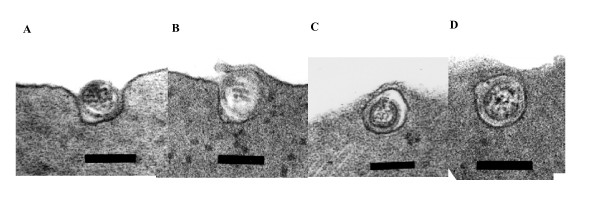
Infectious salmon anaemia (ISA) virus (ISAV) is a fish orthomyxovirus that has recently been assigned to the new genus Isavirus within the family Orthomyxoviridae. It possesses the major functional characteristics of the virus family including haemagglutinating, receptor destroying enzyme (RDE), and fusion activities associated with the virion surface proteins. It is generally accepted that ISAV agglutinates erythrocytes of several fish species and that the ISAV RDE activity dissolves this haemagglutination reaction except for Atlantic salmon (Salmo salar) erythrocytes. We used electron microscopy to examine the physical interaction between ISAV and erythrocytes from Atlantic salmon and rainbow trout (Oncorhynchus mykiss) during haemagglutination. We present evidence that ISAV enters into Atlantic salmon erythrocytes. Atlantic salmon erythrocytes incubated with ISAV for 4 hours showed endocytosis of the virus particles, which is consistent with virus infection. These observations suggest that the lack of dissolution of ISAV-induced haemagglutination of Atlantic salmon erythrocytes favours virus infection of the erythrocytes. Moreover, such a haemagglutination-infection phenotype is fundamentally different from haemagglutination by avian and mammalian orthomyxoviruses, and is indicative of a different pathogenesis for the fish orthomyxovirus.
传染性鲑鱼贫血病毒(ISAV)是一种鱼类正黏病毒,最近被归入正黏病毒科的新属异病毒属。它具有该病毒科的主要功能特性,包括血凝、受体破坏酶(RDE)以及与病毒粒子表面蛋白相关的融合活性。一般认为,ISAV能凝集几种鱼类的红细胞,且除大西洋鲑(Salmo salar)红细胞外,ISAV的RDE活性可溶解这种血凝反应。我们利用电子显微镜检查了血凝过程中ISAV与大西洋鲑和虹鳟(Oncorhynchus mykiss)红细胞之间的物理相互作用。我们提供的证据表明,ISAV可进入大西洋鲑红细胞。与ISAV孵育4小时的大西洋鲑红细胞显示出病毒粒子的内吞作用,这与病毒感染一致。这些观察结果表明,ISAV诱导的大西洋鲑红细胞血凝反应缺乏溶解现象有利于病毒对红细胞的感染。此外,这种血凝 - 感染表型与禽和哺乳动物正黏病毒的血凝作用根本不同,表明鱼类正黏病毒具有不同的发病机制。