Hsu S M, Xie S S, el-Okda M O, Hsu P L
Department of Pathology, University of Arkansas for Medical Sciences, Little Rock.
Am J Pathol. 1992 Jan;140(1):155-65.
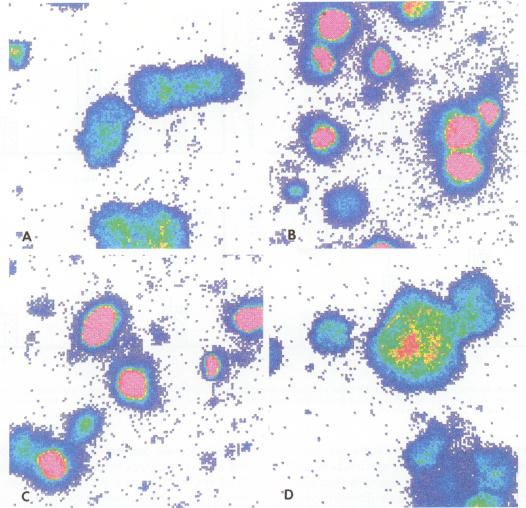
The c-fos proto-oncogene, which is the normal homolog of the transforming gene carried by murine osteogenic sarcoma viruses, interacts with the protein product of another proto-oncogene, c-jun, to form a heterodimer that can recognize and bind to a specific sequence of nucleotides in the DNA. The expression of c-fos and c-jun is linked to the proliferation of certain cells and the differentiation of others, including those of monomyelocyte lineage. The authors used two cultured Hodgkin's Reed-Sternberg (H-RS) cell lines, KM-H2 and HDLM-1, and their single-cell clones to study the correlation of c-fos/c-jun expression with cell differentiation in H-RS cells. Within 48 hours after induction with phorbol ester (TPA), both parent lines exhibited markedly increased expression of c-fos/c-jun. The expression returned to the preinduction level after 96 hours, however, and the cells retained their differentiated status. The transitory increase in c-fos/c-jun expression suggests that binding of these proteins to a specific promoter in the nucleus triggers a cascade of events that result in cell differentiation. Expression of these proteins may not be required for the cells to maintain their differentiation. The authors selected three groups of sublines of HDLM-1 cells based on their degree of spontaneous cytologic differentiation. The first group, without obvious differentiation, showed a c-fos/c-jun expression pattern similar to that of the parent line. The second group, with moderate differentiation, had a high degree of expression, which decreased on treatment with TPA. The third group, which had morphologic features resembling those of histiocytes, expressed minimal amounts of c-fos/c-jun, irrespective of TPA treatment. These findings provide further evidence that c-fos/c-jun expression is related to differentiation of H-RS cells, and that these proteins are not byproducts of TPA induction. Expression of c-fos/c-jun also was noted in a subpopulation of H-RS cells in tissues; and this expression also was enhanced when these cells were treated with TPA in culture. These findings indicate that H-RS cells can differentiate to become mature-appearing cells in tissues.
c-fos原癌基因是鼠成骨肉瘤病毒携带的转化基因的正常同源物,它与另一个原癌基因c-jun的蛋白质产物相互作用,形成一个异二聚体,该异二聚体能够识别并结合DNA中的特定核苷酸序列。c-fos和c-jun的表达与某些细胞的增殖以及其他细胞(包括单核细胞系细胞)的分化有关。作者使用两种培养的霍奇金里德-斯腾伯格(H-RS)细胞系KM-H2和HDLM-1及其单细胞克隆,来研究H-RS细胞中c-fos/c-jun表达与细胞分化的相关性。在用佛波酯(TPA)诱导后的48小时内,两个亲代细胞系均表现出c-fos/c-jun表达显著增加。然而,96小时后表达恢复到诱导前水平,且细胞保持其分化状态。c-fos/c-jun表达的短暂增加表明,这些蛋白质与细胞核中特定启动子的结合触发了一系列导致细胞分化的事件。这些蛋白质的表达可能不是细胞维持其分化所必需的。作者根据HDLM-1细胞的自发细胞学分化程度选择了三组亚系。第一组没有明显分化,其c-fos/c-jun表达模式与亲代细胞系相似。第二组有中度分化,表达程度高,用TPA处理后表达降低。第三组具有类似于组织细胞的形态特征,无论是否用TPA处理,均表达极少量的c-fos/c-jun。这些发现进一步证明c-fos/c-jun表达与H-RS细胞的分化有关,且这些蛋白质不是TPA诱导的副产物。在组织中的H-RS细胞亚群中也观察到了c-fos/c-jun的表达;当这些细胞在培养中用TPA处理时,这种表达也会增强。这些发现表明,H-RS细胞在组织中可以分化为外观成熟的细胞。