Laboratory of Experimental Virology, Department of Medical Microbiology, Centre for Infection and Immunity Amsterdam (CINIMA), Academic Medical Centre of the University of Amsterdam, Amsterdam, The Netherlands.
PLoS One. 2007 Feb 28;2(2):e257. doi: 10.1371/journal.pone.0000257.
Sialoadhesin (CD169, siglec-1 or Sn) is an activation marker seen on macrophages in chronic inflammatory diseases and in tumours, and on subsets of tissue macrophages. CD169 is highly expressed by macrophages present in AIDS-related Kaposi's sarcoma lesions. It is also increased on blood monocytes of HIV-1 infected patients with a high viral load despite antiretroviral treatment.
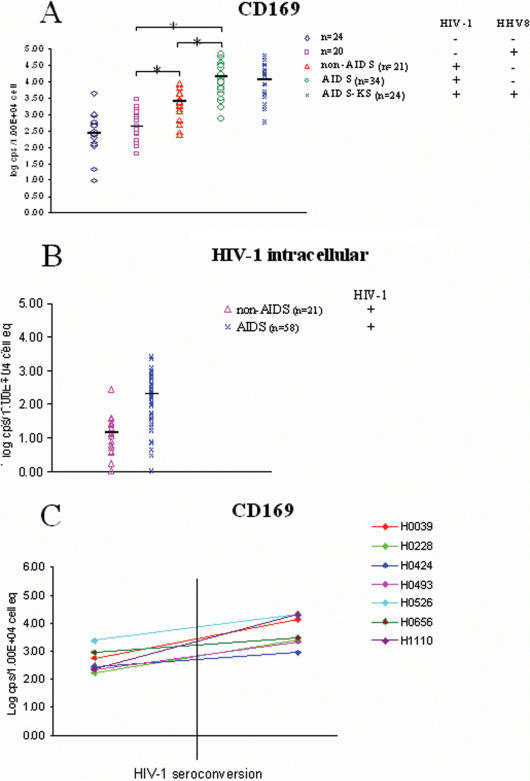
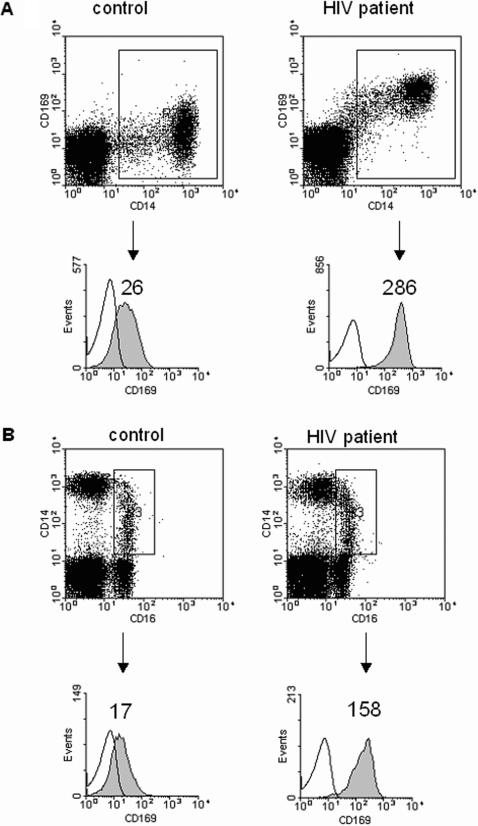
METHODOLOGY/PRINCIPAL FINDINGS: We investigated expression of sialoadhesin in untreated HIV-1 and HHV-8 infected patients, by real-time PCR and FACS analysis to establish its expression in relation to infection and disease progression. Patients analysed were either HIV-1 seroconverters (n = 7), in the chronic phase of HIV-1 infection (n = 21), or in the AIDS stage (n = 58). Controls were HHV-8 infected, but otherwise healthy individuals (n = 20), and uninfected men having sex with men (n = 24). Sialoadhesin mRNA was significantly elevated after HIV-1, but not HHV-8 infection, and a further increase was seen in AIDS patients. Samples obtained around HIV-1 seroconversion indicated that sialoadhesin levels go up early in infection. FACS analysis of PBMCs showed that sialoadhesin protein was expressed at high levels by approximately 90% of CD14(+) and CD14(+)CD16(+)cells of HIV-1(+) patients with a concomitant 10-fold increase in sialoadhesin protein/cell compared with uninfected controls.
CONCLUSIONS/SIGNIFICANCE: We have shown that sialoadhesin is induced to high levels on CD14(+) cells early after HIV-1 infection in vivo. The phenotype of the cells is maintained during disease progression, suggesting that it could serve as a marker for infection and probably contributes to the severe dysregulation of the immune system seen in AIDS.
唾液酸结合蛋白(CD169,Siglec-1 或 Sn)是一种在慢性炎症性疾病和肿瘤以及组织巨噬细胞亚群中可见的巨噬细胞活化标志物。CD169 在艾滋病相关卡波西肉瘤病变中的巨噬细胞中高度表达。尽管进行了抗逆转录病毒治疗,但 HIV-1 感染患者的血液单核细胞中 CD169 的表达也会增加,且病毒载量较高。
方法/主要发现:我们通过实时 PCR 和 FACS 分析研究了未经治疗的 HIV-1 和 HHV-8 感染患者中唾液酸结合蛋白的表达情况,以确定其与感染和疾病进展的关系。分析的患者要么是 HIV-1 血清转换者(n=7),要么是 HIV-1 感染的慢性期(n=21),要么是艾滋病期(n=58)。对照组为 HHV-8 感染者,但其他方面健康的个体(n=20)和无感染的男男性行为者(n=24)。HIV-1 感染后,唾液酸结合蛋白 mRNA 显著升高,但 HHV-8 感染后没有升高,在艾滋病患者中进一步升高。在 HIV-1 血清转换前后获得的样本表明,感染早期唾液酸结合蛋白水平就会升高。对 PBMCs 的 FACS 分析表明,HIV-1(+)患者中约 90%的 CD14(+)和 CD14(+)CD16(+)细胞高表达唾液酸结合蛋白,与未感染对照组相比,唾液酸结合蛋白蛋白/细胞增加了 10 倍。
结论/意义:我们已经表明,在体内 HIV-1 感染后早期,唾液酸结合蛋白就会在 CD14(+)细胞上高水平诱导。在疾病进展过程中,细胞的表型得以维持,这表明它可以作为感染的标志物,并且可能有助于艾滋病中严重的免疫系统失调。