Castro Mauro A A, Mombach José C M, de Almeida Rita M C, Moreira José C F
Departamento de Bioquímica, Universidade Federal do Rio Grande do Sul, Porto Alegre 90035-003, Brazil.
Nucleic Acids Res. 2007;35(6):1859-67. doi: 10.1093/nar/gkm061. Epub 2007 Mar 1.
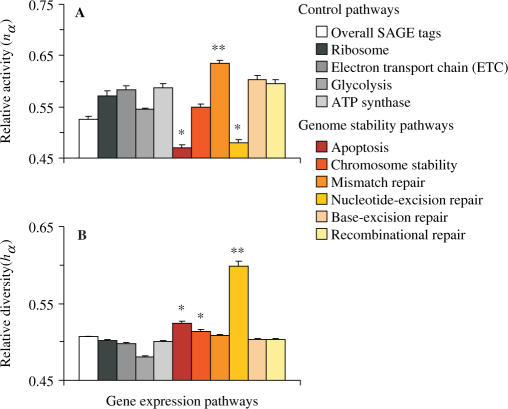
Nucleotide repair genes are not generally altered in sporadic solid tumors. However, point mutations are found scattered throughout the genome of cancer cells indicating that the repair pathways are dysfunctional. To address this point, in this work we focus on the expression pathways rather than in the DNA structure of repair genes related to either genome stability or essential metabolic functions. We present here a novel statistical analysis comparing ten gene expression pathways in human normal and cancer cells using serial analysis of gene expression (SAGE) data. We find that in cancer cells nucleotide-excision repair (NER) and apoptosis are the most impaired pathways and have a highly altered diversity of gene expression profile when compared to normal cells. We propose that genome point mutations in sporadic tumors can be explained by a structurally conserved NER with a functional disorder generated from its entanglement with the apoptosis gene network.
核苷酸修复基因在散发性实体瘤中通常不会发生改变。然而,在癌细胞基因组中发现了散在的点突变,这表明修复途径功能失调。为了解决这一问题,在本研究中,我们关注的是表达途径,而非与基因组稳定性或基本代谢功能相关的修复基因的DNA结构。我们在此展示了一种新颖的统计分析方法,该方法利用基因表达序列分析(SAGE)数据,比较了人类正常细胞和癌细胞中的十种基因表达途径。我们发现,与正常细胞相比,癌细胞中的核苷酸切除修复(NER)和凋亡途径受损最为严重,并且基因表达谱的多样性发生了高度改变。我们提出,散发性肿瘤中的基因组点突变可以通过结构保守的NER来解释,其功能紊乱是由与凋亡基因网络的纠缠所导致的。