Castro Mauro A A, Dalmolin Rodrigo J S, Moreira José C F, Mombach José C M, de Almeida Rita M C
Bioinformatics Unit, Department of Biochemistry, Federal University of Rio Grande do Sul (UFRGS), Rua Ramiro Barcelos 2600-anexo, Porto Alegre 90035-003, Brazil.
Nucleic Acids Res. 2008 Nov;36(19):6269-83. doi: 10.1093/nar/gkn636. Epub 2008 Oct 2.
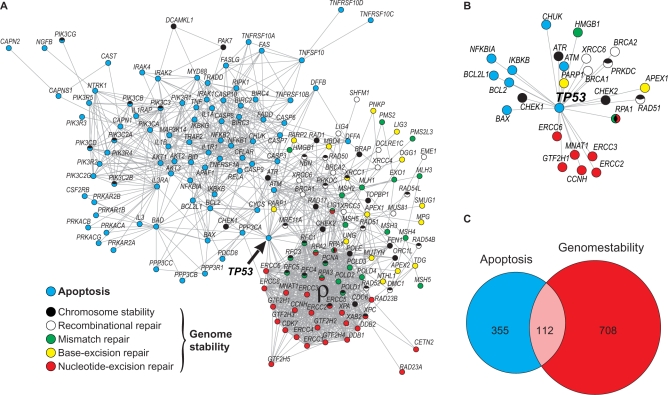
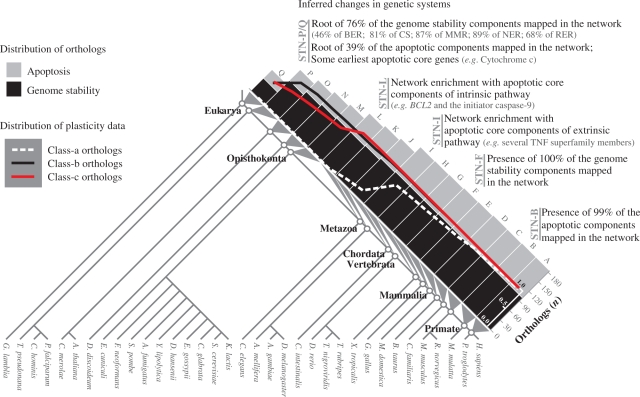
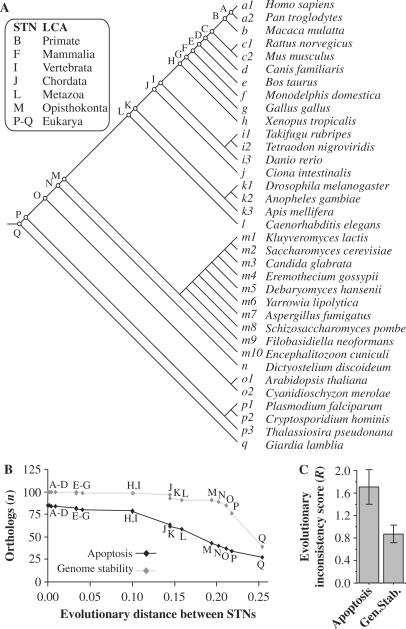
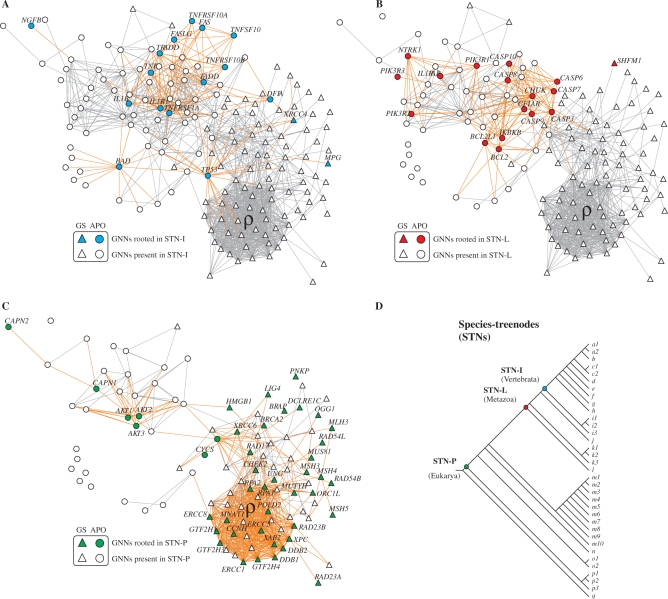
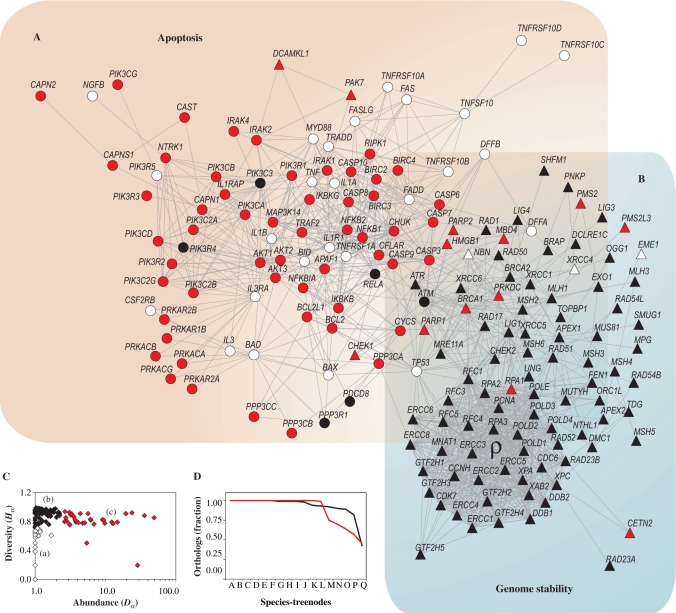
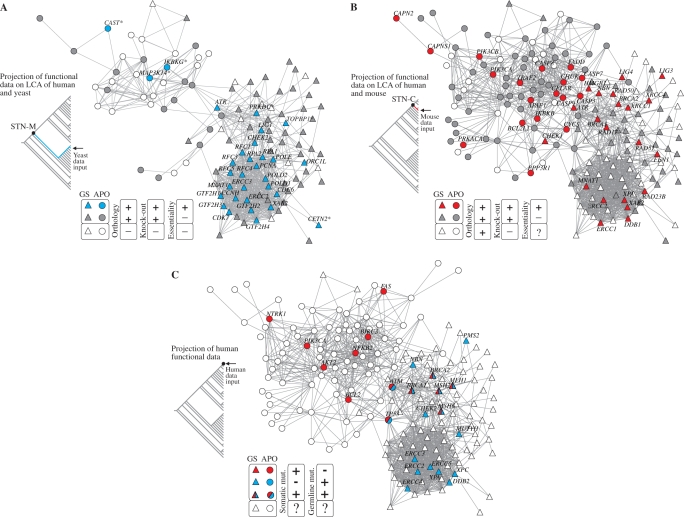
Apoptosis is essential for complex multicellular organisms and its failure is associated with genome instability and cancer. Interactions between apoptosis and genome-maintenance mechanisms have been extensively documented and include transactivation-independent and -dependent functions, in which the tumor-suppressor protein p53 works as a 'molecular node' in the DNA-damage response. Although apoptosis and genome stability have been identified as ancient pathways in eukaryote phylogeny, the biological evolution underlying the emergence of an integrated system remains largely unknown. Here, using computational methods, we reconstruct the evolutionary scenario that linked apoptosis with genome stability pathways in a functional human gene/protein association network. We found that the entanglement of DNA repair, chromosome stability and apoptosis gene networks appears with the caspase gene family and the antiapoptotic gene BCL2. Also, several critical nodes that entangle apoptosis and genome stability are cancer genes (e.g. ATM, BRCA1, BRCA2, MLH1, MSH2, MSH6 and TP53), although their orthologs have arisen in different points of evolution. Our results demonstrate how genome stability and apoptosis were co-opted during evolution recruiting genes that merge both systems. We also provide several examples to exploit this evolutionary platform, where we have judiciously extended information on gene essentiality inferred from model organisms to human.
细胞凋亡对于复杂的多细胞生物至关重要,其功能失调与基因组不稳定及癌症相关。细胞凋亡与基因组维护机制之间的相互作用已有大量文献记载,包括转录激活非依赖性功能和依赖性功能,其中肿瘤抑制蛋白p53在DNA损伤反应中作为一个“分子节点”发挥作用。尽管细胞凋亡和基因组稳定性已被确认为真核生物系统发育中的古老途径,但整合系统出现背后的生物学进化仍 largely unknown。在此,我们使用计算方法,在一个功能性人类基因/蛋白质关联网络中重建了将细胞凋亡与基因组稳定性途径联系起来的进化情景。我们发现,DNA修复、染色体稳定性和细胞凋亡基因网络的纠缠随着半胱天冬酶基因家族和抗凋亡基因BCL2的出现而出现。此外,一些纠缠细胞凋亡和基因组稳定性的关键节点是癌症基因(如ATM、BRCA1、BRCA2、MLH1、MSH2、MSH6和TP53),尽管它们的直系同源基因在不同的进化点出现。我们的结果展示了在进化过程中基因组稳定性和细胞凋亡是如何通过招募融合这两个系统的基因而被共同利用的。我们还提供了几个利用这个进化平台的例子,在这些例子中,我们明智地将从模式生物推断出的基因必需性信息扩展到了人类。