van der Groep Petra, Hoelzel Michael, Buerger Horst, Joenje Hans, de Winter Johan P, van Diest Paul J
Department of Pathology, University Medical Center, Utrecht, The Netherlands.
Breast Cancer Res Treat. 2008 Jan;107(1):41-7. doi: 10.1007/s10549-007-9534-7. Epub 2007 Feb 27.
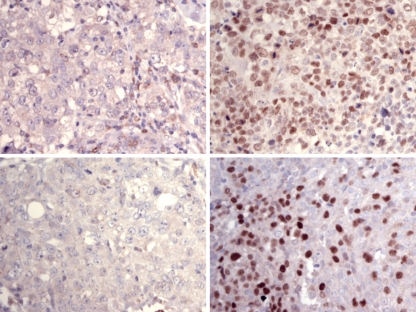
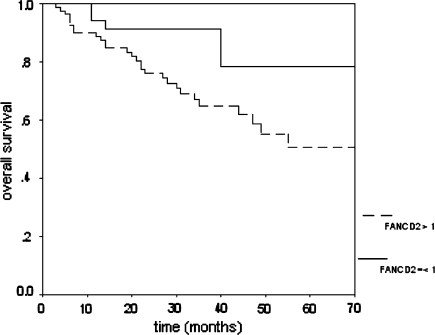
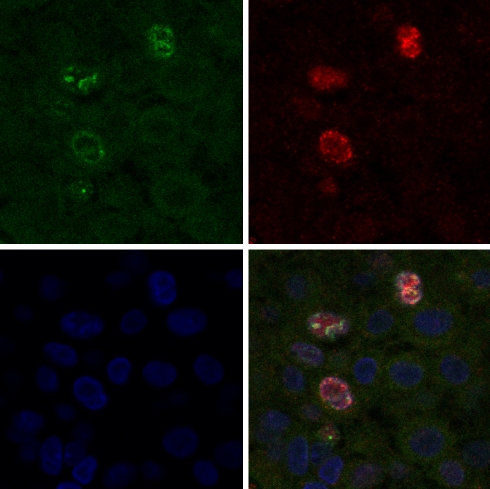
Fanconi anemia (FA) is a recessive disorder associated with progressive pancytopenia, multiple developmental defects, and marked predisposition to malignancies. FA is genetically heterogeneous, comprising at least 12 complementation groups (A-M). Activation of one of the FA proteins (FANCD2) by mono-ubiquitination is an essential step in DNA damage response. As FANCD2 interacts with BRCA1, is expressed in proliferating normal breast cells, and FANCD2 knockout mice develop breast tumors, we investigated the expression of FANCD2 in sporadic and hereditary invasive breast cancer patients to evaluate its possible role in breast carcinogenesis. Two tissue microarrays of 129 and 220 sporadic breast cancers and a tissue microarray containing 25 BRCA1 germline mutation-related invasive breast cancers were stained for FANCD2. Expression results were compared with several clinicopathological variables and tested for prognostic value. Eighteen of 96 (19%) sporadic breast cancers and two of 21 (10%) BRCA1-related breast cancers were completely FANCD2-negative, which, however, still showed proliferation. In the remaining cases, the percentage of FANCD2-expressing cells correlated strongly with mitotic index and percentage of cells positive for the proliferation markers Ki-67 and Cyclin A. In immunofluorescence double staining, coexpression of FANCD2 and Ki-67 was apparent. In survival analysis, high FANCD2 expression appeared to be prognostically unfavorable for overall survival (p = 0.03), independent from other major prognosticators (p = 0.026). In conclusion, FANCD2 expression is absent in 10-20% of sporadic and BRCA1-related breast cancers, indicating that somatic inactivating (epi)genetic events in FANCD2 may be important in both sporadic and hereditary breast carcinogenesis. FANCD2 is of independent prognostic value in sporadic breast cancer.
范可尼贫血(FA)是一种隐性疾病,与进行性全血细胞减少、多种发育缺陷以及明显的恶性肿瘤易感性相关。FA在遗传上具有异质性,至少包括12个互补组(A - M)。FA蛋白之一(FANCD2)通过单泛素化激活是DNA损伤反应中的一个关键步骤。由于FANCD2与BRCA1相互作用,在正常增殖的乳腺细胞中表达,且FANCD2基因敲除小鼠会发生乳腺肿瘤,因此我们研究了散发性和遗传性浸润性乳腺癌患者中FANCD2的表达,以评估其在乳腺癌发生中的可能作用。对129例和220例散发性乳腺癌的两个组织芯片以及一个包含25例与BRCA1种系突变相关的浸润性乳腺癌的组织芯片进行FANCD2染色。将表达结果与几个临床病理变量进行比较,并测试其预后价值。96例散发性乳腺癌中有18例(19%)和21例BRCA1相关乳腺癌中有2例(10%)FANCD2完全阴性,但这些病例仍显示有增殖。在其余病例中,FANCD2表达细胞的百分比与有丝分裂指数以及增殖标志物Ki - 67和细胞周期蛋白A阳性细胞的百分比密切相关。在免疫荧光双重染色中,FANCD2和Ki - 67的共表达明显。在生存分析中,高FANCD2表达似乎对总生存预后不利(p = 0.03),独立于其他主要预后因素(p = 0.026)。总之,10 - 20%的散发性和BRCA1相关乳腺癌中不存在FANCD2表达,这表明FANCD2的体细胞失活(表观)遗传事件在散发性和遗传性乳腺癌发生中可能都很重要。FANCD2在散发性乳腺癌中具有独立的预后价值。