Piśkiewicz Anna M, Duyts Henk, Berg Matty P, Costa Sofia R, van der Putten Wim H
Department of Multitrophic Interactions, Centre for Terrestrial Ecology, Netherlands Institute of Ecology, Boterhoeksestraat 48, P.O. Box 40, 6666 ZG Heteren, The Netherlands.
Oecologia. 2007 Jun;152(3):505-14. doi: 10.1007/s00442-007-0678-2. Epub 2007 Mar 8.
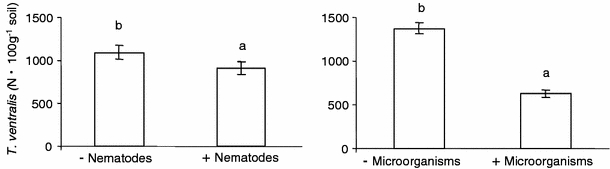
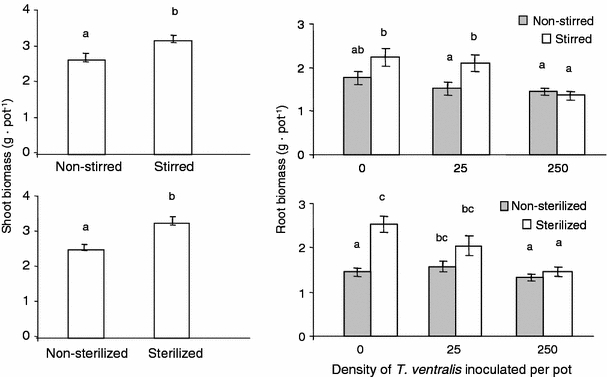
Belowground herbivores can exert important controls on the composition of natural plant communities. Until now, relatively few studies have investigated which factors may control the abundance of belowground herbivores. In Dutch coastal foredunes, the root-feeding nematode Tylenchorhynchus ventralis is capable of reducing the performance of the dominant grass Ammophila arenaria (Marram grass). However, field surveys show that populations of this nematode usually are controlled to nondamaging densities, but the control mechanism is unknown. In the present study, we first established that T. ventralis populations are top-down controlled by soil biota. Then, selective removal of soil fauna suggested that soil microorganisms play an important role in controlling T. ventralis. This result was confirmed by an experiment where selective inoculation of microarthropods, nematodes and microbes together with T. ventralis into sterilized dune soil resulted in nematode control when microbes were present. Adding nematodes had some effect, whereas microarthropods did not have a significant effect on T. ventralis. Our results have important implications for the appreciation of herbivore controls in natural soils. Soil food web models assume that herbivorous nematodes are controlled by predaceous invertebrates, whereas many biological control studies focus on managing nematode abundance by soil microorganisms. We propose that soil microorganisms play a more important role than do carnivorous soil invertebrates in the top-down control of herbivorous ectoparasitic nematodes in natural ecosystems. This is opposite to many studies on factors controlling root-feeding insects, which are supposed to be controlled by carnivorous invertebrates, parasitoids, or entomopathogenic nematodes. Our conclusion is that the ectoparasitic nematode T. ventralis is potentially able to limit productivity of the dune grass A. arenaria but that soil organisms, mostly microorganisms, usually prevent the development of growth-reducing population densities.
地下食草动物能够对天然植物群落的组成施加重要控制。到目前为止,相对较少的研究调查了哪些因素可能控制地下食草动物的数量。在荷兰海岸前沙丘,以根为食的线虫腹侧针线虫能够降低优势草种沙拂子茅(沙茅草)的生长性能。然而,野外调查表明,这种线虫的种群数量通常被控制在无害密度,但控制机制尚不清楚。在本研究中,我们首先确定腹侧针线虫种群受到土壤生物群的自上而下的控制。然后,选择性去除土壤动物表明土壤微生物在控制腹侧针线虫方面发挥着重要作用。这一结果通过一项实验得到证实,该实验将微型节肢动物、线虫和微生物与腹侧针线虫一起选择性接种到灭菌的沙丘土壤中,结果表明当存在微生物时,线虫得到了控制。添加线虫有一定效果,而微型节肢动物对腹侧针线虫没有显著影响。我们的研究结果对于理解天然土壤中的食草动物控制具有重要意义。土壤食物网模型假设食草线虫受捕食性无脊椎动物控制,而许多生物防治研究则专注于通过土壤微生物来控制线虫数量。我们认为,在自然生态系统中,土壤微生物在自上而下控制食草外寄生线虫方面比食肉土壤无脊椎动物发挥着更重要的作用。这与许多关于控制食根昆虫因素的研究相反,食根昆虫被认为受食肉无脊椎动物、寄生蜂或昆虫病原线虫控制。我们的结论是,外寄生线虫腹侧针线虫有可能限制沙丘草沙拂子茅的生产力,但土壤生物,主要是微生物,通常会阻止导致生长降低的种群密度的发展。