Ciancio Aurelio, Cabrera Ileana Miranda, Hidalgo-Diáz Leopoldo, Puertas Ana, Duvergel Yoannia Castillo
CNR, Istituto per la Protezione Sostenibile delle Piante, Bari, Italy.
Centro Nacional de Sanidad Agropecuaria (CENSA), San José de las Lajas, Mayabeque, Cuba.
Front Fungal Biol. 2022 Jul 26;3:900974. doi: 10.3389/ffunb.2022.900974. eCollection 2022.
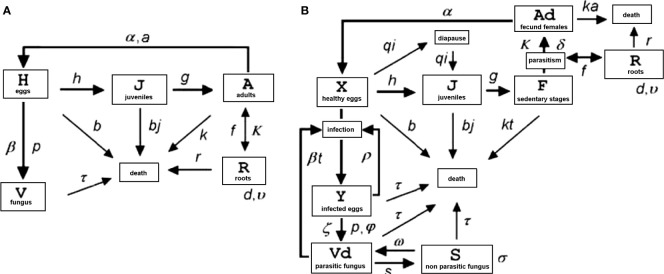
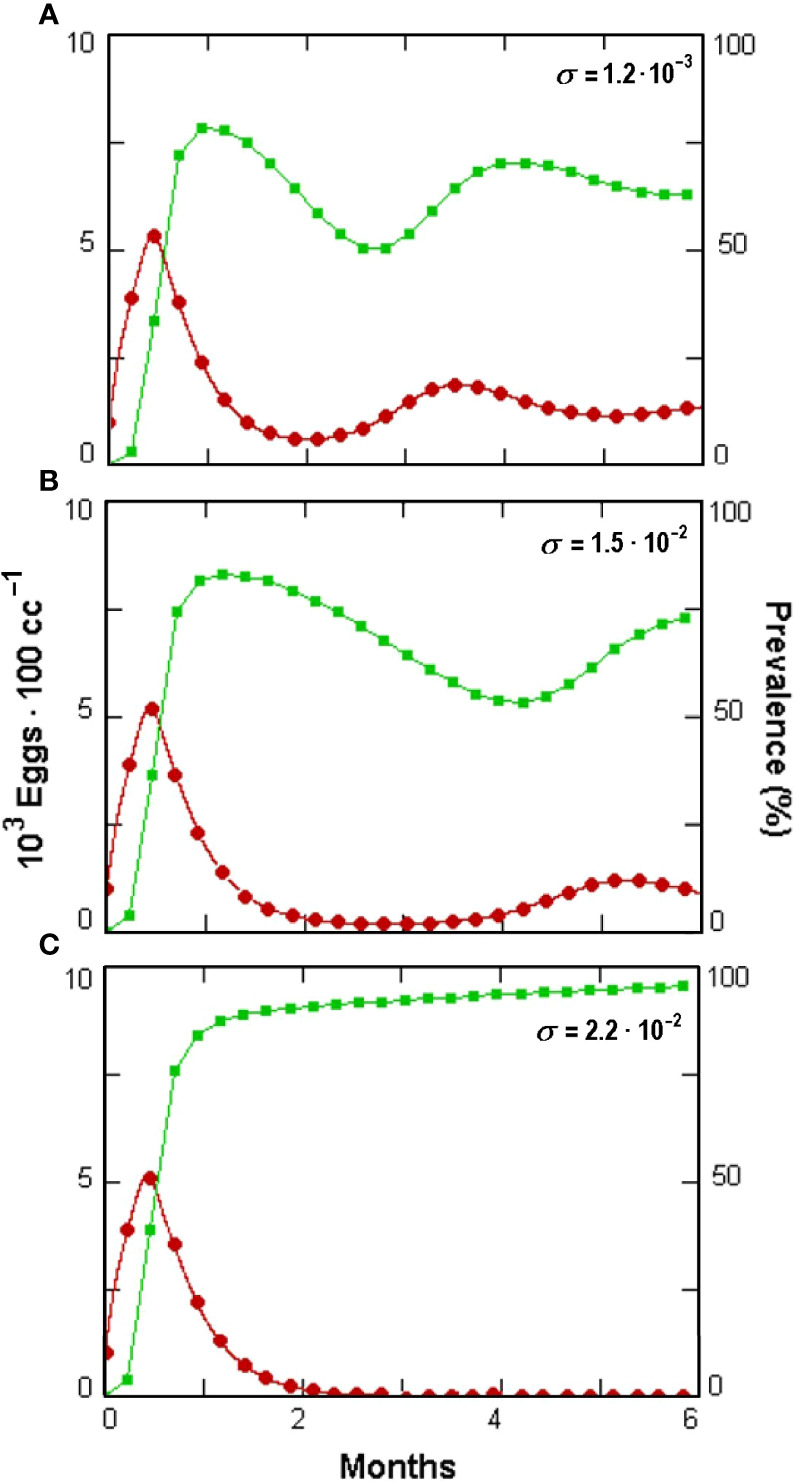
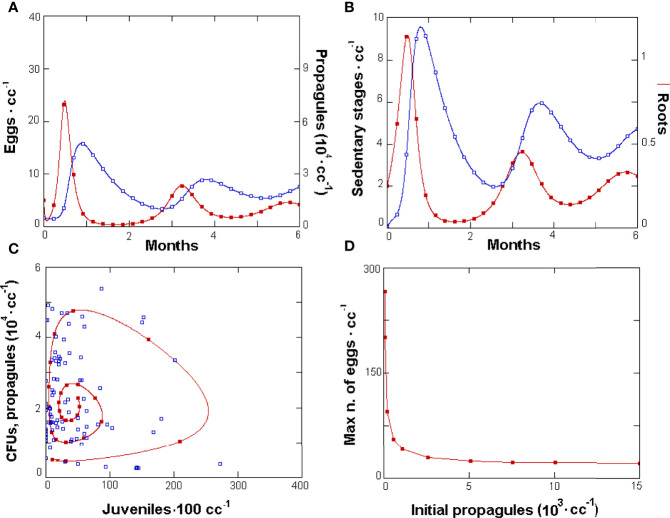
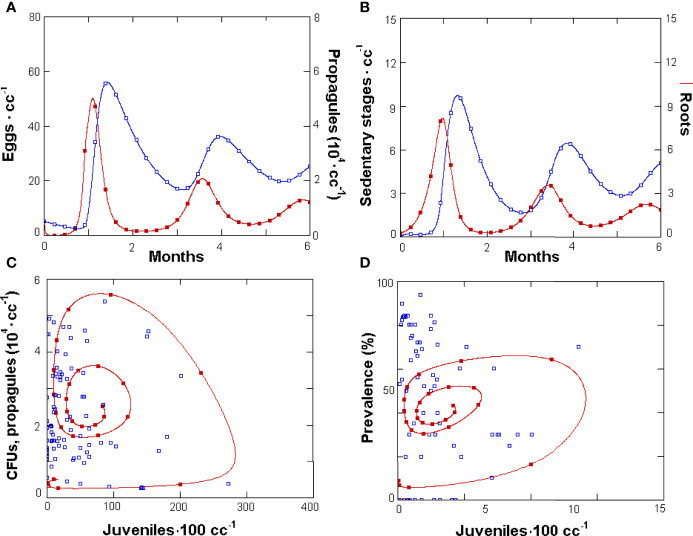
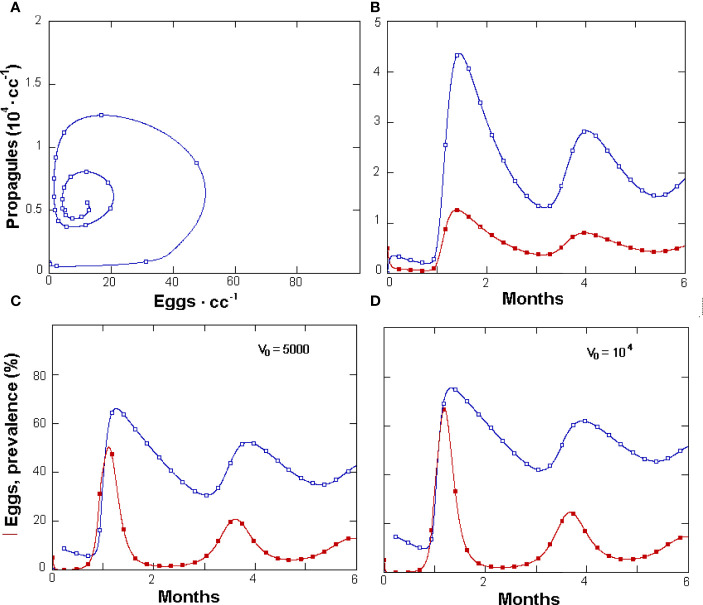
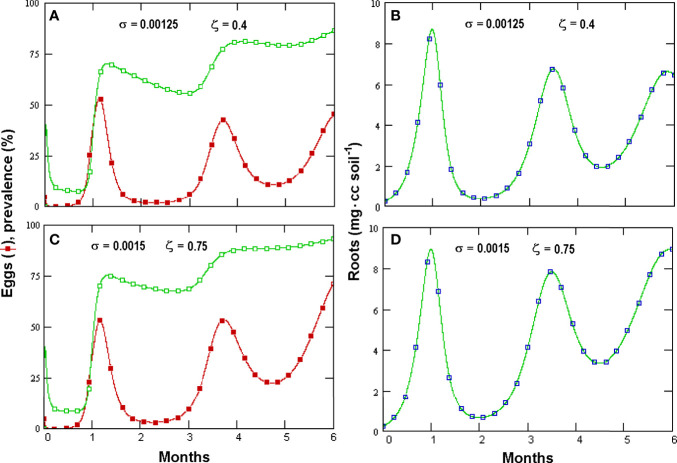
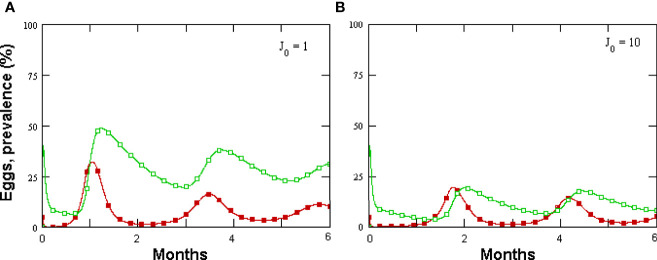
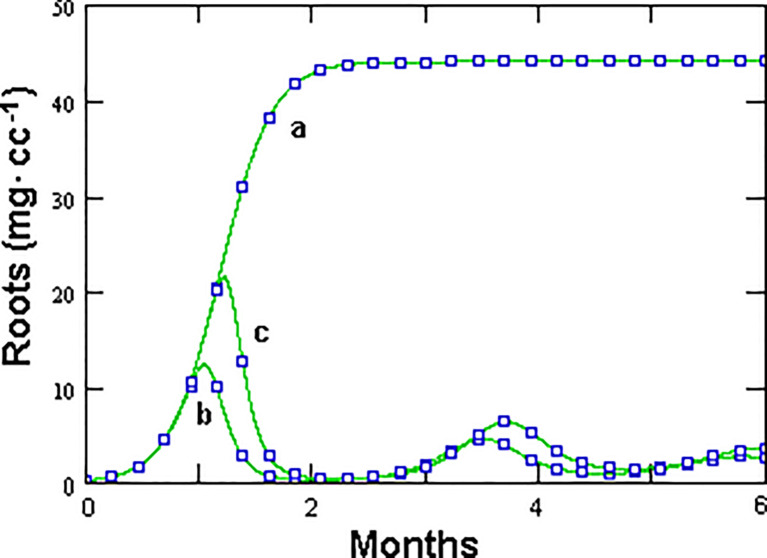
Two models of increasing complexity were constructed to simulate the interactions between the root-knot nematode (RKN) and the biocontrol fungus var. in a rhizosphere microcosm. The models described discrete population dynamics at hourly rates over a 6-month period and were validated using real parasitism and nematode or fungus data. A first, general -nematode-root model (GPNR) used five functions and 16 biological constants. The variables and constants describing the RKN life cycle included the rates of egg production, hatching, juvenile (J2), and mature female development, including root or nematode self-density-dependent factors. Other constants accounted for egg parasitism, nematode-induced root losses, growth, and mortalities. The relationship between nematodes and fungal propagules showed density dependence and cyclic variations in time, including an attractor on the propagules and J2 phases space. The simulations confirmed a optimal initial density of 5 · 10 propagules · cc soil, as usually applied in assays. The constants used in GPNR showed adherence to the nematode biology, with 10 eggs per egg mass, a 10-day average lifespan of J2, with 2 days required to enter roots, and adult lifespan lasting 24 days. The fungus propagule lifespan was 25 days, with an average feeder root lifespan lasting around 52 days. A second, more complex -nematode-root detailed model (GPNRd) was then constructed using eight functions and 23 constants. It was built as GPNR did not allow the evaluation of host prevalence. GPNRd allowed simulations of all RKN life stages and included non-parasitic and parasitic fungus population fractions. Both GPNR and GPNRd matched real J2 and fungus density data observed in a RKN biocontrol assay. Depending on the starting conditions, simulations showed stability in time, interpreted as effective host regulation. GPNRd showed a fungus cyclic relationship with the J2 numbers, with prevalence data close to those observed (38.3 . 39.4%, respectively). This model also showed a further density-independent nematode regulation mechanism based on the switch from a non-parasitic to a parasitic trophic behavior. This mechanism supported the biocontrol of , also sustained by a concomitant increase of the root density.
构建了两个复杂度递增的模型,以模拟根结线虫(RKN)与生物防治真菌变种在根际微宇宙中的相互作用。这些模型描述了6个月内每小时的离散种群动态,并使用实际寄生情况以及线虫或真菌数据进行了验证。第一个,通用线虫-根模型(GPNR)使用了五个函数和16个生物学常数。描述根结线虫生命周期的变量和常数包括产卵率、孵化率、幼虫(J2)以及成熟雌虫发育率,其中包括根或线虫的自我密度依赖因子。其他常数则用于解释卵寄生、线虫诱导的根损失、生长和死亡率。线虫与真菌繁殖体之间的关系呈现出密度依赖性和随时间的周期性变化,包括繁殖体和J2阶段空间上的一个吸引子。模拟结果证实,通常在试验中应用的5·10个繁殖体·立方厘米土壤的初始密度是最优的。GPNR中使用的常数符合线虫生物学特性,每个卵块有10个卵,J2的平均寿命为10天,进入根部需要2天,成虫寿命持续24天。真菌繁殖体的寿命为25天,平均须根寿命约为52天。然后,使用八个函数和23个常数构建了第二个更复杂的线虫-根详细模型(GPNRd)。之所以构建它,是因为GPNR无法评估宿主患病率。GPNRd允许模拟根结线虫的所有生命阶段,并包括非寄生和寄生真菌种群比例。GPNR和GPNRd均与根结线虫生物防治试验中观察到真实J2和真菌密度数据相匹配。根据起始条件,模拟显示随时间具有稳定性,这被解释为有效的宿主调控。GPNRd显示出真菌与J2数量之间的周期性关系,患病率数据与观察到的数据接近(分别为38.3%和39.4%)。该模型还显示了一种基于从非寄生到寄生营养行为转变的进一步的密度独立线虫调控机制。这种机制支持了对[具体生物名称未给出]的生物防治,同时根密度的增加也起到了辅助作用。