Uttman Leif, Ogren Helena, Niklason Lisbet, Drefeldt Björn, Jonson Björn
Department of Clinical Physiology, Lund University, 221 85 Lund, Sweden.
Crit Care. 2007;11(2):R36. doi: 10.1186/cc5719.
To prevent further lung damage in patients with acute respiratory distress syndrome (ARDS), it is important to avoid overdistension and cyclic opening and closing of atelectatic alveoli. Previous studies have demonstrated protective effects of using low tidal volume (VT), moderate positive end-expiratory pressure and low airway pressure. Aspiration of dead space (ASPIDS) allows a reduction in VT by eliminating dead space in the tracheal tube and tubing. We hypothesized that, by applying goal-orientated ventilation based on iterative computer simulation, VT can be reduced at high respiratory rate and much further reduced during ASPIDS without compromising gas exchange or causing high airway pressure.
ARDS was induced in eight pigs by surfactant perturbation and ventilator-induced lung injury. Ventilator resetting guided by computer simulation was then performed, aiming at minimal VT, plateau pressure 30 cmH2O and isocapnia, first by only increasing respiratory rate and then by using ASPIDS as well.
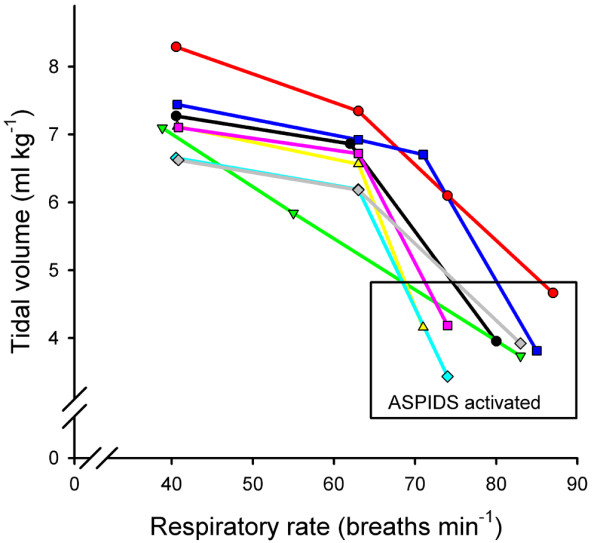
VT decreased from 7.2 +/- 0.5 ml/kg to 6.6 +/- 0.5 ml/kg as respiratory rate increased from 40 to 64 +/- 6 breaths/min, and to 4.0 +/- 0.4 ml/kg when ASPIDS was used at 80 +/- 6 breaths/min. Measured values of arterial carbon dioxide tension were close to predicted values. Without ASPIDS, total positive end-expiratory pressure and plateau pressure were slightly higher than predicted, and with ASPIDS they were lower than predicted.
In principle, computer simulation may be used in goal-oriented ventilation in ARDS. Further studies are needed to investigate potential benefits and limitations over extended study periods.
为防止急性呼吸窘迫综合征(ARDS)患者的肺部进一步受损,避免肺泡过度扩张以及肺不张肺泡的周期性开闭至关重要。既往研究已证实采用低潮气量(VT)、适度呼气末正压和低气道压力具有保护作用。死腔抽吸(ASPIDS)可通过消除气管导管和管路中的死腔来减少VT。我们推测,通过基于迭代计算机模拟应用目标导向通气,在高呼吸频率时可降低VT,且在使用ASPIDS期间能进一步大幅降低VT,同时不影响气体交换或导致高气道压力。
通过表面活性剂扰动和呼吸机诱导的肺损伤在八头猪中诱发ARDS。然后在计算机模拟引导下进行呼吸机参数重置,目标是实现最小VT、平台压30 cmH₂O和等碳酸血症,首先仅通过增加呼吸频率,然后同时使用ASPIDS。
随着呼吸频率从40次/分钟增加到64±6次/分钟,VT从7.2±0.5 ml/kg降至6.6±0.5 ml/kg;当在80±6次/分钟使用ASPIDS时,VT降至4.0±0.4 ml/kg。动脉二氧化碳分压的测量值接近预测值。在不使用ASPIDS时,总呼气末正压和平台压略高于预测值,使用ASPIDS时则低于预测值。
原则上,计算机模拟可用于ARDS的目标导向通气。需要进一步研究以探讨在更长研究期间的潜在益处和局限性。