Flash Tamar, Handzel Amir A
Department of Computer Science and Applied Mathematics, Weizmann Institute of Science, Rehovot, 76100 Israel.
Biol Cybern. 2007 Jun;96(6):577-601. doi: 10.1007/s00422-007-0145-5. Epub 2007 Apr 4.
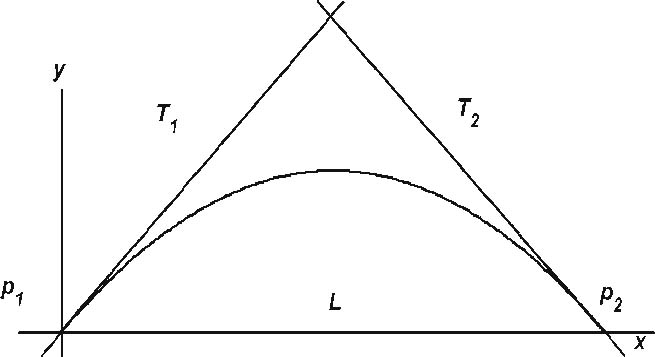
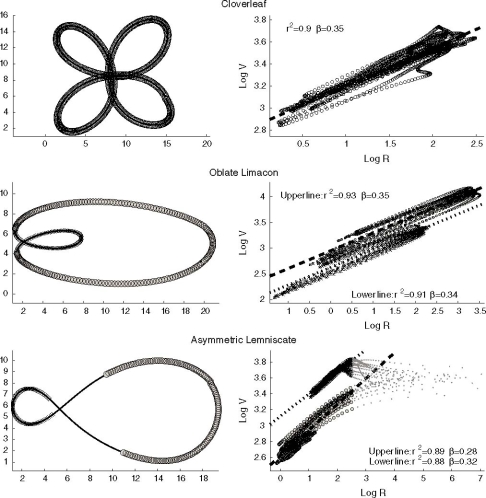
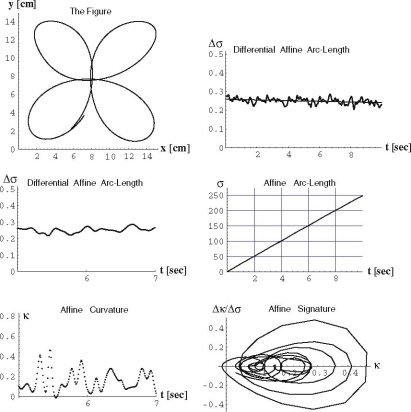
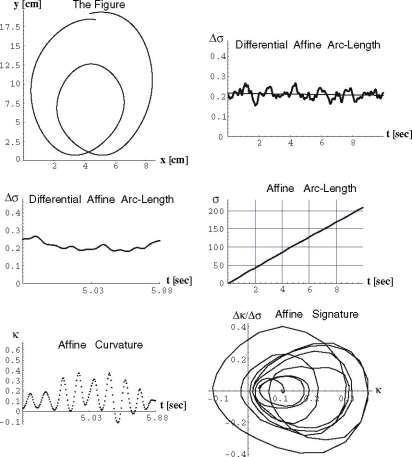
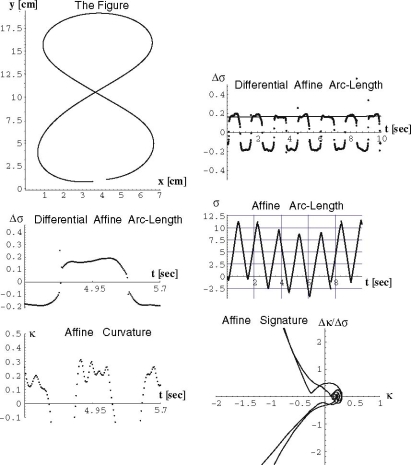
Humans interact with their environment through sensory information and motor actions. These interactions may be understood via the underlying geometry of both perception and action. While the motor space is typically considered by default to be Euclidean, persistent behavioral observations point to a different underlying geometric structure. These observed regularities include the "two-thirds power law", which connects path curvature with velocity, and "local isochrony", which prescribes the relation between movement time and its extent. Starting with these empirical observations, we have developed a mathematical framework based on differential geometry, Lie group theory and Cartan's moving frame method for the analysis of human hand trajectories. We also use this method to identify possible motion primitives, i.e., elementary building blocks from which more complicated movements are constructed. We show that a natural geometric description of continuous repetitive hand trajectories is not Euclidean but equi-affine. Specifically, equi-affine velocity is piecewise constant along movement segments, and movement execution time for a given segment is proportional to its equi-affine arc-length. Using this mathematical framework, we then analyze experimentally recorded drawing movements. To examine movement segmentation and classification, the two fundamental equi-affine differential invariants-equi-affine arc-length and curvature are calculated for the recorded movements. We also discuss the possible role of conic sections, i.e., curves with constant equi-affine curvature, as motor primitives and focus in more detail on parabolas, the equi-affine geodesics. Finally, we explore possible schemes for the internal neural coding of motor commands by showing that the equi-affine framework is compatible with the common model of population coding of the hand velocity vector when combined with a simple assumption on its dynamics. We then discuss several alternative explanations for the role that the equi-affine metric may play in internal representations of motion perception and production.
人类通过感官信息和运动行为与环境进行交互。这些交互可以通过感知和行为的潜在几何结构来理解。虽然运动空间默认通常被认为是欧几里得空间,但持续的行为观察表明存在不同的潜在几何结构。这些观察到的规律包括将路径曲率与速度联系起来的“三分之二幂律”,以及规定运动时间与其范围之间关系的“局部等时性”。从这些实证观察出发,我们基于微分几何、李群理论和嘉当活动标架法开发了一个数学框架,用于分析人类手部轨迹。我们还使用这种方法来识别可能的运动基元,即构成更复杂运动的基本组成部分。我们表明,连续重复手部轨迹的自然几何描述不是欧几里得几何而是等仿射几何。具体而言,等仿射速度在运动段上是分段恒定的,并且给定段的运动执行时间与其等仿射弧长成比例。然后,我们使用这个数学框架来分析实验记录的绘图运动。为了检验运动分割和分类,针对记录的运动计算两个基本的等仿射微分不变量——等仿射弧长和曲率。我们还讨论了圆锥曲线(即具有恒定等仿射曲率的曲线)作为运动基元的可能作用,并更详细地关注抛物线,即等仿射测地线。最后,我们通过表明等仿射框架在结合对手部速度矢量动力学的一个简单假设时与群体编码的常见模型兼容,探索了运动命令内部神经编码的可能方案。然后,我们讨论了等仿射度量在运动感知和产生的内部表示中可能发挥的作用的几种替代解释